
Fluconazole and marine velvet (Amyloodinium)
Three reefkeepers report fish that recovered: a hypothesis to be tested, not a cure
Recent second-hand experiences would suggest that fluconazole, now used successfully to wipe out Derbesia and Bryopsis from our aquariums, is able to fight an infection that often affects the fish in our tanks: marine velvet (Oodinium disease).
Three of our reefkeeping friends, Valente Damiano, Francesco Accorinti and Alessandro Natale, recently shared some posts reporting that, having had to use fluconazole to solve an algae problem, they had noticed a complete recovery in some fish that were suffering from marine velvet at the time.
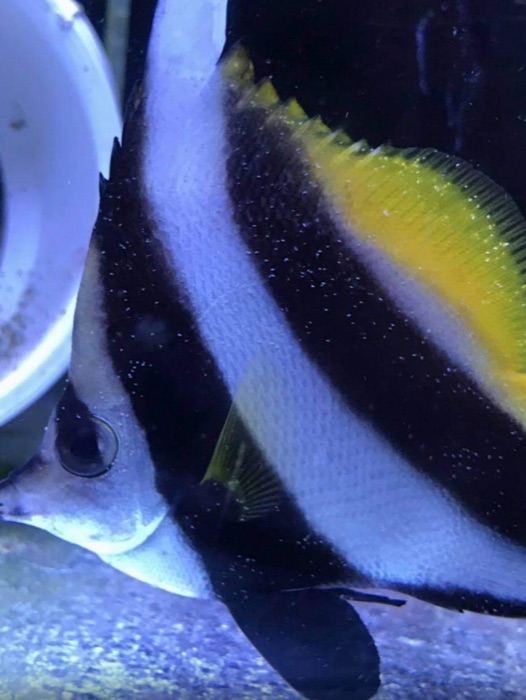
What marine velvet is
Marine velvet, for those who do not know it, is an infection caused by a dinoflagellate, Amyloodinium ocellatum 1.
The life cycle of Amyloodinium ocellatum
- 1Trophont attached to gills, fins and body, feeds on the fish
- 2It drops off when mature, it falls to the bottom
- 3Tomont a cyst that divides: up to 256 infective stages
- 4Dinospores swim in search of a new fish
The cycle lasts 7 to 20 days, depending on temperature. The drugs mentioned in the fact sheet consulted do not kill the tomont 2.
Sources: [2]
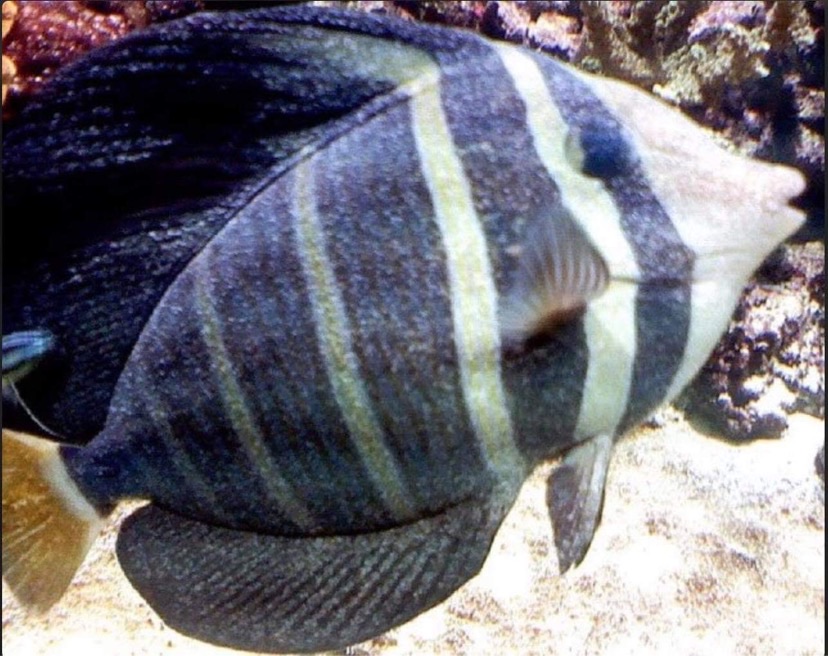
The ergosterol hypothesis
The interesting aspect, which gives food for thought, is that ergosterols, whose biosynthesis fluconazole blocks, are present in the cell membranes of many species of dinoflagellates. So it cannot be ruled out that these components are also present in this type of dinoflagellate and that blocking them could be fatal to its survival.
What it does in fungi, what we do not know in the parasite
- 1Fluconazole antifungal, blocks the enzyme
- 2Enzyme turns lanosterol into ergosterol
- 3Ergosterol without it, membrane sterols change
- 4The parasite no study consulted has proved it
In fungi the mechanism is described. In the fish parasite it is still a hypothesis.
If all this were confirmed by further experience, it would in fact be a really important discovery, saving us many of the headaches that come with this disease.
Today's remedies
I would remind you that marine velvet is currently treated with methods that are hard to apply, because they involve medicines that are difficult to handle: copper salts and drugs such as quinine which, if not used properly, can cause serious problems for the tank. Fluconazole, on the other hand, now seems to have passed numerous tests and to have proved well tolerated by the aquarium ecosystem.
What is known about each one
Copper salts
- For the author: hard to handle
- Used in ornamental fish, with mixed results
- They do not kill the tomont
Drugs such as quinine
- For the author: hard to handle
- The fact sheet consulted mentions chloroquine, with mixed results
- Chloroquine does not kill the tomont
Fluconazole
- Only reefkeepers' accounts
- No peer-reviewed study found
- Effectiveness yet to be proved
- Prescription required
No doses here: choosing a medicine is up to the veterinary surgeon.
Sources: [2]
It is still too early to state with certainty that fluconazole is effective against marine velvet: further experience is needed.
An appeal
So, on behalf of all hobbyists, I would like to appeal to anyone who decides to try this drug for this purpose to kindly share their experience with the rest of the group (the group is in Italian). Anyone who wishes can also contact me directly through Messenger or the BallingMania website.
A vet is needed
I take this opportunity to point out that fluconazole is a prescription-only medicine (medical or veterinary) and therefore cannot be used without a prescription from a veterinary surgeon. It is also worth pointing out that the use of antibiotic drugs can lead to antibiotic resistance and that their use must always be advised by the veterinary surgeon, who will judge case by case whether it is appropriate.
Thanks again.
My thanks to Damiano Valente, Francesco Accorinti and Alessandro Natale for reporting their valuable experience, and to my friend Marco Paci for his essential help.
Kind regards, Giuseppe Ossolengo
Sources
- WoRMS Editorial Board (2026). Amyloodinium ocellatum (E.-M.Brown) E.-M.Brown & Hovasse, 1946. World Register of Marine Species.
- Smith S.A., Schwarz M.H. (2019). Getting Acquainted with Amyloodinium ocellatum. Virginia Cooperative Extension, Virginia Tech (VSG-18-7).
- U.S. National Library of Medicine (2018). Fluconazole: MedlinePlus Drug Information. MedlinePlus.
- Pfizer, document filed with the FDA (2011). Diflucan (fluconazole): package insert. U.S. Food and Drug Administration.
- Lu Y., Jiang J., Zhao H., Han X., Xiang Y., Zhou W. (2020). Clade-Specific Sterol Metabolites in Dinoflagellate Endosymbionts Are Associated with Coral Bleaching in Response to Environmental Cues. mSystems 5(5): e00765-20.
- Stonik V.A., Stonik I.V. (2018). Sterol and Sphingoid Glycoconjugates from Microalgae. Marine Drugs 16(12): 514.
- World Health Organization (2022). WHO releases first-ever list of health-threatening fungi. WHO.
On the same topic
Euphyllia: parasites, treatment, husbandry
A garden of Euphyllia is very rewarding, but these corals suffer from swings and parasites. The values to keep, how…
Fluconazole and Oodiniasis
English version of the article Fluconazolo e Oodiniasi: the reports of three reefkeepers, the ergosterol hypothesis…
Oodiniasis, or Marine Velvet Disease
What velvet is, where it attacks the fish, how to recognise it and which remedies have been used, with notes on…