
Fish diseases in the marine aquarium: Cryptocaryon irritans
Marine white spot disease: the parasite's life cycle, the signs, prevention and remedies
The disease caused by Cryptocaryon irritans, better known as "white spot" disease, is certainly one of the most common illnesses affecting the fish in our aquariums.
It is caused by a ciliate protozoan, an obligate parasite, Cryptocaryon irritans in fact, which needs to parasitise fish to complete its life cycle.
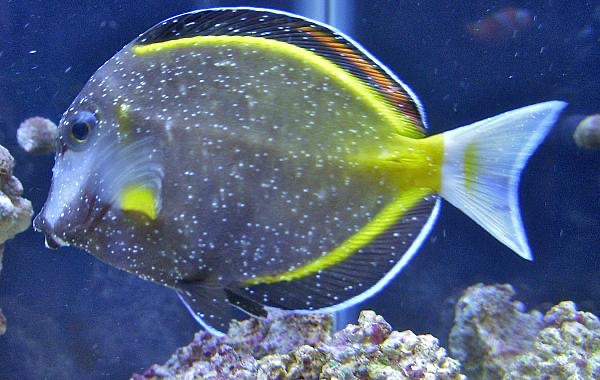
It has low specificity, meaning it can attack most fish: as far as we know today, only species in the shark family are immune. Among others, surgeonfish (Acanthuridae) are particularly susceptible to this infection.
The parasite is usually brought into the aquarium with an infected fish, but not only: it can also be introduced with contaminated rocks.
This is why quarantining fish and rocks is essential and indispensable if you want to avoid contaminating the tank.
In this regard we need to dispel the myth that the parasite is present, in some latent way, in almost all aquariums, and that the disease shows itself only when, for whatever reason, a fish's immune defences drop. Although it is true that weakened immune defences make animals more exposed to the risk of falling ill, various scientific experiments have observed that even perfectly healthy fish are easily susceptible to attack by Cryptocaryon irritans. Another peculiar aspect of this protozoan's life cycle supports this view: Cryptocaryon cannot survive for more than a limited period without parasitising fish. It follows that if the protozoan is present in the tank, the associated disease must inevitably appear.
The life cycle of Cryptocaryon irritans
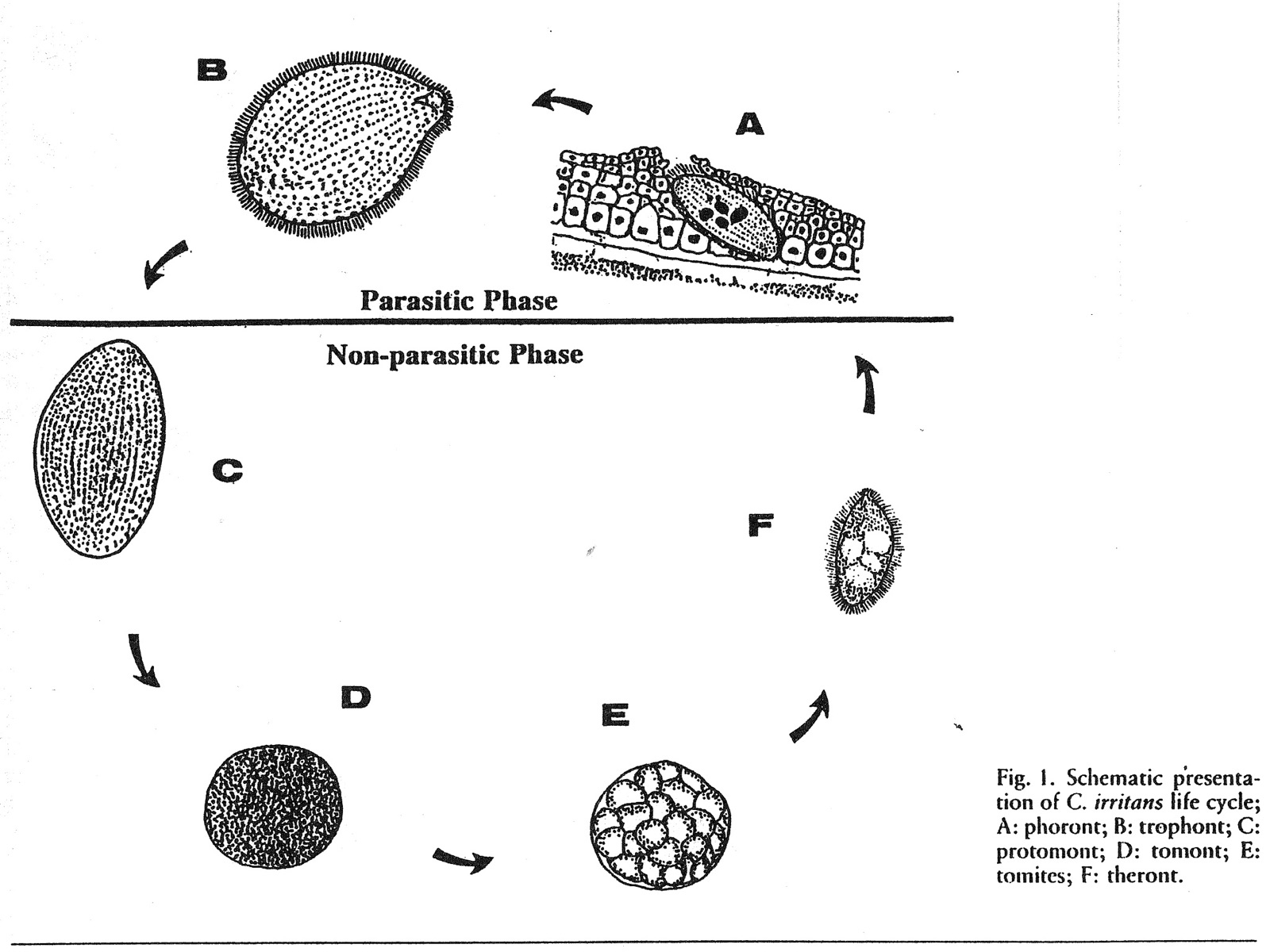
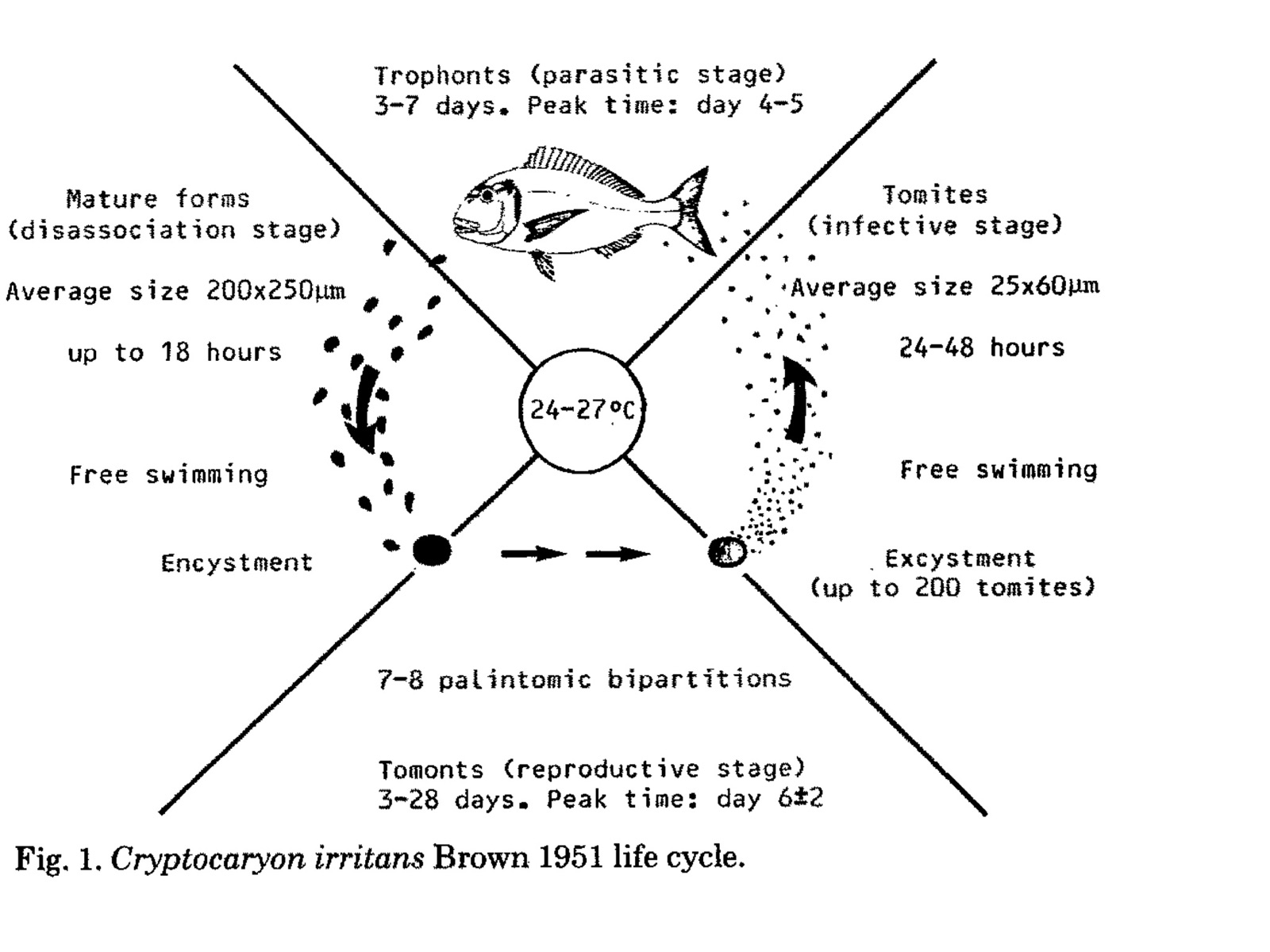
The life cycle of Cryptocaryon irritans has 4 stages through which it develops and changes.
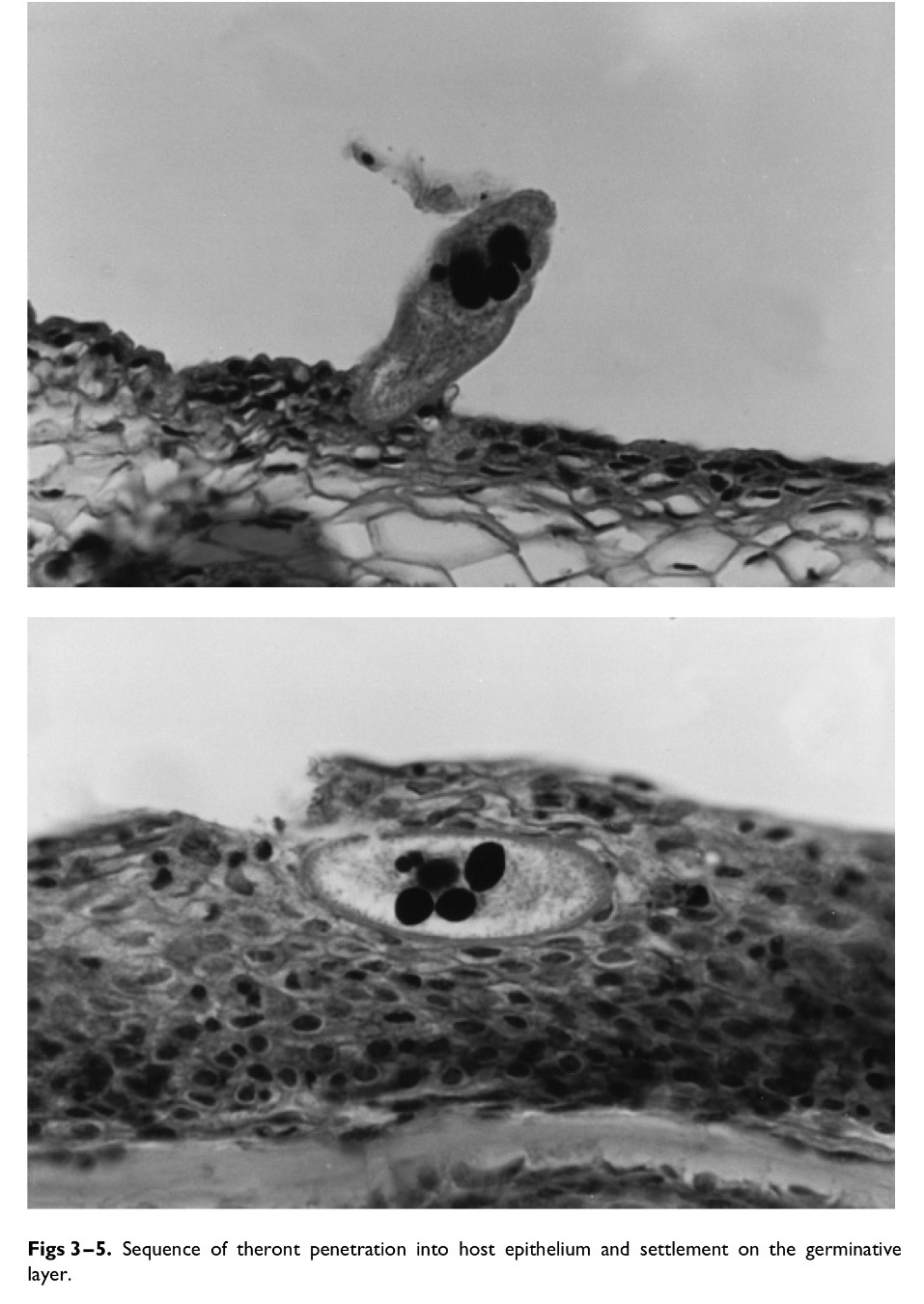
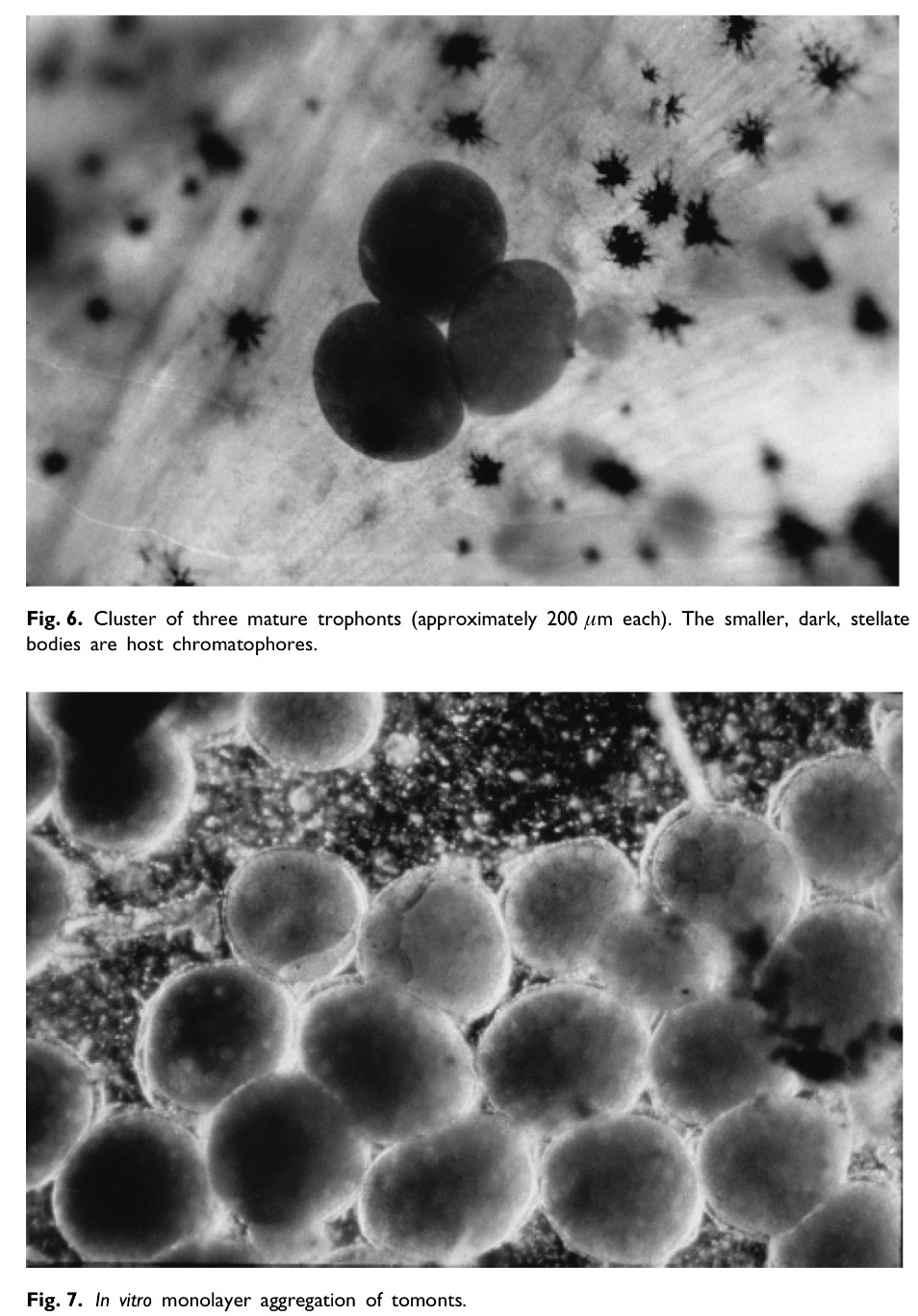
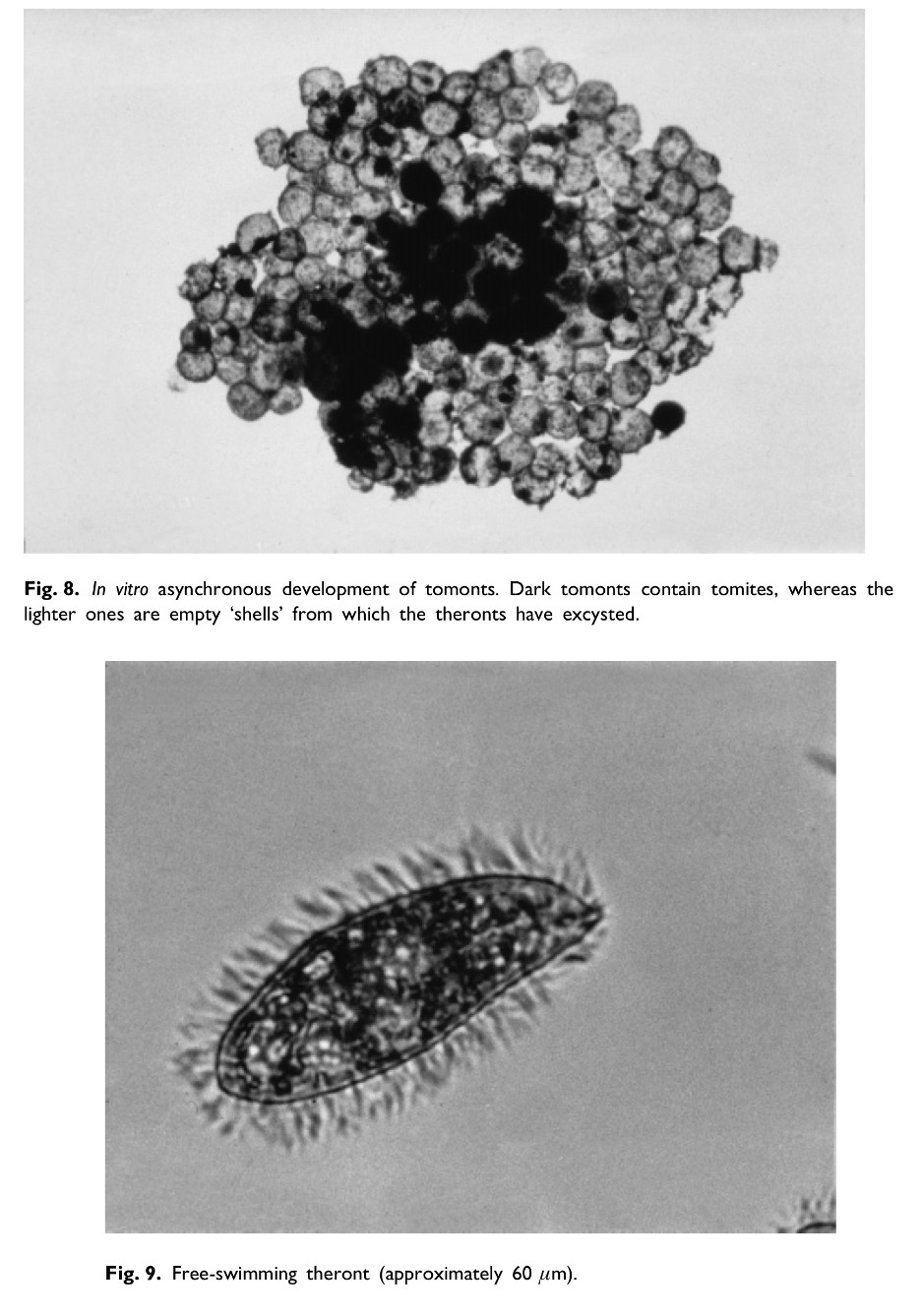
It all starts with a ciliate (theront) infecting a fish. It attaches to the skin, the gills and in general the mucous membranes of a fish and starts feeding on them.
At this stage the parasite is called a trophont. This stage lasts 3 to 7 days.
At the end of this period the parasite, now called a protomont, is ready to leave the host and anchor itself to any substrate by producing a sticky substance. Once anchored, it changes again into a stage called the tomont, and at this point begins to multiply very quickly into numerous tomites. The number of tomites produced by each tomont can range from 200 to 1000. This reproductive stage can last from 3 to 72 days. Its length depends on temperature: at the temperatures we normally find in our aquariums, about 25 degrees, it can last from 3 to 28 days. At the end of this reproductive period the tomites are released into the water, ready to infect a new fish. At this stage, when they are free to swim and infect, they are called theronts. It has been observed that once released, theronts quickly lose their ability to infect: about 11 hours after hatching, only 9% of them can still infect.
If they do not find a host to infect and feed on within 48 hours, the theronts are doomed to die.
The life cycle of Cryptocaryon irritans
- 1Trophont feeds on skin, gills and mucous membranes
- 2Protomont leaves the host and anchors to the substrate
- 3Tomont on the bottom, divides into many tomites
- 4Theronts after 11 hours only 9% can still infect
The parasite leaves the fish to reproduce on the bottom: that is why the disease seems to disappear and then comes back, stronger.
Sources: [1]
Signs and symptoms of infection
The individual parasites are visible on affected fish, appearing as "white spots".
Fish tend to rub themselves on the rocks and decor of the tank.
Breathing is faster.
Increased mucus production is seen.
Hyperactivity, in the early stage of infection.
Hiding.
Cloudy eyes due to secondary bacterial infections.
Dull colours.
Hanging at the surface or in very turbulent areas.
Loss of appetite, dehydration and weight loss, especially in the advanced stage of the disease.
The signs to look for on an affected fish
- 1White spots these are the individual parasites
- 2Gills breathing is faster
- 3Cloudy eyes from secondary bacterial infections
- 4More mucus production increases
- 5Dull colours the colours look faded
- 6Rubbing on rocks and tank decor
The spots are the best-known sign, but they are not always visible: if only the gills are affected they may be missing.
Sources: [1]
Course of the disease
Very often the disease first appears in a mild form, which the fish manage to get over on their own a few days after the first "white spots" appear. After a period of apparent calm, however, it appears again in a much more violent and aggressive form. This is due to the complex life cycle of Cryptocaryon irritans: after leaving the infected animal, the parasite multiplies exponentially, releasing more parasites ready to strike the fish in the tank again.
It is a disease that often leads to the death of the affected animal. In most cases, affected animals die of secondary bacterial or fungal infections.
Fish can also die of osmotic shock or suffocation. If the infection is very extensive, the badly damaged skin loses its ability to act as an osmotic barrier, just as the gills lose their ability to carry out their vital role of exchanging oxygen and carbon dioxide with the outside environment.
Prevention and treatment
Prevention is certainly the safest way to avoid the risk of infection. In this regard, quarantining fish, but also rocks, for about three weeks greatly reduces the risk of bringing the parasite into the aquarium.
There are various ways to fight the disease, although only some are not only more effective but also simpler to put into practice.
What each remedy involves, according to the author
| Method | What it does | What it requires |
|---|---|---|
| Ozone | Effective in itself | Redox meter and constant monitoring |
| UV lamps | Hits the free-swimming infective stage | A very efficient lamp, on for long periods |
| Copper sulphate | The most effective remedy | Separate tank, air pump, no decor |
| Hyposalinity | Hits tomonts, in the reproductive stage | Dedicated tank, pH and KH checks, at least 3 weeks |
| Transfer | Much less stressful for the fish | Two tanks, 4 moves, 12 days |
No method is simple: that is why the winning choice remains quarantine.
Ozone and UV lamps
One remedy involves using ozone; this method is effective in itself but requires constant monitoring of the gas's concentration in the tank, so it needs a redox potential meter.
Another remedy uses UV lamps. In its free-swimming infective form the parasite is susceptible to UV rays: the problem is that you would need a very efficient lamp kept on for long periods, given the parasite's long life cycle.
Copper sulphate
The most effective remedy is chemical treatment with copper sulphate.
Since copper has strong disinfectant properties, at least at the high concentrations needed in the tank for this treatment, setting up a separate tank in which to put the animal to be treated is a must.
There are specific products on the market based on this salt: they are expensive, but for those who are not used to preparing solutions or do not want to struggle with calculations, they can be a convenient and simple choice. In this case, just follow the instructions on the product.
A much cheaper choice, but one that takes a little "effort", is to get plain copper sulphate: it is a bluish powder and can be bought at the chemist's.
First prepare a solution by dissolving 4 grams of copper sulphate and 0.25 grams of citric acid (also available at the chemist's) in 1 litre of double-distilled water, then add 1 ml of this solution for every 4 litres of water to be treated.
The solution must be shaken before each addition to the tank and, since copper sulphate is unstable in solution, it is best to prepare the amount to add each time.
In practice: set up a tank with an air pump, without decor since it could absorb the copper and so distort the concentration, then add 1 ml of the prepared solution for every 4 litres of water to be treated.
The treatment should last at least 10 days, better 15.
Of course, feeding must be kept to a minimum, since there is no biological filter.
To keep copper concentrations steady throughout the treatment, proceed as follows: 48 hours after the first addition, add 0.5 ml of solution for every 4 litres of tank water, and after a further 36 hours add 0.25 ml of solution for every 4 litres.
If after a day or two the problem has still not been solved, you must replace all the water in the tank and start the treatment again from scratch.
Hyposalinity
Another method to wipe out Cryptocaryon is hyposalinity.
This procedure involves gradually lowering the tank's salinity.
Of course, in this case too we must set up a dedicated quarantine tank. Salinity must be brought down to 0.14 ppt.
At these values it is not the free-swimming forms of the parasite that die (theronts): it is hit in its reproductive stage (tomonts), so its ability to reinfect is blocked.
The final salinity can be reached with two water changes a day, each lowering salinity by 5 ppt.
The treatment should last at least 3 weeks from reaching the final salinity.
Since both pH and KH tend to fall at low salinity, these two values must be constantly monitored and corrected if necessary.
At the end of the treatment the initial salinity (35 ppt) must be restored in the same way, with two water changes a day, each raising it by 5 ppt.
The transfer technique
This method was tested successfully in 1985 by Angelo Colorni, a researcher at Israel's Oceanographic Centre. When I contacted him personally, the very kind and helpful Dr Angelo Colorni pointed out to me that, although it is true that most fish (Teleostei) can withstand hyposaline conditions for a limited time, it is still a very stressful condition for them.
He therefore pointed me to a much less stressful technique for the fish, which he has used many times, called the transfer technique. In this case you need two tanks and you move the fish to be treated from one tank to the other. The fish are moved 4 times at three-day intervals (days 1, 4, 7 and 10), and the aquarium they are taken from is disinfected or, even better, completely drained and dried each time (tomonts do not survive drying out).
So the treatment lasts 12 days in all and solves the problem with a very high probability while keeping stress on the fish to a minimum.
Four moves in twelve days
- 1Clean tank the fish stays three days
- 2Tomonts on the bottom stay in the tank left behind
- 3Move the fish then disinfect or dry the empty tank
- 4End the treatment lasts 12 days in all
The fish leaves the tomonts behind before new theronts hatch: the cycle is broken without drugs.
Sources: [1]
As we have seen, fighting a Cryptocaryon irritans infection in the tank is anything but simple: every method involves long, laborious procedures.
Quarantining fish and/or buying them from careful, conscientious shops is therefore the winning choice.
I would like to thank Dr Angelo Colorni once again for his great helpfulness and for sharing his valuable experience on the subject with us all.
author: Giuseppe Ossolengo
Sources
- Yanong R.P.E. (2012). Cryptocaryon irritans Infections (Marine White Spot Disease) in Fish (FA164). UF/IFAS Extension, University of Florida; revised 2024.
- WoRMS (2026). Cryptocaryon irritans Brown, 1951. World Register of Marine Species.
On the same topic
Euphyllia: parasites, treatment, husbandry
A garden of Euphyllia is very rewarding, but these corals suffer from swings and parasites. The values to keep, how…
Fluconazole and Oodiniasis
English version of the article Fluconazolo e Oodiniasi: the reports of three reefkeepers, the ergosterol hypothesis…
Oodiniasis, or Marine Velvet Disease
What velvet is, where it attacks the fish, how to recognise it and which remedies have been used, with notes on…