
Turbellarie (Amakusaplana acroporae)
Currently accepted name: Prosthiostomum acroporae
A small flatworm that eats corals of the genus Acropora, once called Amakusaplana acroporae. 1 3 In the tank it can kill whole colonies and, thanks to its camouflage, it is hard to see. 2 3 The term 'turbellarians' is no longer used in classification. 5
At a glance
Data from the scientific sources listed at the bottom.
Size
up to 0.6 cm
maximum length measured on preserved specimens from Lizard Island, not the maximum for the species [2]
Conservation
IUCN Red List: not evaluated.
Where it lives
It was described from aquariums in the United States. 4 In the wild it was found for the first time in 2011 at Lizard Island, on Australia's Great Barrier Reef, and then on other reefs in the central part. 2 3 Its real range is not known. 3 The early reports for Indonesia and the Red Sea do not stand up to a check of the sources. 2
How to recognise it
Tap a number on the photo: the key explains what to look for.
Life in the wild
Reproduction
It lays clusters of eggs on bare coral skeleton, on average 14 capsules per cluster, with 1-5 embryos each. 3 In the laboratory hatching came on average after 25.9 days at 21 °C, 14.8 at 24 °C, 11.3 at 27 °C and 9.4 at 30 °C. 3 Sexual maturity was reached on average in 56 days at 24 °C, 34.5 at 27 °C and 32.5 at 30 °C. 3
In the aquarium
From the experience of the BallingMania community.
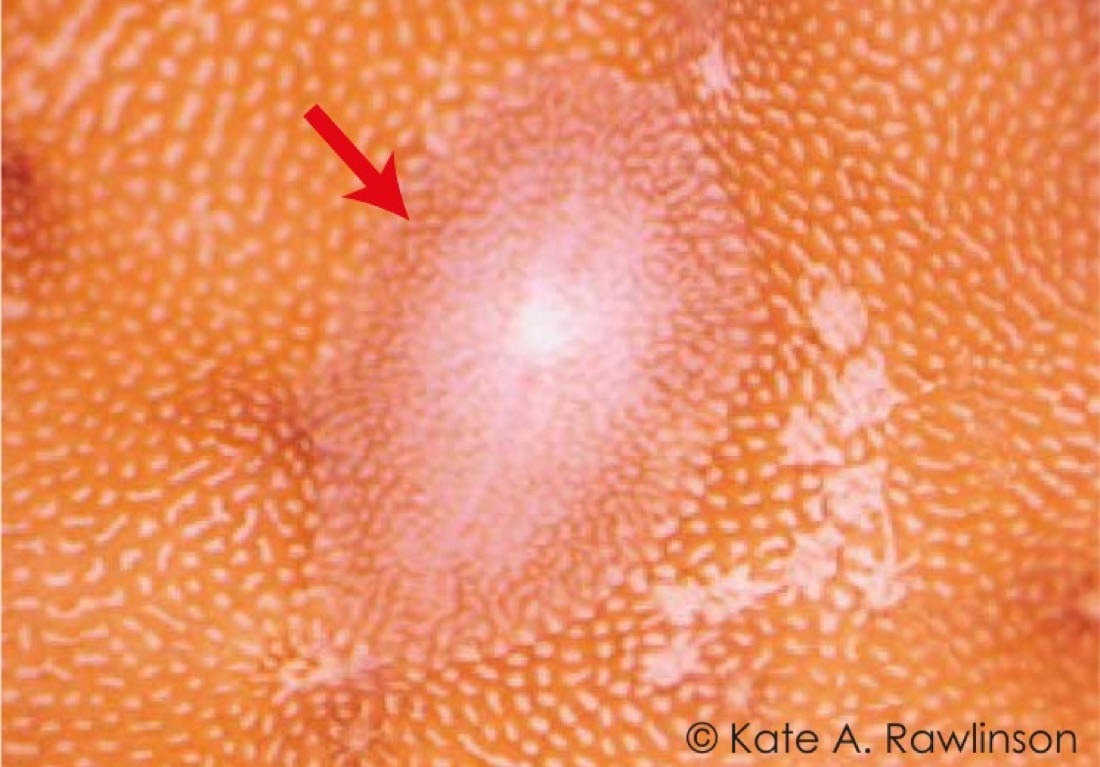
These flatworms strike terror into marine aquarists, and in particular into those who keep Acropora. They are certainly one of the hardest plagues to spot and can lead to the death of every Acropora in the whole aquarium. They camouflage themselves perfectly among the corals and feed on the living tissue; in the top photo, besides the adult flatworm, the bite marks can also be seen, while in the bottom photo you can see the clusters of amber-coloured eggs attached to the coral skeleton. To avoid this plague it would be good practice to quarantine all Acropora in a small separate aquarium before adding them to the tank; we know, however, that only a few people have a quarantine aquarium; as an alternative you can keep natural predators in the tank, such as fish of the genus Synchiropus, wrasses of the genus Halichoeres, Labroides dimidiatus or Pseudocheilinus hexataenia. The ideal time to spot these little crawling creatures is at night with a small torch, because it is precisely at night that they move.
good or bad?
VERDICT:
Key: Good! An organism beneficial to the system. Reef Safe!
An organism whose benign or harmful nature is not yet known, to be kept an eye on.
Bad! The organism is a threat to the other inhabitants of the aquarium or could become a pest.
A food source for the other inhabitants of the aquarium.
A potentially toxic or venomous organism.
© Kate A. Rawlinson · © J. Weatherson
What studies say about keeping it
Results and suggestions from studies, not a treatment to follow. Barton et al. propose repeating the treatment to hit newly hatched worms, between hatching and maturity: at 28 °C between day 13 and day 31, but they did not test how effective the dips are. 3 They also suggest removing the egg capsules by hand and treating all infested colonies together. 3 At 30 °C, without live Acropora, they estimate about 21 days to eliminate eggs and newly hatched worms; at 24 °C about 25. 3 In the tank some wrasses eat adults that have come off the coral. 2
Did you know?
Sources
- Tyler, S.; Artois, T.; Schilling, S.; Hooge, M.; Bush, L.F. (World List of turbellarian worms) (2026). Prosthiostomum acroporae (Rawlinson, Gillis, Billings & Borneman, 2011). World Register of Marine Species.
- Rawlinson, K.A.; Stella, J.S. (2012). Discovery of the corallivorous polyclad flatworm, Amakusaplana acroporae, on the Great Barrier Reef, Australia - the first report from the wild. PLoS ONE 7(8): e42240.
- Barton, J.A.; Hutson, K.S.; Bourne, D.G.; Humphrey, C.; Dybala, C.; Rawlinson, K.A. (2019). The life cycle of the Acropora coral-eating flatworm (AEFW), Prosthiostomum acroporae; the influence of temperature and management guidelines. Frontiers in Marine Science 6: 524.
- Hume, B.C.C.; D'Angelo, C.; Cunnington, A.; Smith, E.G.; Wiedenmann, J. (2014). The corallivorous flatworm Amakusaplana acroporae: an invasive species threat to coral reefs?. Coral Reefs 33(1): 267-272.
- WoRMS Editorial Board (2026). Turbellaria Ehrenberg, 1831. World Register of Marine Species.
Sources checked on 5 November 2026. Community texts and ratings are kept separate from the scientific data.