
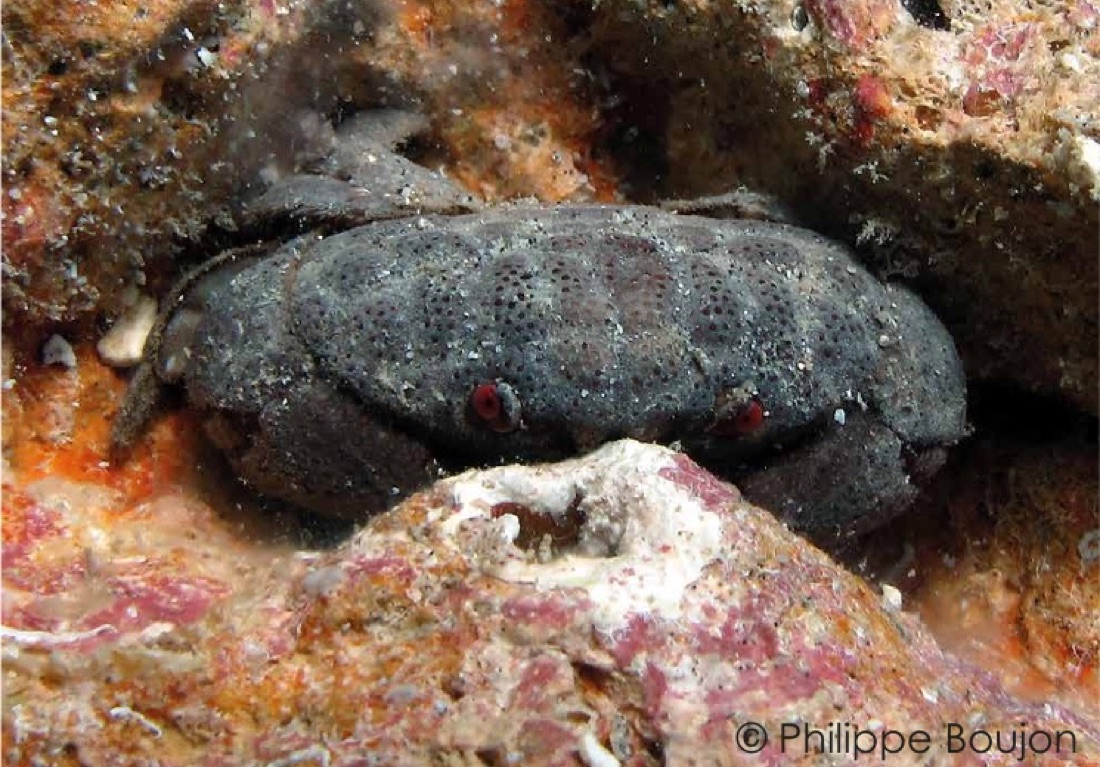
At a glance
Data from the scientific sources listed at the bottom.
Depth in the wild
0–6 m
Size
up to 2.5 cm
carapace width of the larger of the two specimens measured at Rhodes; not a maximum for the species
Conservation
IUCN Red List: not evaluated. Red List data taken from SeaLifeBase and GBIF. 2 8 It does not appear in the CITES lists checked on Species+. 7 For its arrival in the Mediterranean, migration through the Suez Canal, transport by ships and, as a more remote hypothesis, escape from aquariums have been considered. 3
Where it lives
Widespread in the Indo-Pacific: the Red Sea, the Gulf of Aden, eastern and southern Africa, the islands of the western Indian Ocean, as far as Australia, Japan and Hawaii. 3 WoRMS adds New Caledonia, Wallis and Futuna and French Polynesia. 1 In Taiwan it is common in reef habitats. 4 In the Mediterranean it is an alien species: the first two males were collected at Rhodes in 2013 and 2014, and WoRMS also records Tunisia. 1 3
How to recognise it
Tap a number on the photo: the key explains what to look for.
Life in the wild
Where it is found
It lives in the intertidal zone and just below it, in rock crevices or on reefs. 2 According to Serène, cited in a 2015 study, it is the most common species on intertidal reefs. 3 In Taiwan it was extracted from small rock crevices, with a carapace up to 1.24 cm wide. 4 At Rhodes it was collected at 2 m on a rocky bottom. 3 The usual range is 0-6 m, but SeaLifeBase gives a general range down to 100 m. 2
What it eats
Its diet in the wild is not documented in open-access sources. In a research tank at Rhodes one specimen handled the filamentous algae present, probably to eat them, even though it was given flake food. 3
Reproduction
The first larvae (zoeae) were described from females collected on the Saudi coast of the Red Sea. 3
In the aquarium
From the experience of the BallingMania community.
A crab belonging to the family Xanthidae, which includes some crabs that are sometimes found inside live rock; this one in particular is not considered reef safe. When small it tends to eat the algae growing on the rocks, but once it starts to grow it is able to prey on invertebrates (snails, shrimp, etc.), can eat corals and may even try to attack fish. Although its carapace can come in different colours, it is easy to identify by various features such as its large claws, red eyes and hairy legs.
good or bad?
VERDICT:
Key: Good! An organism beneficial to the system. Reef Safe!
An organism whose benign or harmful nature is not yet known, to be kept an eye on.
Bad! The organism is a threat to the other inhabitants of the aquarium or could become a pest.
A food source for the other inhabitants of the aquarium.
A potentially toxic or venomous organism.
© Philippe Boujon
Did you know?
Sources
- DecaNet (2026). Actaeodes tomentosus (H. Milne Edwards, 1834). World Register of Marine Species.
- SeaLifeBase (2026). Actaeodes tomentosus. SeaLifeBase.
- Corsini-Foka M., Kondylatos G. (2015). First occurrence of Actaeodes tomentosus (H. Milne Edwards, 1834) (Brachyura: Xanthidae: Actaeinae) in the Mediterranean Sea. Mediterranean Marine Science.
- Hsueh P.W., Tzeng Y.W. (2024). On a Collection of Rocky Intertidal Xanthid Crabs (Crustacea, Decapoda, Xanthidae) from Taiwan, with Description of a New Species of Cyclodius Dana 1851. Zoological Studies.
- Deeds J.R., Landsberg J.H., Etheridge S.M., Pitcher G.C., Longan S.W. (2008). Non-Traditional Vectors for Paralytic Shellfish Poisoning. Marine Drugs.
- Zhang Y., Zhu H., Takatani T., Arakawa O. (2025). Toxin Accumulation, Distribution, and Sources of Toxic Xanthid Crabs. Toxins.
- UNEP-WCMC (2026). Search for Actaeodes tomentosus in the CITES lists. Species+.
- GBIF Secretariat (2026). Actaeodes tomentosus, IUCN Red List category. GBIF.
Sources checked on 5 November 2026. Community texts and ratings are kept separate from the scientific data.