At a glance
Data from the scientific sources listed at the bottom.
Depth in the wild
2–10 m
Conservation
IUCN Red List: not evaluated. Red List data taken from SeaLifeBase and GBIF. 2 11 It does not appear in the CITES lists checked on Species+. 10
Where it lives
Indo-Pacific. 2 Recorded in the Seychelles, Mozambique and Réunion, in the Gulf of Thailand, Malaysia, Indonesia, Japan, the Solomon Islands, Australia and New Caledonia; the type locality is in Queensland. 3 It is also known from Singapore, Guam and the Philippines, and from northern Taiwan since 2016. 4 WoRMS adds Mayotte, the East China Sea and French Polynesia. 1
How to recognise it
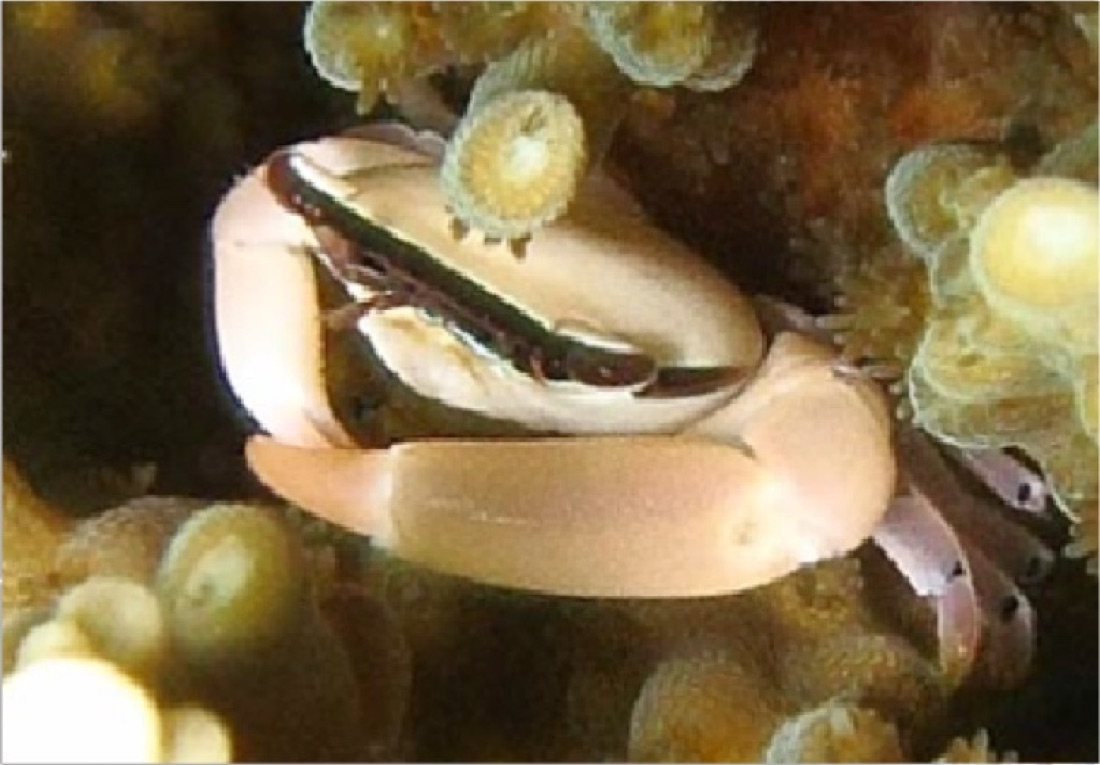
Tap a number on the photo: the key explains what to look for.
Life in the wild
Where it is found
It lives among Acropora branches. 4 5 In Taiwan it was collected at 2-10 m on Acropora hyacinthus and Acropora digitifera 4, at Lizard Island at 2-4 m on Acropora valida. 8 In the literature it goes down to 52 m 4, and SeaLifeBase gives 1-66 m. 2 It is not entirely exclusive: in one study it also turned up on pocilloporid corals 7, and a not-yet-adult individual was found on a sea fan. 4
What it eats
The data are at genus level: Tetralia ingests coral mucus together with the detritus it contains, and on its legs it has small brushes and two rows of bristles, called a 'feeding comb'. 6 The Aquarium of the Pacific adds that coral crabs use special appendages to stimulate the coral to produce more mucus. 9
Behaviour
Tetralia and Trapezia crabs proved to be the most effective symbionts at keeping crown-of-thorns starfish away from the coral. 7 Tetralia mainly pinches the tube feet and, unlike the larger Trapezia, causes no lasting damage. 7 These crabs also remove detritus and sediment from the colony. 8 9
In the aquarium
From the experience of the BallingMania community.
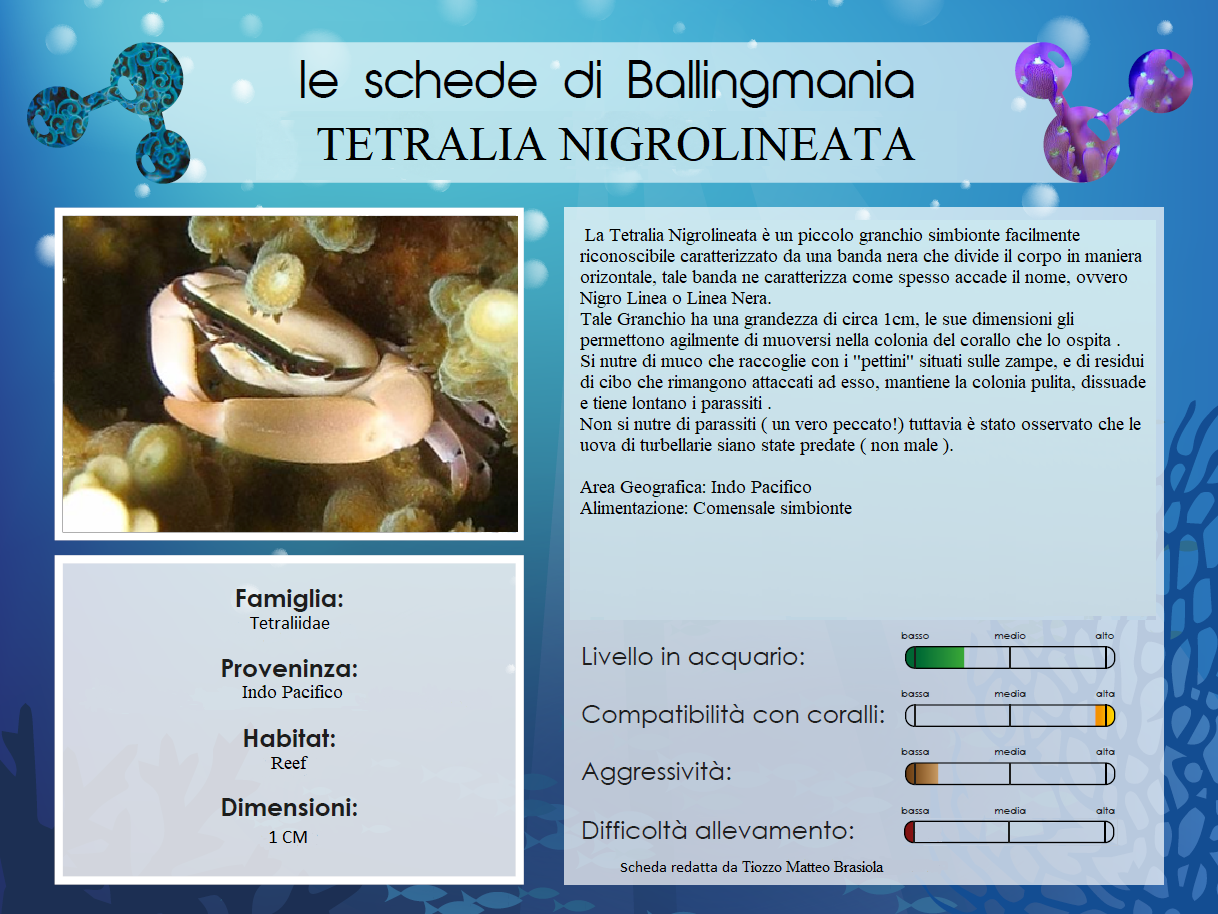
Tetralia nigrolineata is a small, easily recognised symbiotic crab, marked by a black band that divides the body horizontally; as often happens, this band gives it its name, Nigro Linea or Black Line.
This crab is about 1 cm long, and its size lets it move nimbly through the colony of the coral that hosts it. It feeds on mucus, which it gathers with the "combs" on its legs, and on food scraps that stick to it; it keeps the colony clean and deters and keeps away pests.
It does not feed on pests (a real shame!); however, it has been observed preying on flatworm eggs (not bad).
Geographical area: Indo-Pacific. Diet: symbiotic commensal
Species sheet written by Tiozzo Matteo Brasiola
Did you know?
Sources
- DecaNet (2026). Tetralia nigrolineata Serène & Pham, 1957. World Register of Marine Species.
- SeaLifeBase (2026). Tetralia nigrolineata. SeaLifeBase.
- Naturalis Biodiversity Center (2026). Tetralia nigrolineata, Crabs of Japan. Naturalis.
- Limviriyakul P., Tseng L.C., Hwang J.S., Shih T.W. (2016). Anomuran and Brachyuran Symbiotic Crabs in Coastal Areas between the Southern Ryukyu arc and the Coral Triangle. Zoological Studies.
- Trautwein S.E. (2007). Four new species of coral crabs belonging to the genus Tetralia Dana, 1851 (Crustacea, Decapoda, Brachyura, Tetraliidae). Zootaxa.
- Castro P. (1976). Brachyuran Crabs Symbiotic with Scleractinian Corals: A Review of their Biology. Micronesica.
- Pratchett M.S. (2001). Influence of coral symbionts on feeding preferences of crown-of-thorns starfish Acanthaster planci in the western Pacific. Marine Ecology Progress Series.
- Rawlinson K.A., Stella J.S. (2012). Discovery of the Corallivorous Polyclad Flatworm, Amakusaplana acroporae, on the Great Barrier Reef, Australia. PLOS ONE.
- Aquarium of the Pacific (2023). Coral crabs, Online Learning Center. Aquarium of the Pacific.
- UNEP-WCMC (2026). Search for Tetralia nigrolineata in the CITES lists. Species+.
- GBIF Secretariat (2026). Tetralia nigrolineata, IUCN Red List category. GBIF.
Sources checked on 5 November 2026. Community texts and ratings are kept separate from the scientific data.