
At a glance
Data from the scientific sources listed at the bottom.
Conservation
IUCN Red List: not evaluated.
Where it lives
There is no distribution valid for the whole genus. The family has been found mainly in warm and tropical waters, but there are species in Antarctica too. 3 Examples: T. acroporanus in the Marshall Islands, T. georgei in the Gulf of Aqaba, T. knoepffleri at Banyuls, in southern France, and T. okinawaensis in Japan. 2 3
How to recognise it
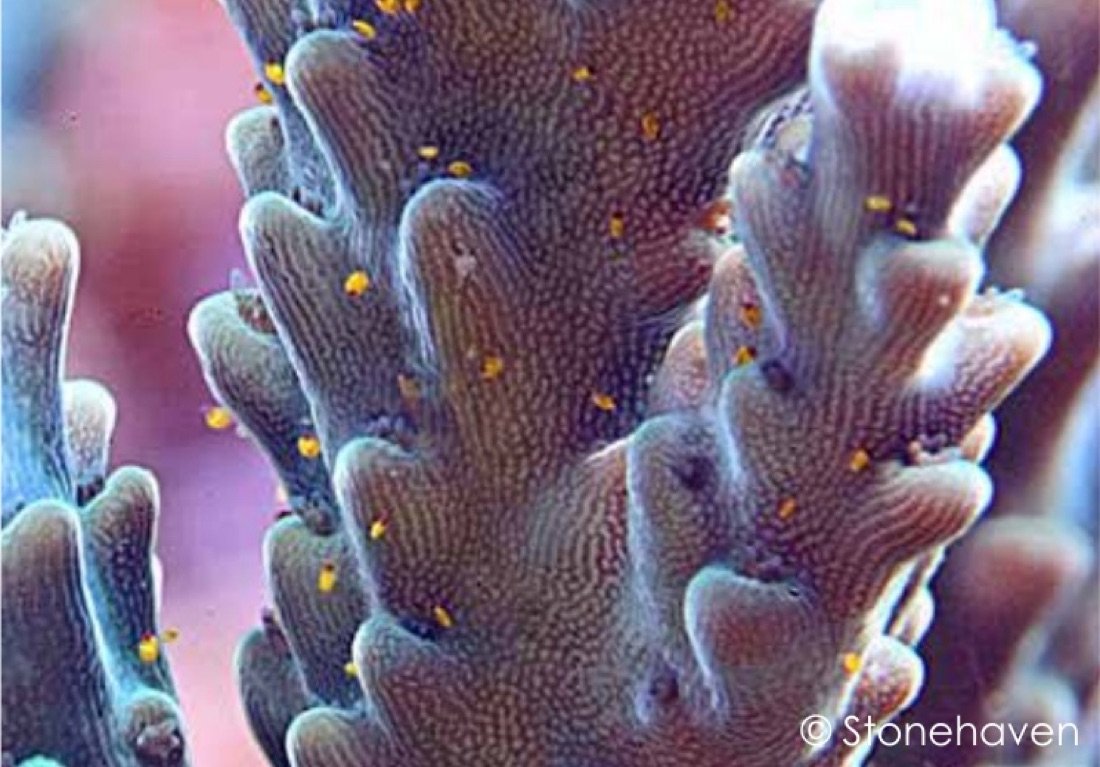
Tap a number on the photo: the key explains what to look for.
Life in the wild
Where it is found
The group is traditionally described from coastal algae, but it is also found in the plankton of shallow tropical waters. 3 Species in the family can live free or associated with algae, bryozoans and cnidarians, including hard corals. 3 Depths vary a lot from species to species: T. acroporanus was collected at 2 m, T. okinawaensis between 583 and 711 m near hydrothermal vents. 2 3
Reproduction
In T. acroporanus both sexes are known and the female carries an egg sac. 2
In the aquarium
From the experience of the BallingMania community.
Tiny crustaceans belonging to the copepod family (zooplankton); aquarists overseas call them “red bugs” (even though they are not really red but rather yellowish-orange), because they look like tiny insects or fleas. They are one of the plagues that can hit aquariums stocked with SPS corals; in fact these tiny creatures tend to gather in large numbers on Acropora colonies; they do not swim freely in the water column but graze and scurry over the coral branches, feeding on the living tissue. They are extremely difficult to spot and kill; at present no fish or natural predator is known that can help us fight this type of copepod; there are remedies that use a very powerful medicine, and for this reason the infested coral must be treated in a separate (quarantine) tank. good or bad?
VERDICT:
Key: Good! An organism beneficial to the system. Reef Safe!
An organism whose benign or harmful nature is not yet known, to be kept an eye on.
Bad! The organism is a threat to the other inhabitants of the aquarium or could become a pest.
A food source for the other inhabitants of the aquarium.
A potentially toxic or venomous organism.
© Stonehaven · © Хimina's
What studies say about keeping it
Study results, not a treatment to follow. T. acroporanus was eliminated from a large exhibit with 12 six-hour baths in water at 0.167 µg/L of milbemycin oxime, using a veterinary ear solution (MilbeMite Otic). 4 The authors report that infestations are widespread in public aquariums and coral farms. 4
Did you know?
Sources
- Walter, T.C.; Boxshall, G. (World of Copepods Database) (2026). Tegastes Norman, 1903. World Register of Marine Species.
- Humes, A.G. (1981). A new species of Tegastes (Copepoda: Harpacticoida) associated with a scleractinian coral at Enewetak Atoll. Proceedings of the Biological Society of Washington 94(1): 254-263.
- Back, J.; Huys, R.; Lee, W. (2010). A new species of the genus Tegastes (Copepoda: Harpacticoida: Tegastidae) from hydrothermal vents in the Okinawa Trough. Zoological Science 27: 678-688.
- Christie, B.L.; Raines, J.A. (2016). Effect of an otic milbemycin oxime formulation on Tegastes acroporanus infesting corals. Journal of Aquatic Animal Health 28(4): 235-239.
- Kim, J.G.; Cho, K.H.; Lee, J.M. (2023). Four new species of the family Tegastidae (Copepoda, Harpacticoida) from shallow waters of Korea. Animal Systematics, Evolution and Diversity 39(4): 218-247.
Sources checked on 5 November 2026. Community texts and ratings are kept separate from the scientific data.