
Stomatella
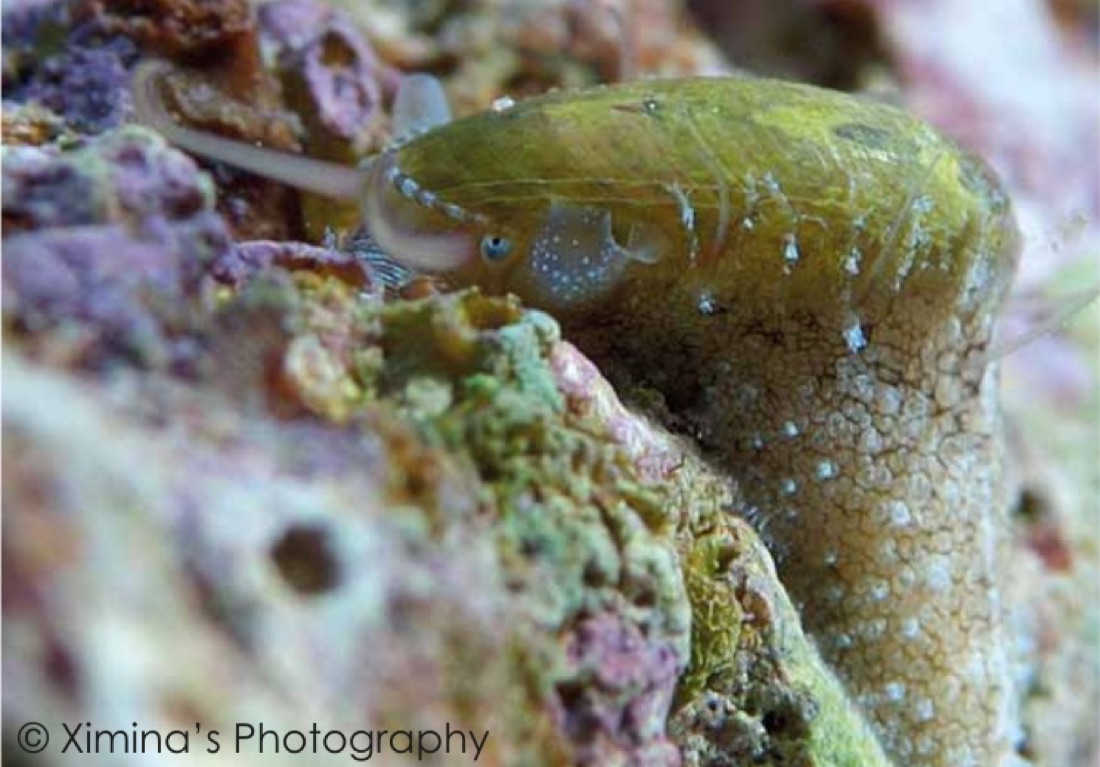
Stomatella is a genus of small sea snails of the family Trochidae, with a good twenty accepted species. 1 The shell, flat and ear-shaped, is much smaller than the animal: the foot, broad and stretching out behind, cannot withdraw under it. 3 4 If touched, the snail can deliberately shed the rear part of its foot. 4
At a glance
Data from the scientific sources listed at the bottom.
Conservation
IUCN Red List: not evaluated. The Red List assesses individual species, not the genus. For S. auricula SeaLifeBase reports no IUCN or CITES assessments. 5
Where it lives
The sources give the range by species, not for the whole genus. S. auricula, the type species of the genus, lives in the Indo-Pacific. 2 5 S. impertusa is recorded in the Indo-Pacific, between Japan, the Philippines, Indonesia and the Red Sea; in the Mediterranean it is known from a single find in 1999 in south-eastern Turkey, which arrived by unknown routes. 3
How to recognise it
Tap a number on the photo: the key explains what to look for.
Life in the wild
Where it is found
Shallow rocky bottoms: by day it hides under stones. 3 At Eilat, in the Red Sea, Gena varia (now in the genus Stomatella) forms large groups under stones just below the low-tide line. 4 For S. auricula SeaLifeBase gives individuals under rocks in the intertidal zone, often several under the same stone, and a depth range from 0 to 67 m. 5 Size varies a lot: S. impertusa measures 5.3 mm in the Mediterranean, 12 mm in the Red Sea and up to 25 mm in the Indo-Pacific. 3
What it eats
There are no data specific to the genus. For the whole family Trochidae, SeaLifeBase gives a diet of detritus and grazed algae, sometimes supplemented by filtering the water. 5
Behaviour
It is active at night and shuns light: at the slightest disturbance it flees downwards and slips between algae and stones. 3 4 If touched, it sheds the part of the foot that sticks out behind the shell, along a thin white transverse line, then clings firmly to a stone covered by its shell. The foot grows back. 3 4
In the aquarium
From the experience of the BallingMania community.
It is one of the first spontaneous guests seen grazing on the rocks in a marine aquarium. It is a small snail, roughly 2-3 cm long, with a very distinctive and recognisable nail-shaped shell on its back. It is active mainly at night and moves quickly (for a snail), because its shell does not give it much protection from predators. It is an excellent clean-up animal and feeds on algae and microalgae. Not everyone knows that it has a special defence mechanism: if in danger it deliberately breaks off part of its foot to distract the predator, a bit like lizards do with their tails.
good or bad?
VERDICT:
Key: Good! An organism beneficial to the system. Reef Safe!
An organism whose benign or harmful nature is not yet known, to be kept an eye on.
Bad! The organism is a threat to the other inhabitants of the aquarium or could become a pest.
A food source for the other inhabitants of the aquarium.
A potentially toxic or venomous organism.
© Ximina's Photography · © Marc Levenson
Did you know?
Sources
- MolluscaBase eds. (2026). Stomatella Lamarck, 1816. World Register of Marine Species.
- MolluscaBase eds. (2026). Stomatella auricula Lamarck, 1816. World Register of Marine Species.
- CIESM (2003). Atlas of Exotic Species in the Mediterranean: Stomatella impertusa. CIESM - The Mediterranean Science Commission.
- Fishelson L., Qidron-Lazar G. (1966). Foot autotomy in the gastropod Gena varia (Prosobranchia: Trochidae). The Veliger 9(1): 8.
- (2026). Stomatella auricula (Lamarck, 1816). SeaLifeBase.
Sources checked on 5 November 2026. Community texts and ratings are kept separate from the scientific data.