Sipunculidi
Sipunculans are a whole group of exclusively marine worms, without visible segments and with about 150 species. 3 5 The body has a trunk and a front part that can be turned out and pulled back in, with the mouth at the tip, surrounded by tentacles. 4 Most studies now place them among the annelids. 1 3 6
At a glance
Data from the scientific sources listed at the bottom.
Conservation
IUCN Red List: not evaluated. The category refers to the group as a whole: there is no single assessment. A search for the name in Species+ gives no results. 2 In some regions they are collected as food and bait. 4
Where it lives
They live all over the world, from the intertidal zone to the deep sea floor. 3 This applies to the group: each species has its own range. In Indonesia 19 species are known. 4
How to recognise it
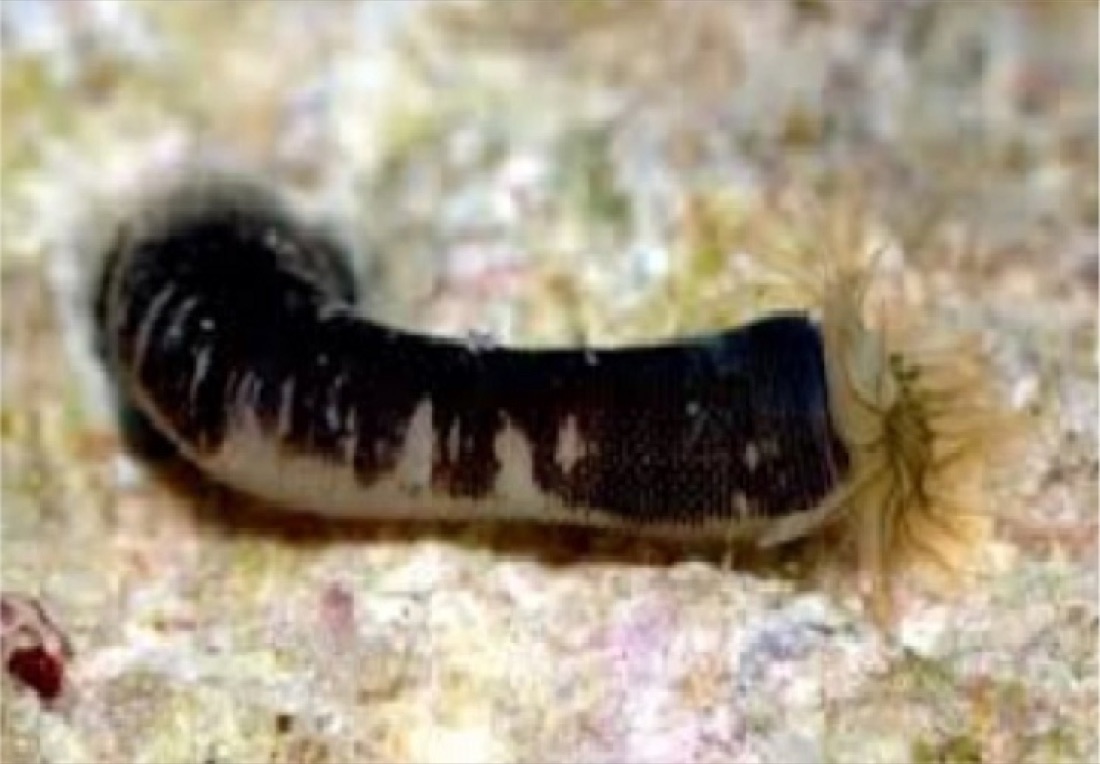
Tap a number on the photo: the key explains what to look for.
Life in the wild
Where it is found
They live in burrows, tubes and sheltered places, in both temperate and tropical waters, down to about 7,000 m deep. In Indonesia they are found in seagrass beds, mangroves and coral reefs, on sand and mud. 4
What it eats
Most eat organic material deposited on the bottom. Foods found in the group include detritus, faeces, bacteria, algae, protozoa and small invertebrates. Some, such as Themiste, trap particles with crowns of tentacles; others scrape the substrate with rows of hooks or papillae. 4
Behaviour
The way of life varies with the group: some burrow into soft sediments and swallow them, others occupy empty shells, others filter particles, and others live in cracks and tunnels in hard substrates. 4
Reproduction
In developmental studies on three species, the adults released their gametes in tanks and the larvae went through the stage called the pelagosphera; metamorphosis came at 10 days in Thysanocardia nigra and at 15 in Themiste pyroides. 5 This cannot be extended to the whole group.
In the aquarium
From the experience of the BallingMania community.
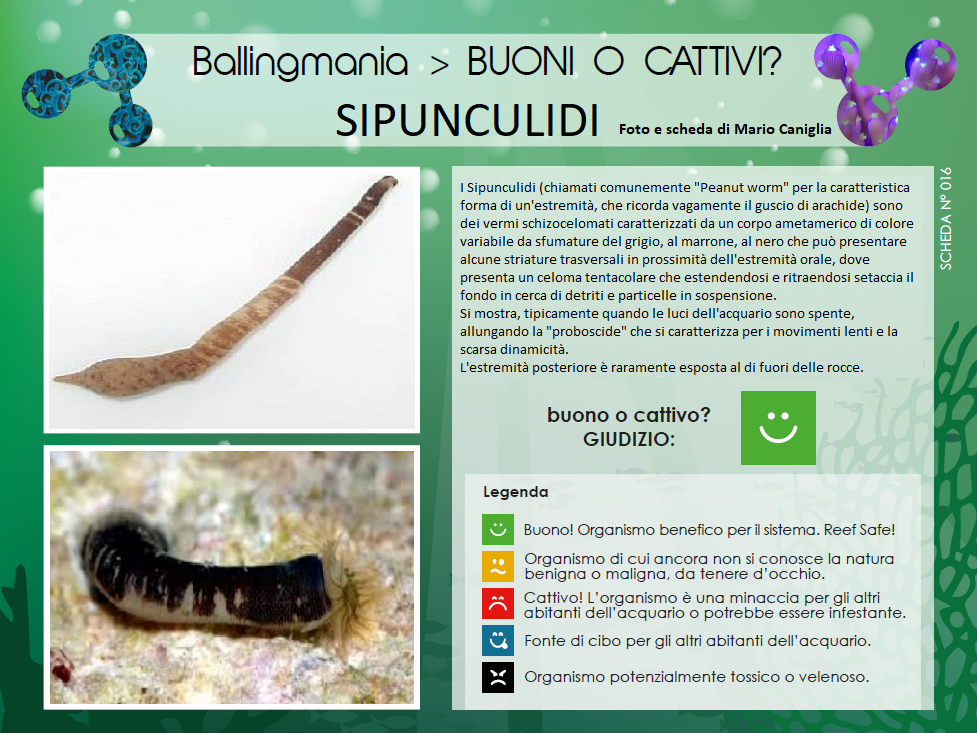
Sipunculans (commonly called "peanut worms" because of the characteristic shape of one end, which vaguely recalls a peanut shell) are schizocoelomate worms with an unsegmented body, in colours ranging from shades of grey to brown and black, which may show some transverse stripes near the mouth end, where there is a tentacular coelom that, by extending and retracting, sifts the bottom in search of detritus and suspended particles.
It typically shows itself when the aquarium lights are off, stretching out its "proboscis", which is marked by slow movements and little activity.
The rear end is rarely exposed outside the rocks.
good or bad?
VERDICT:
Key: Good! An organism beneficial to the system. Reef Safe!
An organism whose benign or harmful nature is not yet known, to be kept an eye on.
Bad! The organism is a threat to the other inhabitants of the aquarium or could become a pest. A food source for the other inhabitants of the aquarium.
A potentially toxic or venomous organism.
Photo and species sheet by Mario Caniglia
Did you know?
Sources
- WoRMS Editorial Board (2026). Sipuncula. World Register of Marine Species.
- UNEP-WCMC (2026). Search for Sipuncula in the CITES lists. Species+.
- Zhong S., Ma X., Jiang Y., Qiao Y., Zhao L., Huang L., Huang G., Zhao Y., Liu Y., Chen X. (2022). The Draft Genome of Chinese Endemic Species Phascolosoma esculenta (Sipuncula, Phascolosomatidae) Reveals the Phylogenetic Position of Sipuncula. Frontiers in Genetics.
- Cintra A.K.A., Fitrian T., Novianty H., Jasmadi, Sjafrie N.D.M. (2024). Sipuncula (Peanut Worms) in Indonesia Waters: A Review. ILMU KELAUTAN: Indonesian Journal of Marine Sciences.
- Kristof A., Wollesen T., Maiorova A.S., Wanninger A. (2011). Cellular and Muscular Growth Patterns During Sipunculan Development. Journal of Experimental Zoology Part B.
- Struck T.H., Schult N., Kusen T., Hickman E., Bleidorn C., McHugh D., Halanych K.M. (2007). Annelid phylogeny and the status of Sipuncula and Echiura. BMC Evolutionary Biology.
Sources checked on 5 November 2026. Community texts and ratings are kept separate from the scientific data.