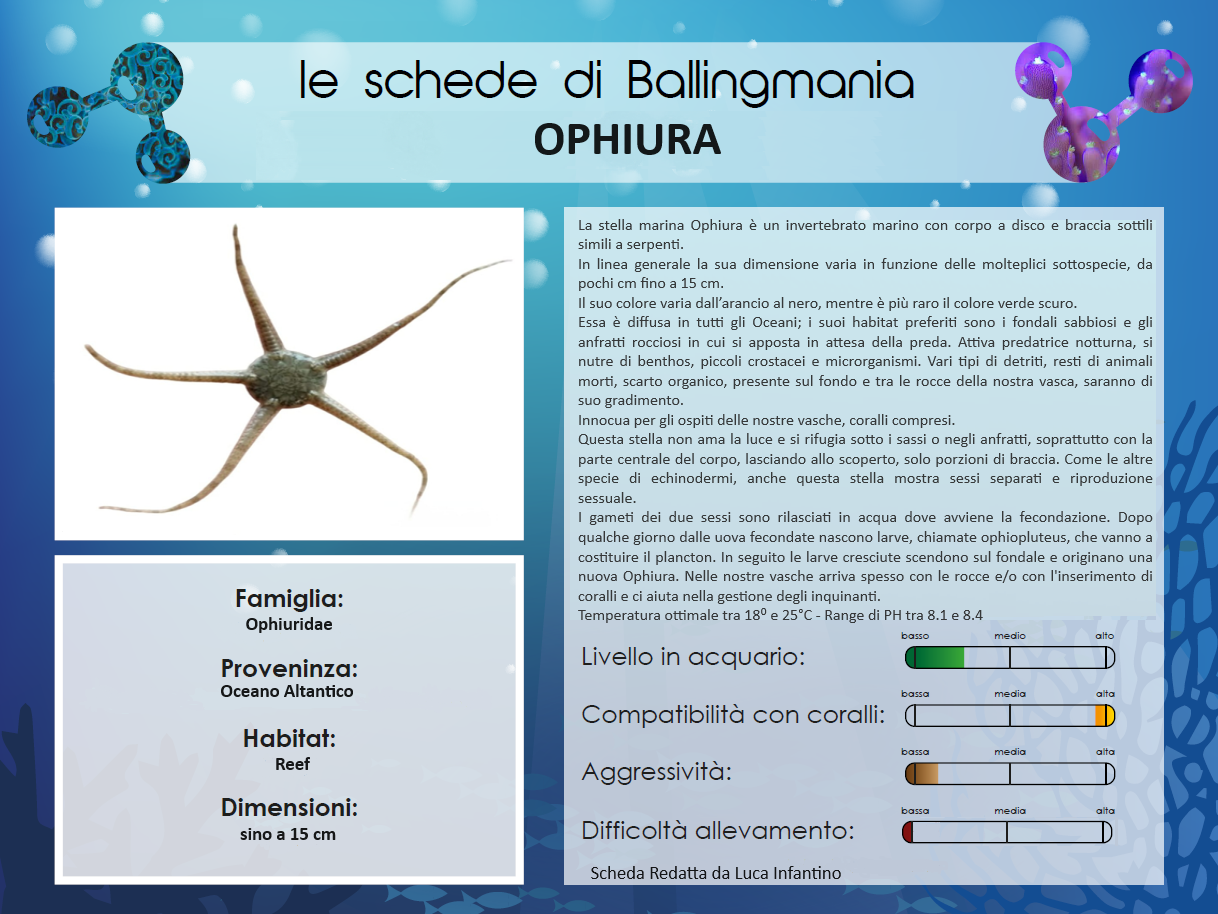
Ophiura
Ophiura is a genus of echinoderms of the class Ophiuroidea and the family Ophiuridae; the type species is Ophiura ophiura, from the Atlantic and the Mediterranean. 1 3 Like other brittle stars they have a central disc clearly separate from thin, mobile arms, which they use to move about. 2 Several species in the genus are predators or scavengers. 2
At a glance
Data from the scientific sources listed at the bottom.
Size
up to 15 cm
different from species to species; in most brittle stars the disc measures between 3 and 50 mm
Conservation
IUCN Red List: not evaluated. The type species, Ophiura ophiura, is not assessed by the Red List or by the CITES and CMS lists. 3 Ophiura sarsii, tied to cold waters, is sensitive to temperature changes and has been proposed as an indicator of the effects of warming in Arctic seas. 4
Where it lives
The species of the genus live in different seas. Ophiura ophiura is found in the north-eastern Atlantic and the Mediterranean, from the surface down to 685 m. 3 Ophiura sarsii is a cold-water species, common on the Arctic continental shelf and found from Japan and the Chukchi Sea to Canada, the United States, the North Atlantic and Norway. 4 The genus is also recorded on seamounts. 1 Considering all brittle stars, the Indo-Pacific region is the richest in species. 2
How to recognise it
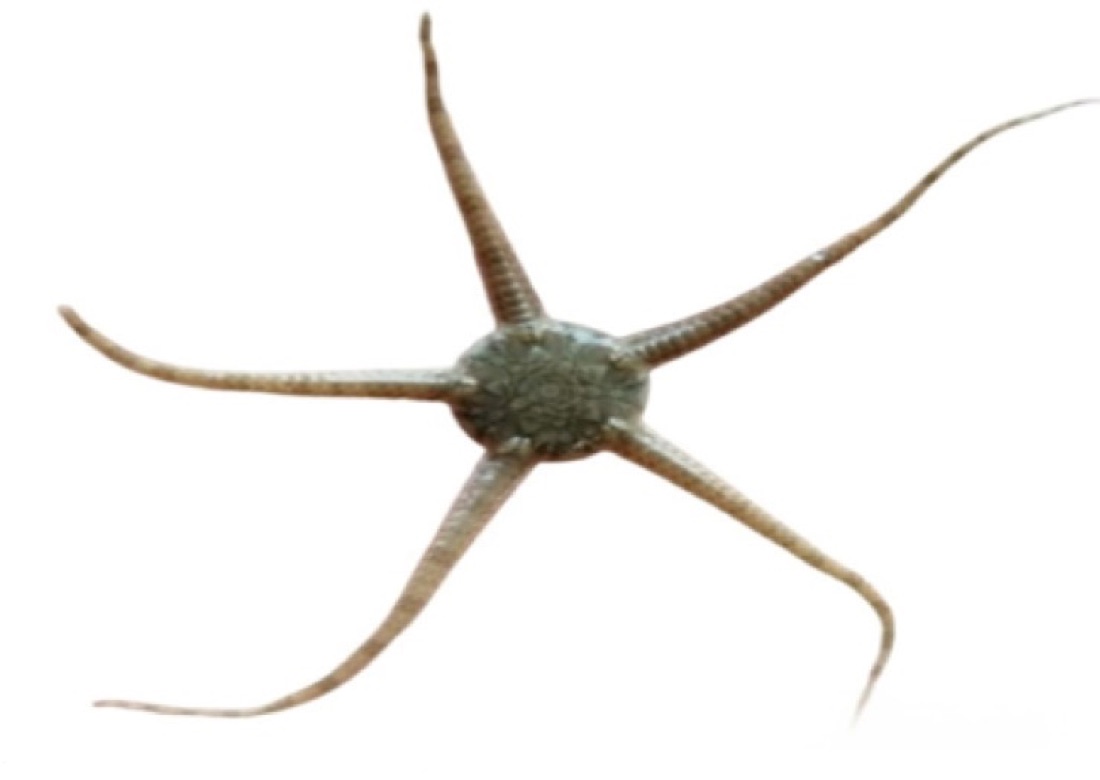
Tap a number on the photo: the key explains what to look for.
Life in the wild
What it eats
Several species of the family Ophiuridae are carnivorous: Ophiura ophiura hunts small bottom-dwelling animals, while Ophiura albida and Ophiura sarsii can hunt prey hidden in the sediment, eat carcasses or feed on organic matter on the seabed. 2 Brittle stars in general filter particles from the water, gather sediment, eat remains or hunt, but studies on their diet are still few. 2
Reproduction
In brittle stars the sexes are mostly separate and fertilisation takes place outside the body. 3 Many species release their eggs into the water, others keep them in pouches in the disc until the young are born. 2 The most ancient larva of the group is considered to be the pluteus, which lives and feeds in the plankton, but other types of development also exist. 2 For the genus Ophiura the sources read give no data of their own.
In the aquarium
From the experience of the BallingMania community.
The Ophiura sea star is a marine invertebrate with a disc-shaped body and thin, snake-like arms.
Generally speaking, its size varies with the many subspecies, from a few cm up to 15 cm.
Its colour ranges from orange to black, while dark green is rarer.
It is found in all oceans; its favourite habitats are sandy bottoms and rocky crevices, where it lies in wait for prey. An active nocturnal predator, it feeds on benthos, small crustaceans and microorganisms. Various kinds of detritus, remains of dead animals and organic waste on the bottom and among the rocks of our tank will be to its liking.
Harmless to the inhabitants of our tanks, corals included.
This star does not like light and takes refuge under stones or in crevices, especially with the central part of its body, leaving only portions of its arms exposed. Like other echinoderm species, this star too has separate sexes and sexual reproduction.
The gametes of the two sexes are released into the water, where fertilisation takes place. A few days later larvae called ophioplutei hatch from the fertilised eggs and become part of the plankton. Later the grown larvae settle on the bottom and give rise to a new Ophiura. In our tanks it often arrives with rocks and/or when corals are added, and it helps us manage pollutants.
Optimal temperature between 18° and 25°C - pH range between 8.1 and 8.4
Species sheet written by Luca Infantino
Did you know?
Sources
- Stöhr S., O'Hara T., Thuy B. (World Ophiuroidea Database), via WoRMS (2026). Ophiura Lamarck, 1801. World Register of Marine Species.
- Stöhr S., O'Hara T.D., Thuy B. (2012). Global diversity of brittle stars (Echinodermata: Ophiuroidea). PLoS ONE 7(3): e31940.
- Palomares M.L.D., Pauly D. (eds.) (2026). Ophiura ophiura, Serpent brittle star. SeaLifeBase.
- Han C., Zhang Q., Li Y., Sun Y., Dong Y., Ge M., Li Z., Hu X., Liu B., Zhang X., Wang Z., Xu Q. (2024). Chromosome-level genome assembly and annotation of the cold-water species Ophiura sarsii. Scientific Data 11.
Sources checked on 5 November 2026. Community texts and ratings are kept separate from the scientific data.