
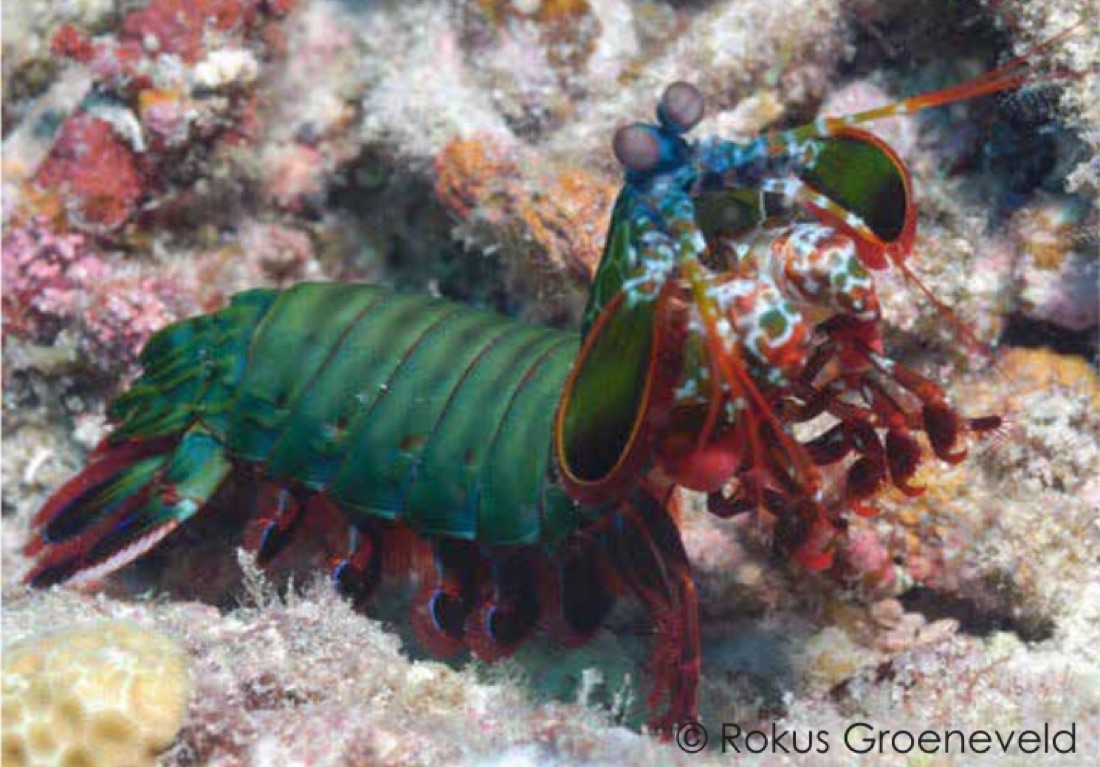
At a glance
Data from the scientific sources listed at the bottom.
Depth in the wild
1–30 m
Size
up to 17 cm
maximum total length
Conservation
IUCN Red List: not evaluated. Red List data taken from SeaLifeBase and GBIF. 2 12 It does not appear in the CITES lists checked on Species+. 11 SeaLifeBase reports its use in the aquarium trade. 2
Where it lives
Western Indo-Pacific. 2 WoRMS lists the Seychelles, Mayotte, the eastern and western Australian shelves, Japan, north-eastern New Zealand and the central Indo-Pacific. 1 Specimens studied also come from the coast of Fujian, in China. 13
How to recognise it
Tap a number on the photo: the key explains what to look for.
Life in the wild
What it eats
It preys on fish and invertebrates, such as snails, crabs and molluscs, which it strikes or spears with its two raptorial appendages. 3 SeaLifeBase also mentions slipper lobsters and the use of the appendages to smash hard-shelled prey. 2 The hammer-like appendages are suited to repeated impacts on heavily mineralised prey. 6
Behaviour
SeaLifeBase describes it as active by day and as the largest of the 'smasher' stomatopods. 2 Each strike produces two force peaks about 390-480 microseconds apart: the impact of the appendage and then the collapse of the cavitation bubbles. 5 The strike is so fast that it needs a saddle-shaped spring in the exoskeleton, which stores and releases energy. 4
Reproduction
The available data are general for the order: some species form lifelong pairs, others meet only to mate; females can brood up to 50,000 eggs, and the planktonic larva lasts about 3 months. 2
In the aquarium
From the experience of the BallingMania community.
Odontodactylus scyllarus (known in Italian as canocchia pavone and in English as peacock mantis shrimp) is a brightly coloured crustacean that lives on coral reefs and sandy flats in the Indo-Pacific. Its common name comes from the brilliant green and blue markings on the male's shell; females are colourful too, but mainly red. The peacock mantis shrimp is a powerful predator and feeds on invertebrates and small fish of every kind. It is known for its lightning-fast predatory strike, and to break the shells of its victims it uses its raptorial limbs like clubs, delivering deadly hooks; it uses this attack to completely dismember crabs, shrimp, snails and other crustaceans.
Peacock mantis shrimp are often stowaways in our aquariums, brought in inside live rock; they are very fast, very shy and active at night, so we will rarely manage to see them. If shrimp, snails and small fish start disappearing from our aquarium, and at night we hear 'clicks' coming from the tank, the cause of the mysterious disappearances is very probably a peacock mantis shrimp! So we will have to arm ourselves with patience and a trap to catch it.
good or bad? VERDICT:
Key: Good! An organism beneficial to the system. Reef Safe!
An organism whose benign or harmful nature is not yet known, to be kept an eye on.
Bad! The organism is a threat to the other inhabitants of the aquarium or could become a pest.
A food source for the other inhabitants of the aquarium.
A potentially toxic or venomous organism.
© Elias Levy
Did you know?
Sources
- WoRMS Editorial Board (2026). Odontodactylus scyllarus (Linnaeus, 1758). World Register of Marine Species.
- SeaLifeBase (2026). Odontodactylus scyllarus. SeaLifeBase.
- Kleinlogel S., Marshall N.J. (2009). Ultraviolet polarisation sensitivity in the stomatopod crustacean Odontodactylus scyllarus. Journal of Comparative Physiology A.
- Patek S.N., Korff W.L., Caldwell R.L. (2004). Biomechanics: deadly strike mechanism of a mantis shrimp. Nature.
- Patek S.N., Caldwell R.L. (2005). Extreme impact and cavitation forces of a biological hammer: strike forces of the peacock mantis shrimp Odontodactylus scyllarus. Journal of Experimental Biology.
- Weaver J.C. et al. (2012). The stomatopod dactyl club: a formidable damage-tolerant biological hammer. Science.
- Thoen H.H., How M.J., Chiou T.H., Marshall J. (2014). A different form of color vision in mantis shrimp. Science.
- Chiou T.H. et al. (2008). Circular polarization vision in a stomatopod crustacean. Current Biology.
- Poding L.H., Jägers P., Senen B., Limmon G.V., Herlitze S., Huhn M. (2024). New observations of fluorescent organisms in the Banda Sea and in the Red Sea. PLOS ONE.
- Alderete N.A. et al. (2025). Does the mantis shrimp pack a phononic shield?. Science.
- UNEP-WCMC (2026). Search for Odontodactylus scyllarus in the CITES lists. Species+.
- GBIF Secretariat (2026). Odontodactylus scyllarus, IUCN Red List category. GBIF.
- Duan X. et al. (2025). Whole-genome survey information revealed the genome characteristics, mitochondrial genome diversity and evolutionary patterns of Stomatopoda species. BMC Genomics.
Sources checked on 5 November 2026. Community texts and ratings are kept separate from the scientific data.