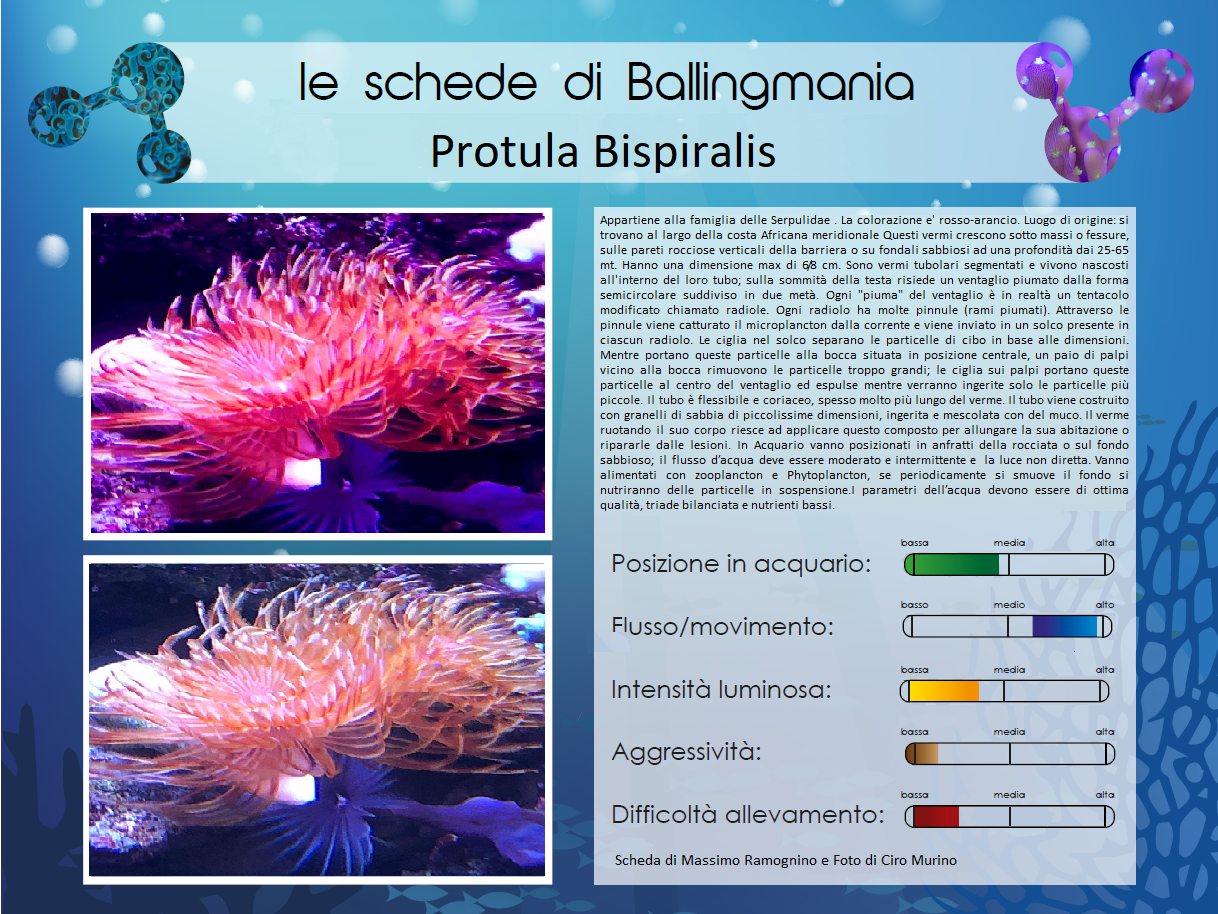
Protula bispiralis
A marine worm that lives fixed in a white calcareous tube and filters the water with a large crown of filaments arranged in a spiral. 3 4 2 It has no operculum, the plug that other similar worms use to close their tube. 3 5 The name today probably covers several species, which science has not yet separated. 3 4
At a glance
Data from the scientific sources listed at the bottom.
Depth in the wild
3–10 m
Size
up to 10 cm
body with tube, according to SeaLifeBase; a specimen measured in Hong Kong reached 7.9 cm
Conservation
IUCN Red List: not evaluated. SeaLifeBase reports no CITES listings 2 and a search for the name in Species+ gives no results. 6
Where it lives
Reported throughout the western Indo-Pacific; 2 3 WoRMS records it for the Indian Ocean. 1 There are also records from the Seychelles, Western Australia, Java, the Great Barrier Reef and Hong Kong. 3 4 However, a 2015 revision considers its real distribution unknown, precisely because the species needs revising. 4
How to recognise it
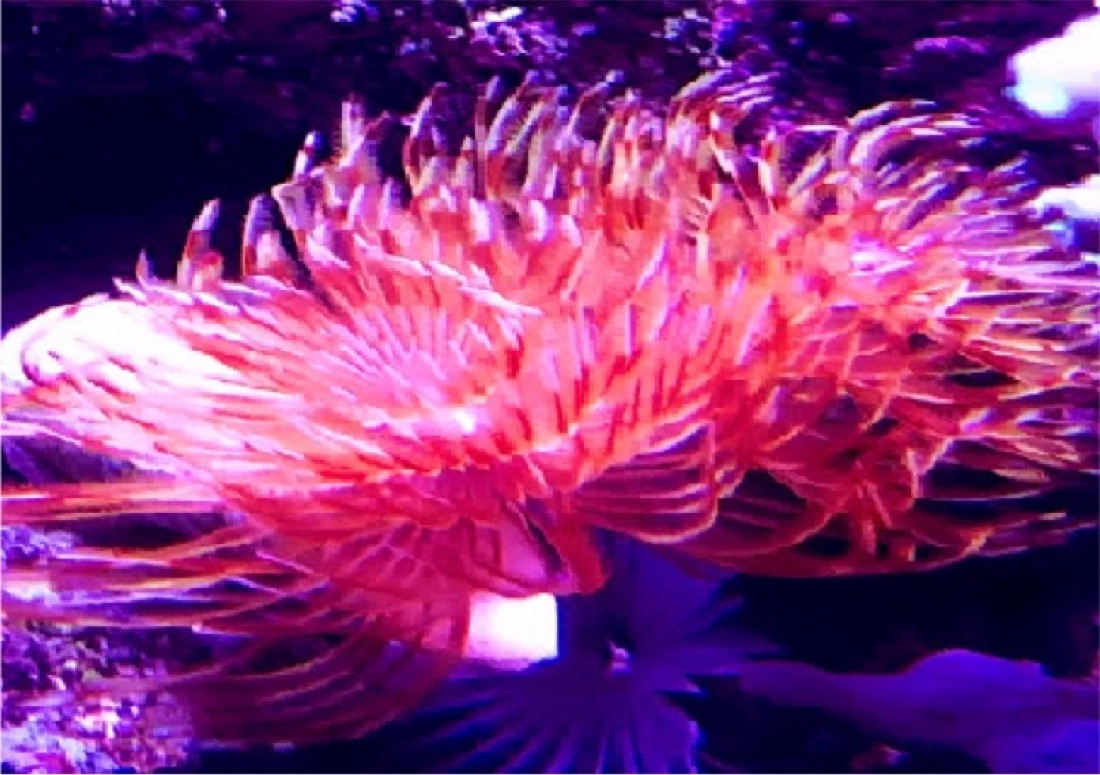
Tap a number on the photo: the key explains what to look for.
Life in the wild
In the aquarium
From the experience of the BallingMania community.
It belongs to the family Serpulidae. Its colour is reddish orange. Place of origin: they are found off the coast of southern Africa. These worms grow under boulders or in crevices, on the vertical rock walls of the reef or on sandy bottoms at a depth of 25-65 m. They reach a maximum size of 68 cm. They are segmented tube worms and live hidden inside their tube; on top of the head there is a semicircular feathery fan divided into two halves. Each "feather" of the fan is actually a modified tentacle called a radiole. Each radiole has many pinnules (feathery branches). Through the pinnules microplankton is caught from the current and sent into a groove in each radiole. Cilia in the groove sort the food particles by size. As they carry these particles to the centrally placed mouth, a pair of palps near the mouth remove particles that are too large; cilia on the palps carry these particles to the centre of the fan, where they are expelled, while only the smallest particles are swallowed. The tube is flexible and leathery, often much longer than the worm. The tube is built from very small grains of sand, swallowed and mixed with mucus. By rotating its body the worm manages to apply this mixture to lengthen its home or repair damage. In the aquarium they should be placed in crevices in the rockwork or on the sandy bottom; the water flow must be moderate and intermittent and the light indirect. They should be fed zooplankton and phytoplankton; if the bottom is stirred up periodically they will feed on the suspended particles. Water parameters must be of excellent quality, with balanced calcium, alkalinity and magnesium and low nutrients.
Species sheet by Massimo Ramognino and photo by Ciro Murino
Did you know?
Sources
- WoRMS Editorial Board (2026). Protula bispiralis (Savigny, 1822). World Register of Marine Species.
- SeaLifeBase (2026). Protula bispiralis. SeaLifeBase.
- Sun Y., ten Hove H.A., Qiu J.-W. (2012). Serpulidae (Annelida: Polychaeta) from Hong Kong: Protula bispiralis. Zootaxa.
- Kupriyanova E.K., Sun Y., ten Hove H.A., Wong E., Rouse G.W. (2015). Serpulidae (Annelida) of Lizard Island, Great Barrier Reef, Australia: Protula bispiralis. Zootaxa.
- Kupriyanova E.K., Sun Y., ten Hove H.A., Wong E., Rouse G.W. (2015). Serpulidae (Annelida) of Lizard Island, Great Barrier Reef, Australia: genere Protula. Zootaxa.
- UNEP-WCMC (2026). Search for Protula bispiralis in the CITES lists. Species+.
Sources checked on 5 November 2026. Community texts and ratings are kept separate from the scientific data.