
Sabellastarte sp.
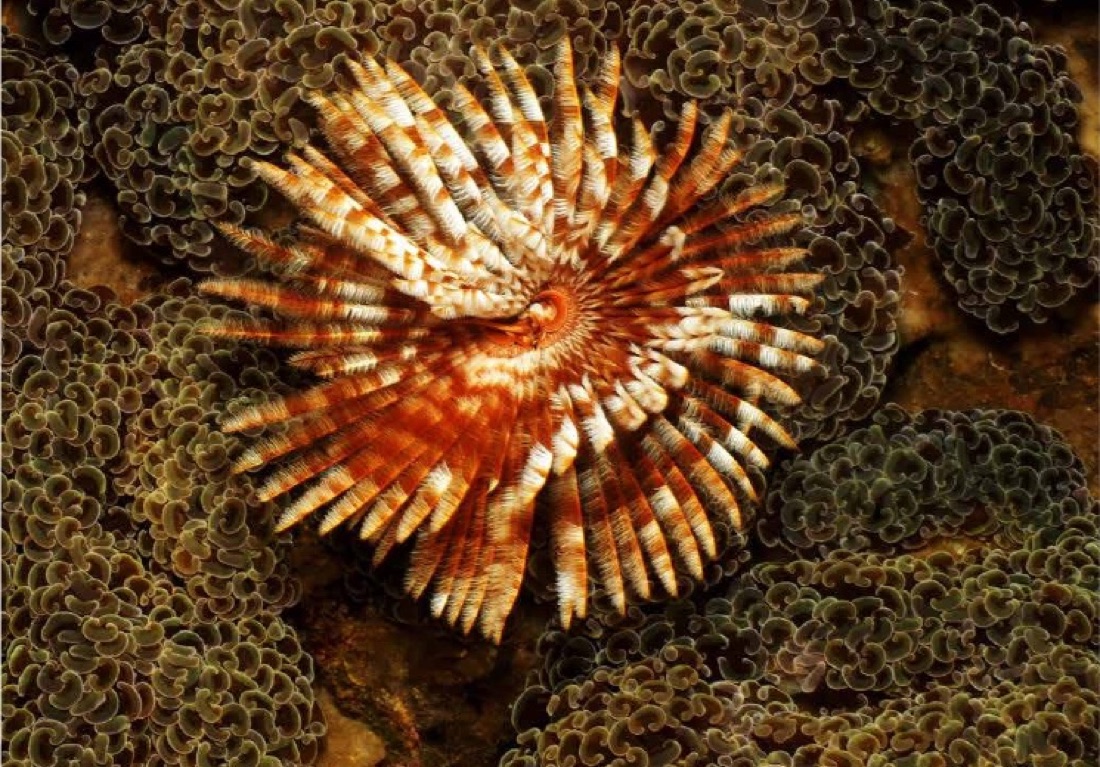
Sabellastarte is a genus of fan-shaped polychaete worms with eight accepted species, not a single species. 1 They live fixed inside a tube and hold out a crown of feathery filaments, the radioles, which they use to feed. 2 4 Telling the species apart is difficult: genetic studies point to at least six evolutionary lineages and perhaps species still without a name. 3
At a glance
Data from the scientific sources listed at the bottom.
Conservation
IUCN Red List: not evaluated. There is no assessment for S. spectabilis either. 5 In Hawaii it is among the most collected marine ornamental organisms: collection is difficult and can damage nearby corals. 4
Where it lives
The genus lives in the warm waters of the Indo-Pacific and the Caribbean. S. spectabilis is recorded from Mauritius to northern Australia, Indonesia, the Philippines, Japan, Taiwan and Hawaii; S. sanctijosephi from the Red Sea; S. samoensis from Samoa; S. magnifica from the Antilles. 2
How to recognise it
Tap a number on the photo: the key explains what to look for.
Life in the wild
Where it is found
Shallow water, on hard substrates. S. spectabilis does well among boulders and coral crevices above muddy bottoms, and has also been collected in harbours; in Indonesia it is documented between 3 and 16 m. 2 3 S. magnifica lives in coral crevices or on any hard surface, while S. sanctijosephi has not been found below 20 m. 2
Reproduction
Data only for S. spectabilis. In Hawaii the eggs, 150-200 micrometres, are released into the water: the larvae swim after 7-8 hours and settle on the bottom after 6-7 days. 4 There the species changes sex as it grows, from male to female, while in Micronesia it is reported as having separate sexes: this is why several species are suspected to be hiding under the same name. 3
In the aquarium
From the experience of the BallingMania community.
Tropical sabellids are native to the muddy bottoms of the Indian Ocean and the Red Sea, but in the aquarium they adapt to a coral sand bottom, as long as it is fine enough.
It is able to rebuild its tube (with the help of special glands) and enlarge it in diameter and length using the sediment that collects near the animal; inside it lives the polychaete, equipped with a sort of feathery "fan" made up of numerous comb-like processes called radioles. To feed, it extends the fan from the tube and, moving the radioles slowly and imperceptibly, creates a current that carries food particles into the mouth; then it withdraws the fan into its tube to digest the prey or to escape predators.
The most common species is certainly “Sabellastarte indica”, fairly similar to the Mediterranean Spirograph but smaller; in fact the diameter of the fully expanded crown is about 5/10 cm and that of the tube about 1/2 cm. The colour of the so-called “FAN” varies, with speckled shades tending towards the following tones: brick red, white, black, light blue and orange.
This polychaete needs fair but not excessive water movement and feeds on phytoplankton and larval-stage zooplankton, but once acclimatised in the tank it adapts to all the foods recommended for plankton feeders.
top photo Rob Bray - bottom photo Sarah Faulwetter · Species sheet written by: Ciro Murino
What studies say about keeping it
A study in Hawaii kept S. spectabilis in 57-litre tanks with running water, at 27 °C and salinity 36: after spawning the larvae settled, but many died, and the surviving juveniles lasted no more than about three months, with a tube 1 mm wide. 4
Did you know?
Sources
- Read G., Fauchald K. (eds.) (2026). Sabellastarte Krøyer, 1856. World Polychaeta Database, via WoRMS.
- Knight-Jones P., Mackie A.S.Y. (2003). A revision of Sabellastarte (Polychaeta: Sabellidae). Journal of Natural History 37(19), via Plazi.
- Tovar-Hernández M.A., ten Hove H.A., Vinn O., Zatoń M., de León-González J.A., García-Garza M.E. (2020). Fan worms (Annelida: Sabellidae) from Indonesia collected by the Snellius II Expedition (1984) with descriptions of three new species and tube microstructure. PeerJ 8:e9692.
- Bybee D.R., Bailey-Brock J.H., Tamaru C.S. (2006). Larval development of Sabellastarte spectabilis (Grube, 1878) (Polychaeta: Sabellidae) in Hawaiian waters. Scientia Marina 70S3.
- Palomares M.L.D., Pauly D. (eds.) (2026). Sabellastarte spectabilis (Grube, 1878). SeaLifeBase.
Sources checked on 5 November 2026. Community texts and ratings are kept separate from the scientific data.