
Pyramidellidae sp.
Pyramidellidae is a family of small sea snails with more than 6,000 known species, all external parasites of other invertebrates, mainly molluscs and polychaete worms. 1 2 Many species prefer a particular host, and some damage bivalve farms, including giant clams. 3 5
At a glance
Data from the scientific sources listed at the bottom.
Conservation
IUCN Red List: not evaluated.
Where it lives
It is a very rich and little-studied family: in Moreton Bay, in Australia, many species are estimated to be still unrecorded or undescribed. 6 A 2019 revision tripled the number of known species in northern Argentine Patagonia. 2 According to a giant clam farming manual, almost everywhere giant clams live there are also parasitic or predatory snails of some kind. 5
How to recognise it
Tap a number on the photo: the key explains what to look for.
Life in the wild
Behaviour
They can gather in groups: the species Boonea impressa, a parasite of oysters, usually has 5 to 40 individuals per oyster, with a recorded maximum of 100. 3
Reproduction
In the species that infest giant clams, according to the farming manual, the larvae do not pass through the plankton: they hatch already as small snails where they were laid, and the snails reproduce every 90-120 days. 5
In the aquarium
From the experience of the BallingMania community.
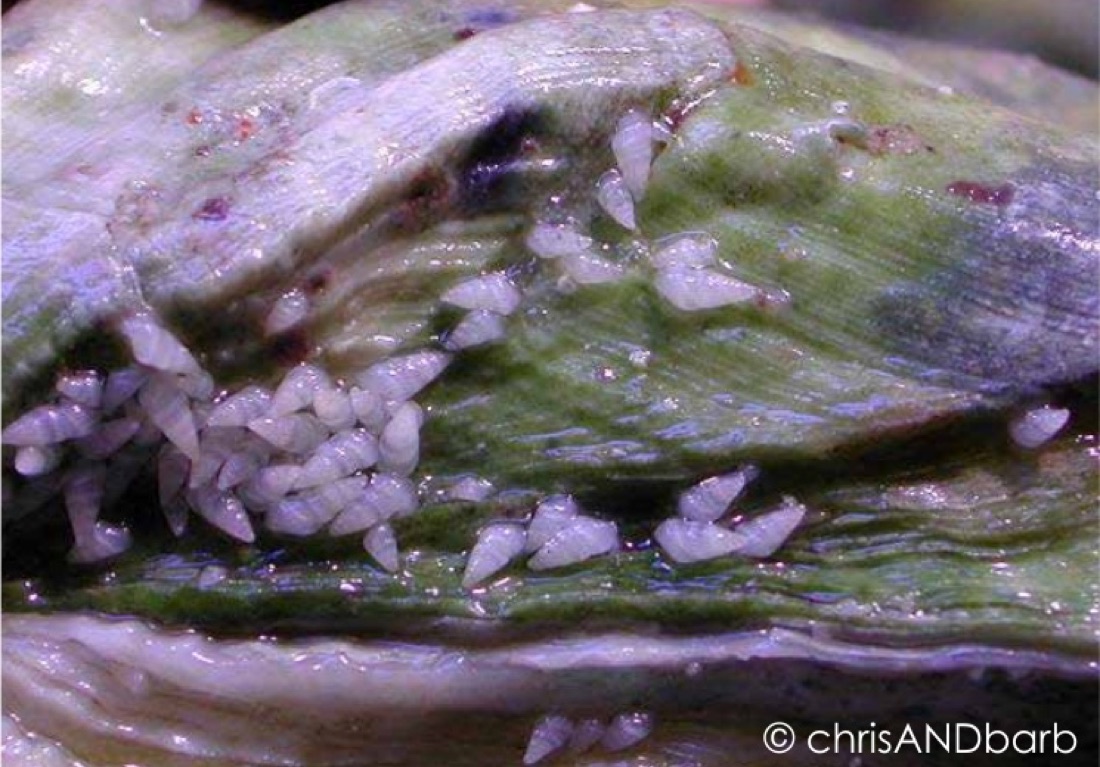
These tiny snails have a pyramid-shaped shell, are generally white and grow no bigger than a few millimetres. Although very small, they can cause a lot of trouble in our aquariums, and in particular for all the molluscs we keep in the tank (snails, giant clams, etc.); in fact, despite their tiny size, they use their proboscis, which is simply their tube-shaped mouth, to pierce the mantle of giant clams and feed on their fluids and zooxanthellae. The snails reproduce every 90-120 days and, if they find a favourable environment, they can multiply out of control and cause serious damage or the death of their host in a very short time.
They are active at night, while by day they stay attached to the base of the host's shell or inside it, which is why they are very hard to spot. If seen, they should be physically removed with tweezers into a separate container of salt water, and the whole shell of the affected mollusc (giant clam, Turbo snail, etc.) should be brushed with a toothbrush to remove any eggs. The natural predators of these terrible little snails are Halichoeres melanurus, Halichoeres chrysus or Pseudocheilinus hexataenia.
.
good or bad?
VERDICT:
Key: Good! An organism beneficial to the system. Reef Safe!
An organism whose benign or harmful nature is not yet known, to be kept an eye on.
Bad! The organism is a threat to the other inhabitants of the aquarium or could become a pest.
A food source for the other inhabitants of the aquarium.
A potentially toxic or venomous organism.
© chrisANDbarb · © Chuck Jordan
What studies say about keeping it
In giant clam farming in land-based tanks or in sea enclosures, a manual names Pyramidellidae and Ranellidae snails as the most serious health risk, especially for small or young giant clams such as T. maxima and T. crocea. 5 Because the young hatch on the spot, an infestation can grow very quickly; farmers keep it in check by taking out and thoroughly cleaning the clams every three months, to break the breeding cycle. 5 A Turbonilla species is documented as a parasite of giant clams. 3
Did you know?
Sources
- MolluscaBase eds. (2026). Pyramidellidae J. E. Gray, 1840. World Register of Marine Species.
- Güller, Zelaya (2019). Revision of Pyramidellidae (Gastropoda: Heterobranchia) from Argentina triples their diversity in northern Patagonia. Journal of Molluscan Studies 85(1).
- Carroll J.M., Finelli C.M. (2015). Impacts of the ectoparasitic snail Boonea impressa on growth of postset juvenile oysters. Journal of Molluscan Studies 81(1): 161-163.
- Fretter V., Graham A. (1949). The structure and mode of life of the Pyramidellidae, parasitic opisthobranchs. Journal of the Marine Biological Association of the United Kingdom 28(2): 493-532.
- Ellis S. (2002). Spawning and early larval rearing of giant clams (Bivalvia: Tridacnidae). Center for Tropical and Subtropical Aquaculture, pubblicazione n. 130.
- Healy J.M., Potter D.G., Carless T.A. (2010). Preliminary checklist of the marine gastropods (Mollusca: Gastropoda) of Moreton Bay, Queensland. Memoirs of the Queensland Museum - Nature 54(3).
Sources checked on 5 November 2026. Community texts and ratings are kept separate from the scientific data.