
Mithrax sculptus
Currently accepted name: Mithraculus sculptus
A small herbivorous crab from the tropical western Atlantic, now called Mithraculus sculptus: 'Mithrax sculptus' is the old name. 1 2 It lives among corals, rocks, algae and shallow seagrass beds, and in the wild it cleans algae off the corals and calcareous algae it shelters in. 2 5 6 It is widely traded for the aquarium. 7
At a glance
Data from the scientific sources listed at the bottom.
Depth in the wild
0–15 m
Size
up to 2.7 cm
carapace width of the largest specimen examined in a 1990 revision, an adult male 2.3 cm long [2]
Conservation
IUCN Red List: not evaluated. SeaLifeBase reports no assessments for either the Red List or CITES. 3 The species is widely traded for the marine aquarium. 7
Where it lives
Florida, the Bahamas, the Gulf of Mexico, the Caribbean and the Antilles, as far as Colombia, Venezuela, Suriname and Brazil. 2 SeaLifeBase gives São Paulo as the southern limit. 3
How to recognise it
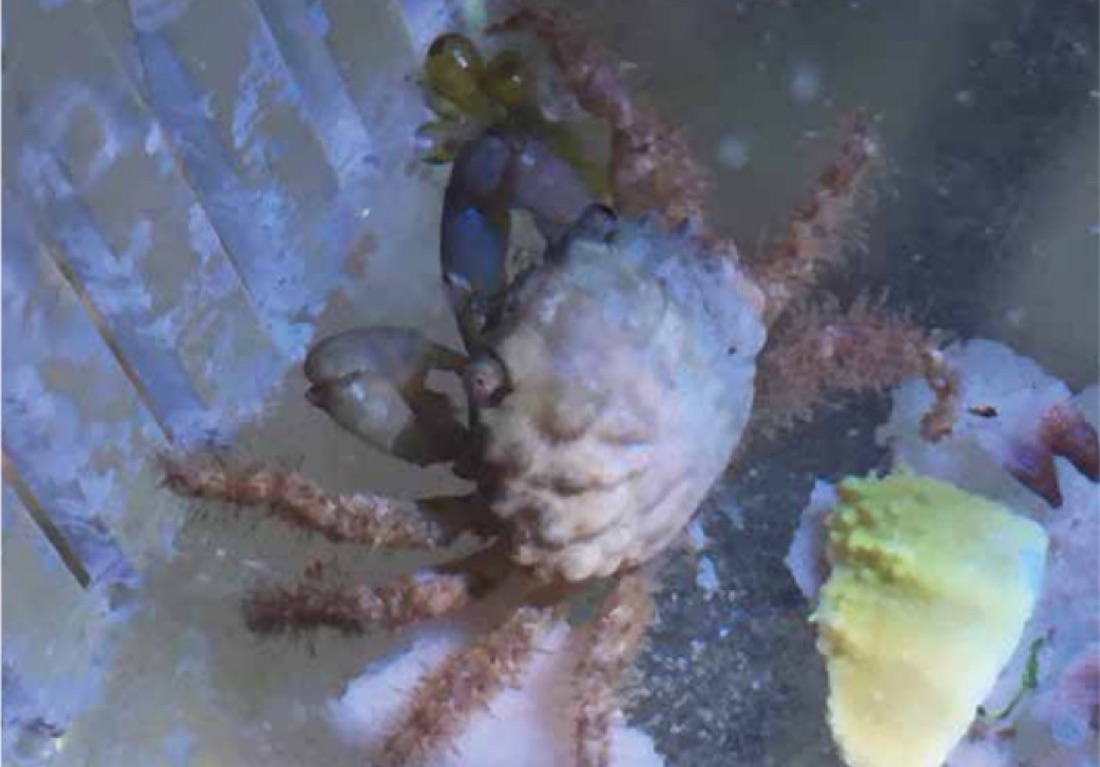
Tap a number on the photo: the key explains what to look for.
Life in the wild
Where it is found
Shallow water: most of the specimens examined by Wagner with a stated depth come from less than 2 m, the deepest from 15 m, on bottoms with rocks, coral rubble, sand, algae, seagrasses (Thalassia, Syringodium) and mangroves. 2 It also lives among the branches of Acropora cervicornis and Porites, with sponges and near anemones. 2 3 WoRMS gives hard bottoms and classes it among shallow-water species (0-100 m), while SeaLifeBase goes down to 55 m. 1 3
What it eats
It eats algae, with spoon-shaped claws suited to fleshy and filamentous algae. 4 In the wild it also eats algae that fish avoid because they have chemical defences, such as Halimeda, Dictyota and Laurencia. 5 In Belize it removes mainly Dictyota from corals. 6 If it has other food, it often chooses that first: in a trial it preferred prepared foods to the bubble alga Valonia ventricosa. 4
In the aquarium
From the experience of the BallingMania community.
Native to the Caribbean Sea and the Gulf of Mexico. It is widespread around the Bahamas and southern Florida, and also in northern Brazil.
This crab is one of the few invertebrates that feed on Valonia algae, but if there is none it does not refuse granular and/or flake foods, or frozen ones.
During the day it will be fairly hard to see in the tank, because it prefers to hide in the recesses of its den.
It is a crab with a peaceful temperament towards fish and other crustaceans and does not nip the polyps of corals of any order or kind.
Mithrax can be kept in groups, and in that case you will see that each one hides in its own crevice/den. It is advisable to keep more females than males; the male can be told apart by its larger carapace and claws; in addition, the shape of its abdomen is a pointed triangle, while that of the female is a rounded shield.
photo by: Ciro Murino
What studies say about keeping it
Data from aquaculture and laboratory studies, not advice for a home aquarium. In a trial, medium and large crabs ate more bubble alga than small ones. They chose prepared foods first (pellets in 77% of cases, frozen mysids in 69%), and with pellets their consumption of the alga fell: the authors doubt it is such an effective control. 4 Starved larvae do not get past the first stage; with Artemia nauplii, enriched or not, only 19-26% reached the juvenile crab stage, far fewer than M. forceps. 7
Did you know?
Sources
- DecaNet (2026). Mithraculus sculptus (Lamarck, 1818). World Register of Marine Species.
- Wagner H.P. (1990). The genera Mithrax Latreille, 1818 and Mithraculus White, 1847 (Crustacea: Brachyura: Majidae) in the western Atlantic Ocean. Zoologische Verhandelingen, Naturalis.
- Palomares M.L.D., Pauly D. (eds.) (2026). Mithraculus sculptus. SeaLifeBase.
- Figueiredo J., Narciso L., Turingan R., Lin J. (2008). Efficiency of using emerald crabs Mithraculus sculptus to control bubble alga Ventricaria ventricosa (syn. Valonia ventricosa) in aquaria habitats. Journal of the Marine Biological Association of the United Kingdom.
- Stachowicz J.J., Hay M.E. (1996). Facultative mutualism between an herbivorous crab and a coralline alga: advantages of eating noxious seaweeds. Oecologia.
- Coen L.D. (1988). Herbivory by crabs and the control of algal epibionts on Caribbean host corals. Oecologia.
- Rhyne A.L., Penha-Lopes G., Lin J. (2005). Growth, development, and survival of larval Mithraculus sculptus (Lamark) and Mithraculus forceps (A. Milne Edwards) (Decapoda: Brachyura: Majidae): economically important marine ornamental crabs. Aquaculture.
- Rhyne A.L., Fujita Y., Calado R. (2006). Larval development and first crab of Mithraculus sculptus (Decapoda: Brachyura: Majoidea: Mithracidae) described from laboratory-reared material. Journal of the Marine Biological Association of the United Kingdom.
Sources checked on 5 November 2026. Community texts and ratings are kept separate from the scientific data.