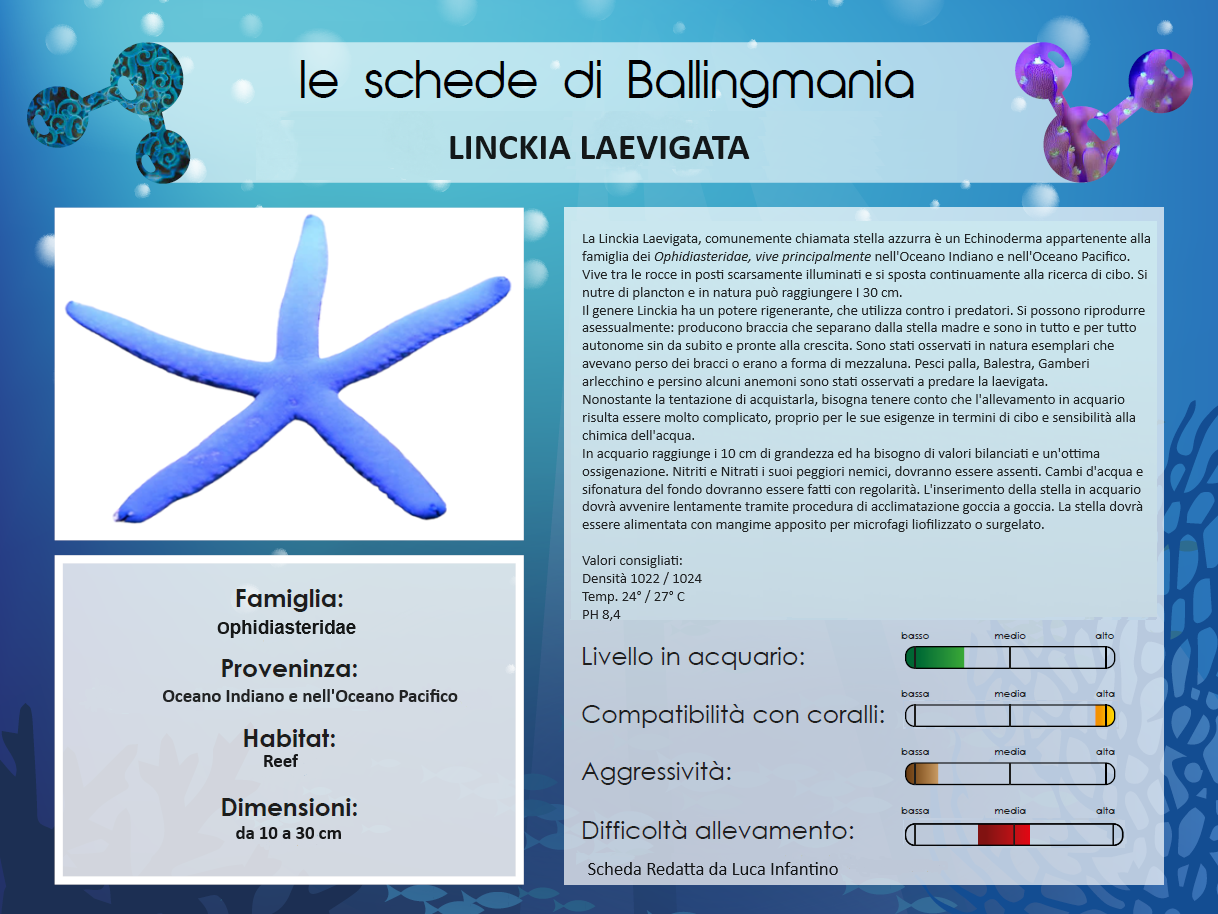
Linckia laevigata
A sea star with five cylindrical arms, usually a deep blue, common on the shallow coral reefs of the Indo-Pacific. 1 3 6 Adults measure 25-30 cm 5 and feed on encrusting algae, detritus and dead animals. 2 4 At the tip of each arm it has a small eye, which it uses to find its way back to the reef. 5
At a glance
Data from the scientific sources listed at the bottom.
Depth in the wild
0–60 m
Size
up to 30 cm
usual adult diameter (25-30 cm); SeaLifeBase gives up to 40 cm
Conservation
IUCN Red List: not evaluated. It is not assessed in the CITES and CMS lists either. 2 3 Studies find populations made up almost entirely of adults, with few new juveniles, so natural turnover seems slow. 3 4
Where it lives
Tropical Indo-Pacific, from the east coast of Africa to Hawaii; 1 to the east it reaches south-eastern Polynesia. 6 WoRMS also records it in the Red Sea, Madagascar, the Seychelles, South Africa and New Caledonia. 1 Genetic studies distinguish four groups of populations: the western Indian Ocean, the eastern Indian Ocean, the Indo-Malay and Philippine archipelago, and the western Pacific. 6
How to recognise it
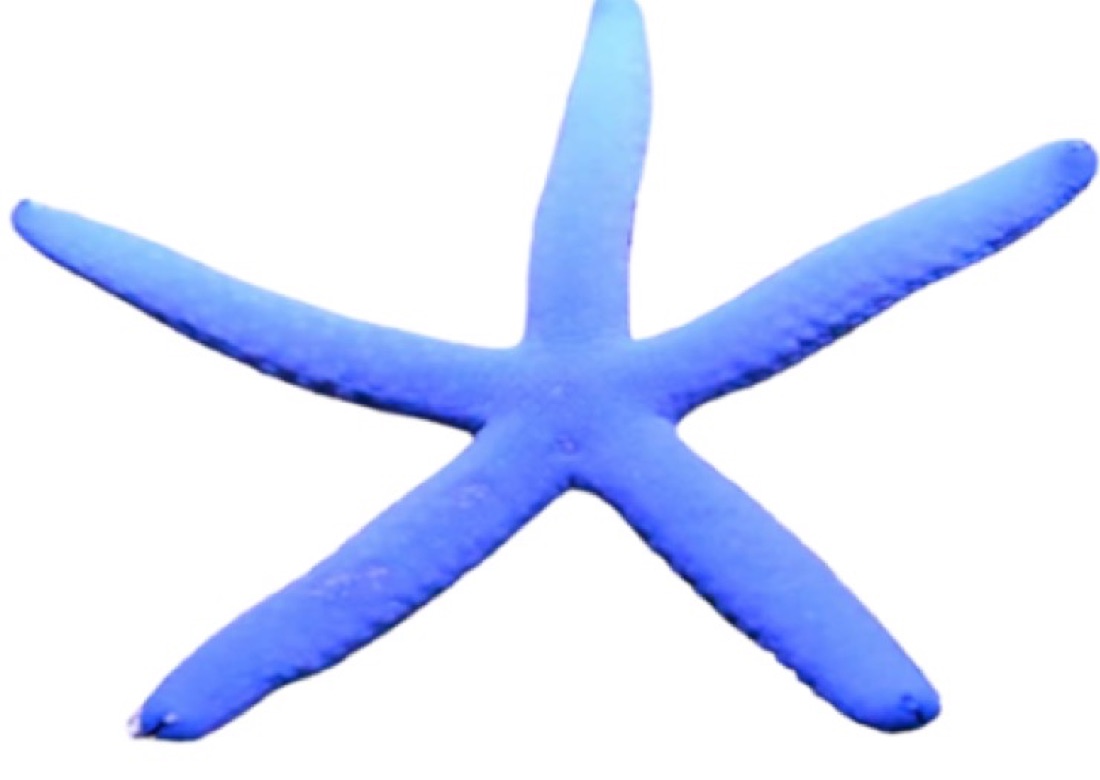
Tap a number on the photo: the key explains what to look for.
Life in the wild
Where it is found
Shallow, sunlit coral reefs: reef flats, rocks, dead coral and rubble, slopes, seagrass beds and stretches with sponges and algae. 2 6 Juveniles stay hidden under corals and rocks. 2 The sources give a depth of 0-60 m; 1 2 according to Animal Diversity Web it lives in water at about 22-26 °C and is sensitive to changes in temperature, oxygen and pH. 3
Behaviour
It moves alone and slowly, on average 4-5 cm a minute. 5 With the eyes at the tips of its arms it can make out the dark outline of the reef up to about 2 m away and return to it; without eyes, or on moonless nights, it moves at random. 5 It can shed an arm to escape a predator and then regenerate it. 3 Its predators include pufferfish, tritons (Charonia), harlequin shrimp (Hymenocera) and anemones. 3
Reproduction
It has separate sexes, which look the same from the outside. 3 It releases eggs and sperm into the water and fertilisation takes place outside the body. 6 In Guam it breeds mainly from May to August, 6 while on the southern Great Barrier Reef it spawns in October. 4 The larva lives in the plankton for at least 22 days before changing form. 6 Animal Diversity Web also reports asexual reproduction by division of the disc, and maturity at about two years. 3
In the aquarium
From the experience of the BallingMania community.
Linckia laevigata, commonly called the blue star, is an echinoderm belonging to the family Ophidiasteridae; it lives mainly in the Indian Ocean and the Pacific Ocean. It lives among rocks in poorly lit places and moves constantly in search of food. It feeds on plankton and in the wild can reach 30 cm.
The genus Linckia has regenerative powers, which it uses against predators. They can reproduce asexually: they produce arms that separate from the mother star and are fully independent right away and ready to grow. Specimens that had lost arms or were crescent-shaped have been observed in the wild. Pufferfish, triggerfish, harlequin shrimp and even some anemones have been observed preying on laevigata.
Despite the temptation to buy it, bear in mind that keeping it in an aquarium is very complicated, precisely because of its food requirements and its sensitivity to water chemistry.
In the aquarium it reaches 10 cm in size and needs balanced values and excellent oxygenation. Nitrite and nitrate, its worst enemies, must be absent. Water changes and siphoning of the bottom must be done regularly. The star must be introduced into the aquarium slowly using drip acclimatisation. The star must be fed special freeze-dried or frozen food for microphagous animals.
Recommended values:
Specific gravity 1.022 / 1.024 Temp. 24° / 27° C pH 8.4
Species sheet written by Luca Infantino
Did you know?
Sources
- Mah C.L. (World Asteroidea Database), via WoRMS (2026). Linckia laevigata (Linnaeus, 1758). World Register of Marine Species.
- Palomares M.L.D., Pauly D. (eds.) (2026). Linckia laevigata, Blue linckia. SeaLifeBase.
- Baptiste M., Jakimovski I.; Howe D.V., Mulcrone R. (eds.) (2011). Linckia laevigata, Blue Sea Star. Animal Diversity Web, University of Michigan.
- Laxton J.H. (1974). A preliminary study of the biology and ecology of the blue starfish Linckia laevigata (L.) on the Australian Great Barrier Reef and an interpretation of its role in the coral reef ecosystem. Biological Journal of the Linnean Society 6(1): 47-64.
- Garm A., Nilsson D.-E. (2014). Visual navigation in starfish: first evidence for the use of vision and eyes in starfish. Proceedings of the Royal Society B 281: 20133011.
- Otwoma L.M., Kochzius M. (2016). Genetic Population Structure of the Coral Reef Sea Star Linckia laevigata in the Western Indian Ocean and Indo-West Pacific. PLoS ONE 11(10): e0165552.
Sources checked on 5 November 2026. Community texts and ratings are kept separate from the scientific data.