
At a glance
Data from the scientific sources listed at the bottom.
Conservation
IUCN Red List: not evaluated.
Life in the wild
In the aquarium
From the experience of the BallingMania community.
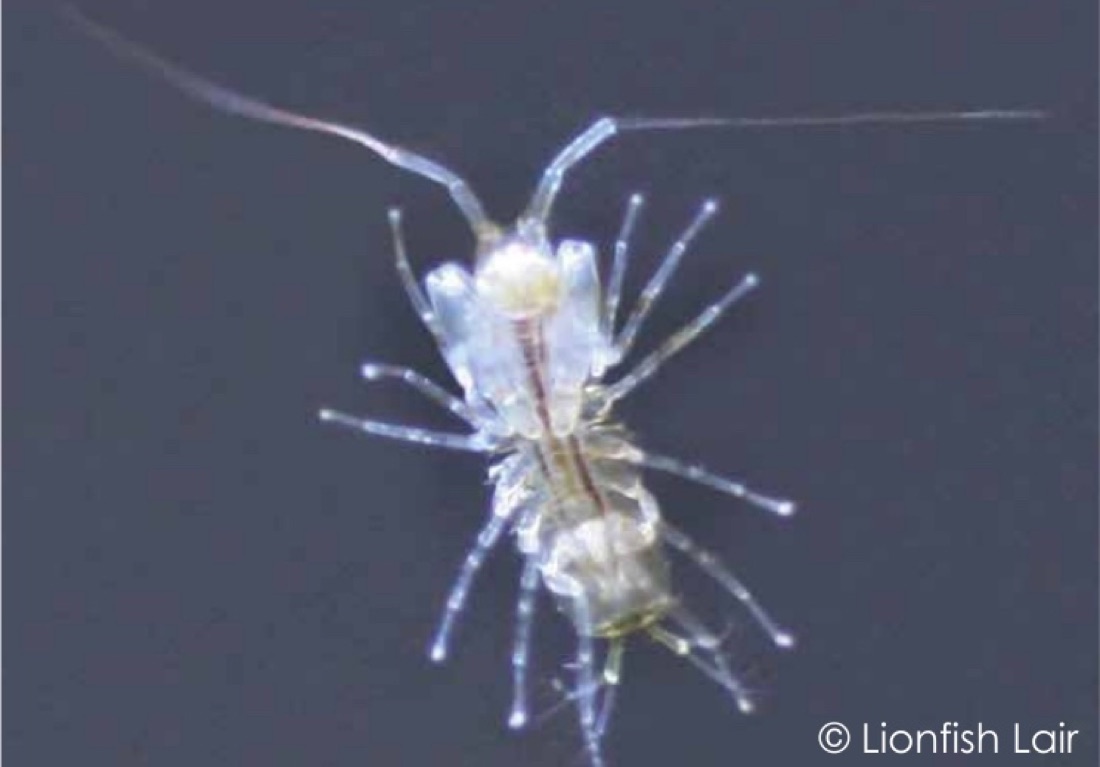
The isopod family is very large: some species are predators, while other species are fairly harmless and are considered useful within the aquarium ecosystem. Isopoda munnidae is herbivorous and feeds on phytoplankton and microalgae; it can often be seen sitting on the rocks, on algae and above all on the glass near the water surface. It is a tiny crustacean a few millimetres long and looks very much like a white ant.
This isopod is a food source for many fish, especially wrasses and mandarinfish, but also for corals, which catch them with their polyps.
good or bad?
VERDICT:
Key: Good! An organism beneficial to the system. Reef Safe!
An organism whose benign or harmful nature is not yet known, to be kept an eye on.
Bad! The organism is a threat to the other inhabitants of the aquarium or could become a pest.
A food source for the other inhabitants of the aquarium.
A potentially toxic or venomous organism.
© Lionfish Lair · © Lionfish Lair
Did you know?
Sources
- Boyko C.B., Bruce N.L., Campos-Filho I.S., Hadfield K.A., Hughes T., Merrin K.L., Ota Y., Poore G.C.B. (eds.) (2026). Munnidae G. O. Sars, 1897. World Marine, Freshwater and Terrestrial Isopod Crustaceans database, via WoRMS.
- Poore G.C.B. (1984). Redefinition of Munna and Uromunna (Crustacea: Isopoda: Munnidae), with descriptions of five species from coastal Victoria. Proceedings of the Royal Society of Victoria 96(2).
- Fresi E., Mazzella L. (1974). The genus Munna Krøyer (Isopoda: Asellota) in the Island of Ischia. Pubblicazioni della Stazione Zoologica di Napoli 39.
- Khalaji-Pirbalouty, Al-Kandari (2024). Uromunna alyamanii sp. nov.. Plazi TreatmentBank.
- Palomares M.L.D., Pauly D. (eds.) (2026). Munna petronastes Kensley, 1984. SeaLifeBase.
Sources checked on 5 November 2026. Community texts and ratings are kept separate from the scientific data.