
Lysmata amboinensis
Pacific cleaner shrimp
A small shrimp from Indo-Pacific coral reefs, recognisable by the red and white bands along its body and its long white antennae. 1 3 It feeds largely by cleaning fish of parasites and dead tissue. 3 10 As an adult it is a hermaphrodite: the same individual produces both eggs and sperm. 3
At a glance
Data from the scientific sources listed at the bottom.
Size
up to 6 cm
maximum length
Temperature in the wild
25–30 °C
Conservation
IUCN Red List: not evaluated. Not evaluated by the IUCN Red List. 2 9 10 It does not appear in the CITES lists checked on Species+. 8 It is in high demand in the aquarium trade, and demand is met mainly by wild-caught specimens. 3
Where it lives
Indo-Pacific. 1 2 Recorded in Réunion, Mayotte, New Caledonia and French Polynesia, 1 in Indonesia, Sri Lanka and the Red Sea. 3 Cleaning stations of this species have been studied at Eilat, in the Red Sea. 4
How to recognise it
Tap a number on the photo: the key explains what to look for.
Life in the wild
Where it is found
It lives on the bottom, tied to coral reefs, in shallow and sheltered areas near the coast; it is found mostly in caves and crevices. It needs shelter especially during moulting, when it is more exposed to predators. 2 3 SeaLifeBase reports a very wide range, from 1 to 120 m, taken from a species list. 2
Behaviour
It occupies a cleaning station on coral or rock and waits for fish. 10 At Eilat it cleaned predatory fish less often (0.28 of interactions) than non-predatory fish (0.51), and with predators it much more often made a rocking movement of its legs (0.51 against 0.12). 4 It moults every 3-8 weeks. 3
Reproduction
A hermaphrodite: juveniles function as males, then become individuals with mixed gonads that produce both eggs and sperm. It cannot self-fertilise or store sperm, so two individuals are needed. Each spawning counts from a few hundred to 2,000 eggs, carried under the abdomen for 10-15 days. 3 After hatching, the larvae live in the plankton, go through ten zoea stages and one decapodid stage 7 and take about 5-6 months to become juveniles. 3
In the aquarium
From the experience of the BallingMania community.
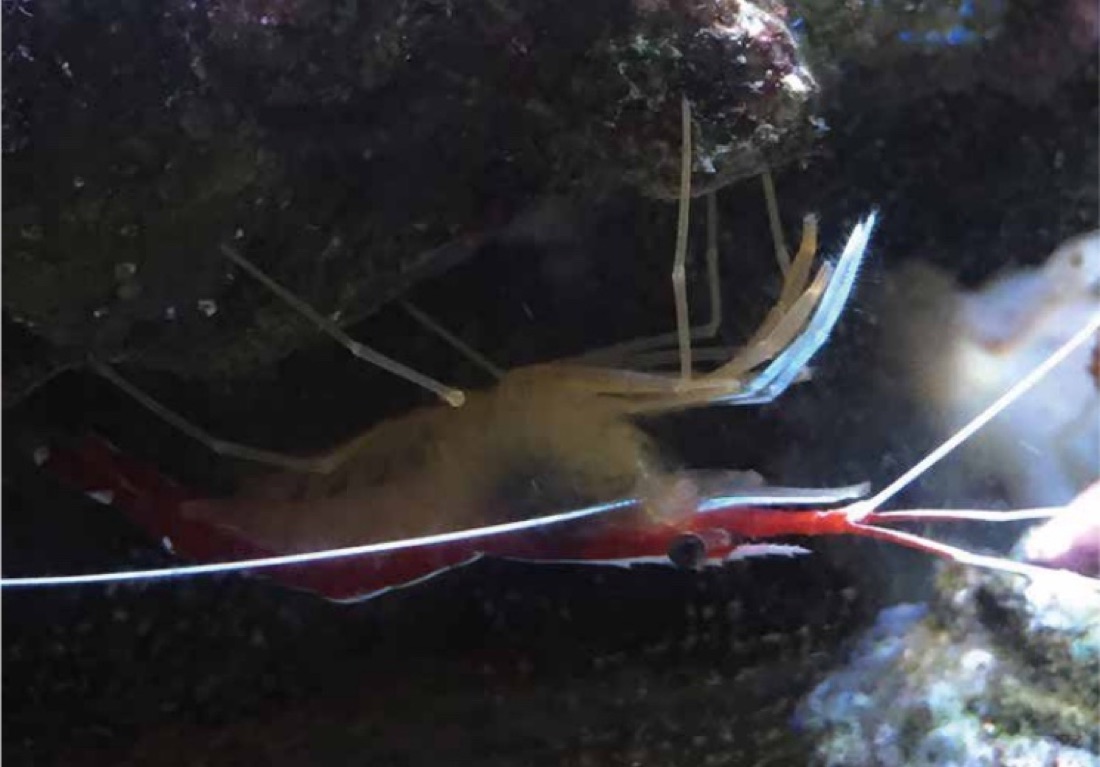
This magnificent decapod crustacean belongs to the family Hippolidae and is native to the tropical Indo-Pacific and the Red Sea. Its striking livery is yellow/cream, with two deep red lengthwise stripes on the back framing a white stripe; the rostrum is deep red, the eyes are black and the antennae are white. It is a shrimp of about 5 cm that lives in groups of dozens of individuals inside caves and crevices of the coral reef, in waters between 5 and 35 metres deep.
This shrimp is sometimes confused with Lysmata grabhami, but a few distinctive differences can be seen by looking closely at the white stripe on the back: in Lysmata grabhami it continues all the way to the tail. Young individuals are males, but as they grow they become hermaphrodites. Breeding in the aquarium is possible, but raising the tiny larvae to adulthood is very difficult. In the wild Lysmata amboinensis forms so-called “cleaning stations”, cleaning fish of parasites, but in the aquarium it willingly accepts flake and granular food as well as frozen food. It is a shrimp with few natural enemies and it is not preyed on by fish of the family Balistidae.
photo by: Ciro Murino
What studies say about keeping it
Data from aquaculture studies, not advice for a home aquarium. In a test with ornamental fish (Pseudanthias squamipinnis) the presence of the shrimp halved the successful infections by larvae of the parasite Neobenedenia. 5 In breeding facilities the broodstock were fed mussels, polychaetes and Artemia nauplii. In a study in Mexico the average was 575 larvae per spawning. The larval phase, up to 140 days long, and the low survival remain the main problem; the larvae were reared with microalgae, rotifers and then Artemia or nematodes. 3
Did you know?
Sources
- DecaNet (2026). Lysmata amboinensis (De Man, 1888). World Register of Marine Species.
- SeaLifeBase (2026). Lysmata amboinensis. SeaLifeBase.
- Santhosh B., Anil M.K., Xavier B. (2017). Lysmata amboinensis (de Man, 1888), in Prioritized Species for Mariculture in India. ICAR - Central Marine Fisheries Research Institute.
- Caves E.M., Chen C., Johnsen S. (2019). The cleaner shrimp Lysmata amboinensis adjusts its behaviour towards predatory versus non-predatory clients. Biology Letters.
- Militz T.A., Hutson K.S. (2015). Beyond Symbiosis: Cleaner Shrimp Clean Up in Culture. PLoS ONE.
- Caves E.M., Davis A.L., Johnsen S. (2024). Nanoscale ultrastructures increase the visual conspicuousness of signalling traits in obligate cleaner shrimps. Journal of Experimental Biology.
- De Sousa L.F., Marques D., Leandro S.M., Santos A.D. (2022). Description of the complete larval development of Lysmata amboinensis (De Man) (Decapoda: Lysmatidae) reared under laboratory conditions. Zootaxa.
- UNEP-WCMC (2026). Search for Lysmata amboinensis in the CITES lists. Species+.
- GBIF Secretariat (2026). Lysmata amboinensis, IUCN Red List category. GBIF.
- Aquarium of the Pacific (2026). Pacific Cleaner Shrimp. Aquarium of the Pacific.
Sources checked on 4 November 2026. Community texts and ratings are kept separate from the scientific data.