
Isopoda cirolanidae
Cirolanidae are a family of isopods with more than 60 genera and about 540 accepted species. 1 They live on the bottom as opportunistic predators and scavengers: they attach to fish only for a meal, but in some cases they can kill them. 2 They are not the parasites that stay fixed on the fish: those belong to the Cymothoidae. 3
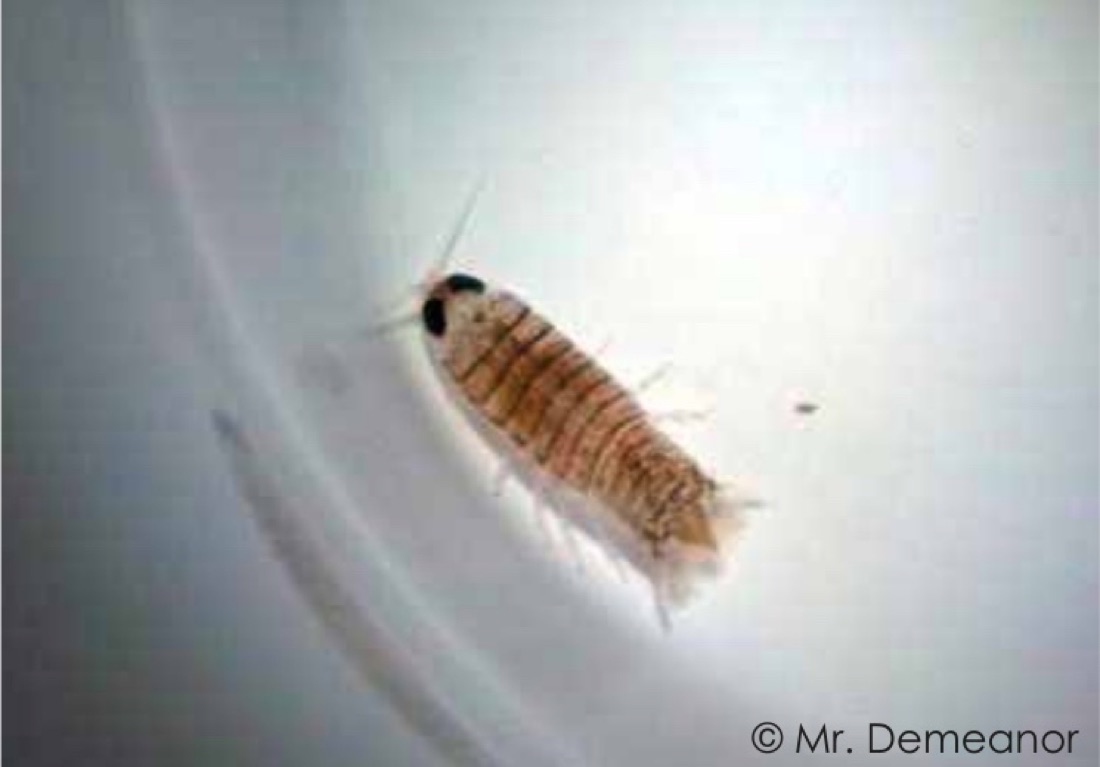
At a glance
Data from the scientific sources listed at the bottom.
Conservation
IUCN Red List: not evaluated.
How to recognise it
Tap a number on the photo: the key explains what to look for.
Life in the wild
What it eats
Opportunistic predators and scavengers: they are caught with bait, in traps and on fish in nets. 2 Few studies actually describe how they feed, especially on live fish; some genera do not enter baited traps and seem less given to scavenging. 2 Natatolana borealis is an omnivorous scavenger that attacks dying or dead fish and assimilates over 90% of the fish flesh. 4
Reproduction
Like other isopods, females keep their eggs in a brood pouch; a juvenile form called a manca hatches from the egg and then becomes an adult. 6
In the aquarium
From the experience of the BallingMania community.
A tiny crustacean belonging to the isopod family (Isopoda), a very large family numbering more than 10,000 species. Although some are harmless (they feed on algae), most are predators, and this extends to parasitism of fish and shrimp. They attach themselves like ticks to their prey and eat it slowly (eventually leading to its death). They can be removed physically from the host they are attached to with tweezers; obviously this must be done as gently as possible to avoid stress and accidental injury to the infested fish or shrimp. They must absolutely be removed if spotted in the tank.
good or bad?
VERDICT:
Key: Good! An organism beneficial to the system. Reef Safe!
An organism whose benign or harmful nature is not yet known, to be kept an eye on.
Bad! The organism is a threat to the other inhabitants of the aquarium or could become a pest.
A food source for the other inhabitants of the aquarium.
A potentially toxic or venomous organism.
© Mr. Demeanor · © Tristan Reynolds
What studies say about keeping it
No studies in reef aquariums are known. On a cage farm in India, between November 2006 and May 2007, Cirolana fluviatilis caused heavy losses among juvenile Asian sea bass 8-12 cm long: 35% in the first two months and 45% over six months, with fish reduced to skeletons. 7
Did you know?
Sources
- Boyko C.B., Bruce N.L., Campos-Filho I.S., Hadfield K.A., Hughes T., Merrin K.L., Ota Y., Poore G.C.B. (eds.) (2026). Cirolanidae Dana, 1852. World Marine, Freshwater and Terrestrial Isopod Crustaceans database, via WoRMS.
- Bruce N.L. (1986). Cirolanidae (Crustacea: Isopoda) of Australia. Records of the Australian Museum, Supplement 6.
- Nagler C., Haug J.T. (2016). Functional morphology of parasitic isopods: understanding morphological adaptations of attachment and feeding structures in Nerocila as a pre-requisite for reconstructing the evolution of Cymothoidae. PeerJ 4:e2188.
- Johansen P.-O., Brattegard T. (1998). Observations on behaviour and distribution of Natatolana borealis (Lilljeborg) (Crustacea, Isopoda). Sarsia 83.
- Sidabalok C.M., Wong H.P.-S., Ng P.K.L. (2020). Description of the supergiant isopod Bathynomus raksasa sp. nov. (Crustacea, Isopoda, Cirolanidae) from southern Java, the first record of the genus from Indonesia. ZooKeys 947.
- Palomares M.L.D., Pauly D. (eds.) (2026). Natatolana borealis (Lilljeborg, 1851). SeaLifeBase.
- Sanil N.K., Vikas P.A., Ratheesh T.B., George K.C., Vijayan K.K. (2009). Mortalities caused by the crustacean isopod, Cirolana fluviatilis, in tropical, cage-cultured Asian seabass, Lates calcarifer: a case study from the southwest coast of India. Aquaculture Research 40(14), FAO AGRIS record.
Sources checked on 5 November 2026. Community texts and ratings are kept separate from the scientific data.