At a glance
Data from the scientific sources listed at the bottom.
Depth in the wild
1–20 m
Size
up to 5 cm
maximum total length according to SeaLifeBase; a pair measured in the Lakshadweep Islands reached 5.6 cm
Conservation
IUCN Red List: not evaluated. SeaLifeBase reports no CITES listings 2 and a search for the name in Species+ gives no results. 8 The species is in high demand in the marine ornamental trade. 6
Where it lives
Tropical Indo-Pacific. 1 2 WoRMS lists the Red Sea, the Seychelles, Réunion, Mayotte, New Caledonia, Wallis and Futuna, French Polynesia and Clipperton. 1 It has also been studied on specimens from the coast between Tanzania and Kenya 3 and collected in the Lakshadweep Islands, in India. 4
How to recognise it
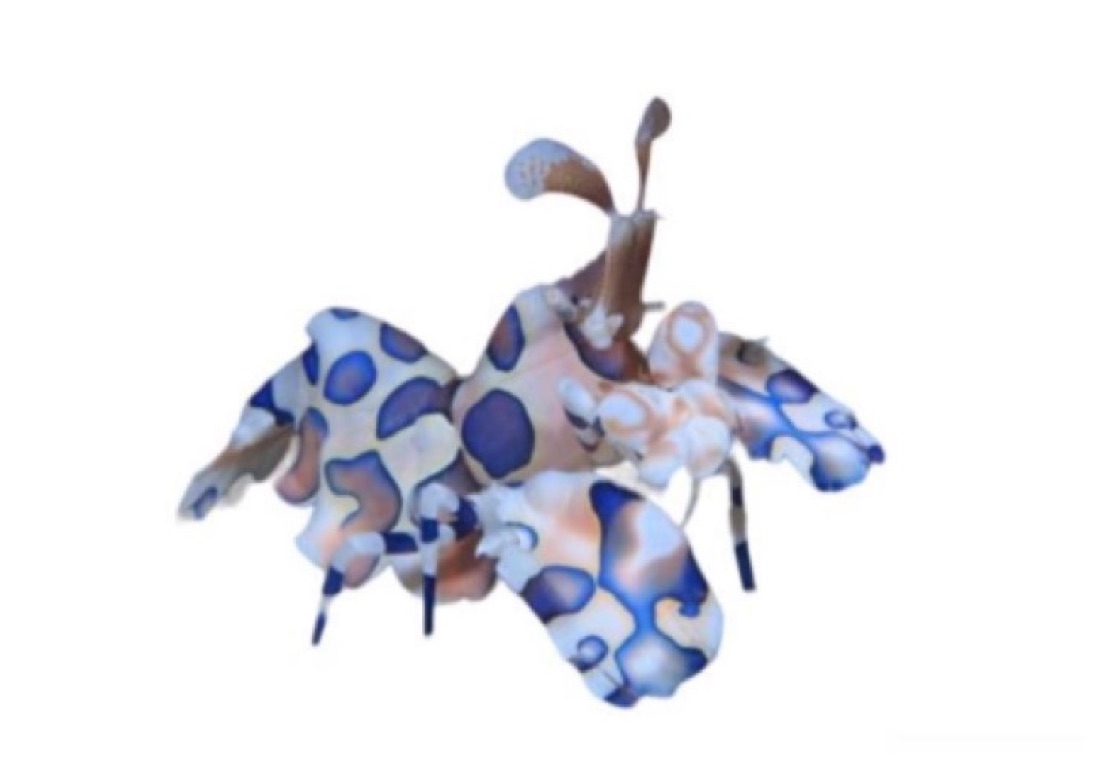
Tap a number on the photo: the key explains what to look for.
Life in the wild
What it eats
It seems to eat only sea stars. 3 4 In the wild it has been seen mainly on Nardoa and Linckia; in the laboratory it accepted all those offered: Linckia, Leiaster, Nardoa, Oreaster, Pentaceraster, Ceramaster and Acanthaster. 3 It turns its prey over, pierces the skin with its first pair of legs, which have small, sharp pincers, and pulls out the internal tissues. 3 4
Behaviour
Territorial and usually in pairs. The male prefers his own partner and returns to her, but tries to mate with every freshly moulted female. 3 Observations on hunting disagree: Wickler saw no real cooperation between the two partners, 3 while in the Lakshadweep Islands the female helped the male turn the prey over, for 30-60 minutes. 4
Reproduction
Separate sexes: sex is already determined about four weeks after metamorphosis. 7 The female can mate only once between a moult and spawning, and that mating covers only one brood; moulting comes every 18-20 days. 3 Each brood contains about 1,000 eggs carried under the abdomen, which hatch in about 18 days. 3 6 In a Thai breeding facility the larvae went through 12 stages and settled on the bottom 32-47 days after hatching. 6
In the aquarium
From the experience of the BallingMania community.
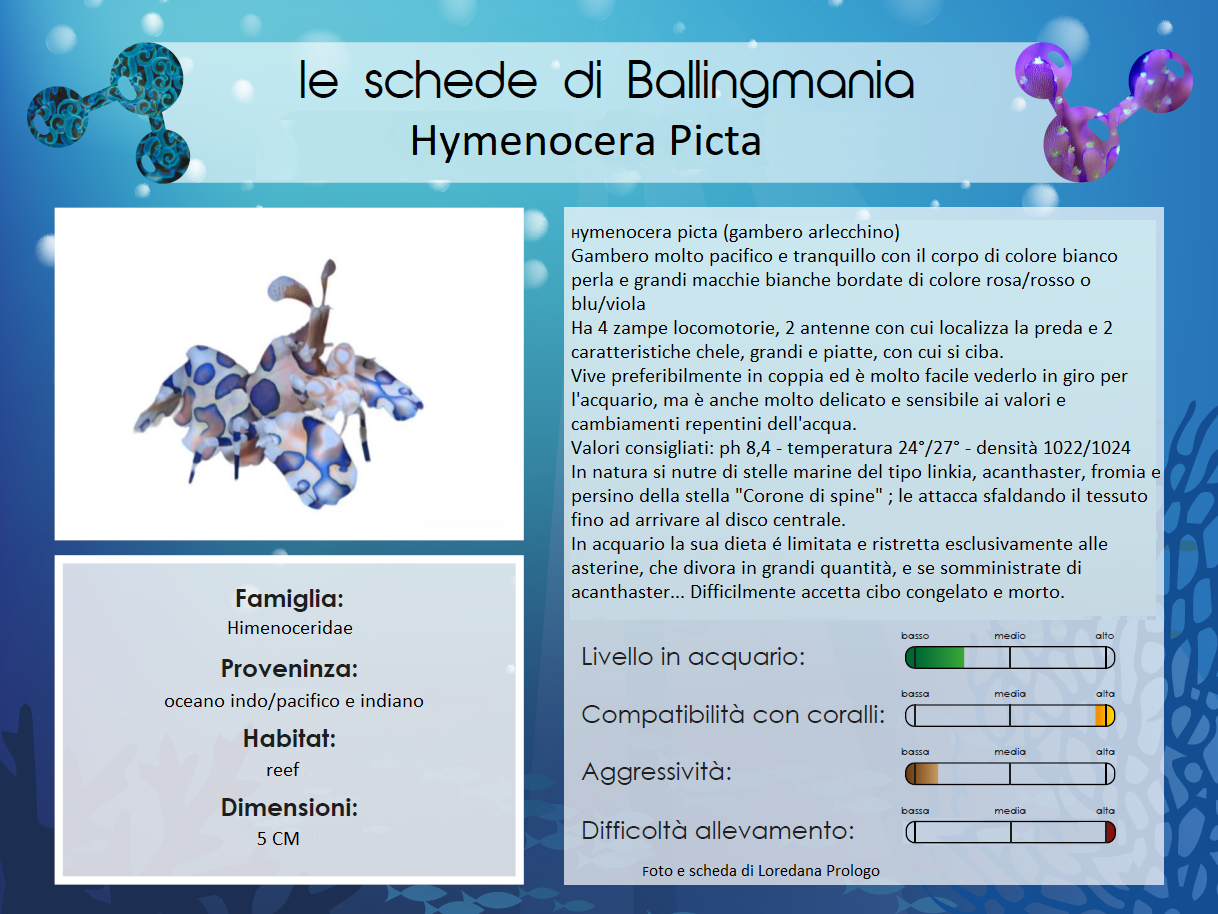
Hymenocera picta (harlequin shrimp). A very peaceful and calm shrimp with a pearl-white body and large white spots edged with pink/red or blue/purple. It has 4 walking legs, 2 antennae with which it locates its prey and 2 distinctive large, flat claws with which it feeds.
It prefers to live in pairs and is very easy to see moving around the aquarium, but it is also very delicate and sensitive to water values and sudden changes.
Recommended values: pH 8.4 - temperature 24°/27° - specific gravity 1.022/1.024. In the wild it feeds on sea stars such as Linckia, Acanthaster, Fromia and even the "crown-of-thorns" starfish; it attacks them by peeling away the tissue until it reaches the central disc.
In the aquarium its diet is limited and restricted exclusively to Asterina stars, which it devours in large quantities, and Acanthaster if offered... It rarely accepts frozen and dead food.
Photo and species sheet by Loredana Prologo
What studies say about keeping it
In a five-month aquaculture study, with the sea star Linckia multifora survival was 100%, with Astropecten indicus 67%; growth did not change significantly, and every group spawned except the one fed Astropecten every two weeks. The authors propose Astropecten as an alternative when Linckia is not available. 5 In the laboratory the specimens lived about a year, growing from about 1 to 5 cm. 3 The long larval phase and low survival hamper breeding. 6 A sea star attacked in a tank often died within a few days, but Wickler warns that this may have been due to laboratory conditions. 3
Did you know?
Sources
- WoRMS Editorial Board (2026). Hymenocera picta Dana, 1852. World Register of Marine Species.
- SeaLifeBase (2026). Hymenocera picta. SeaLifeBase.
- Wickler W. (1973). Biology of Hymenocera picta Dana. Micronesica.
- Prakash S., Ajith Kumar T.T. (2013). Feeding behavior of Harlequin Shrimp Hymenocera picta Dana, 1852 (Hymenoceridae) on Sea Star Linckia laevigata (Ophidiasteridae). Journal of Threatened Taxa.
- Pratoomyot J., Choosri S., Muthuwan V., Luangoon N., Charoendee W., Phuangsanthia W., Shinn A. (2018). Sand star, Astropecten indicus Döderlein, 1888, as an alternative live diet for captive harlequin shrimp, Hymenocera picta Dana, 1852. Aquaculture.
- Charoendee V., Sawatdeepeera S., Muthuwan W., Choosri S., Khunat A. (2010). Embryonic and larval development of the Harlequin shrimp Hymenocera picta Dana (1852). Institute of Marine Science, Burapha University.
- Fiedler G.C. and co-author (2002). The influence of social environment on sex determination in harlequin shrimp (Hymenocera picta: Decapoda, Gnathophyllidae). Journal of Crustacean Biology.
- UNEP-WCMC (2026). Search for Hymenocera picta in the CITES lists. Species+.
Sources checked on 5 November 2026. Community texts and ratings are kept separate from the scientific data.