
At a glance
Data from the scientific sources listed at the bottom.
Conservation
IUCN Red List: not evaluated.
How to recognise it
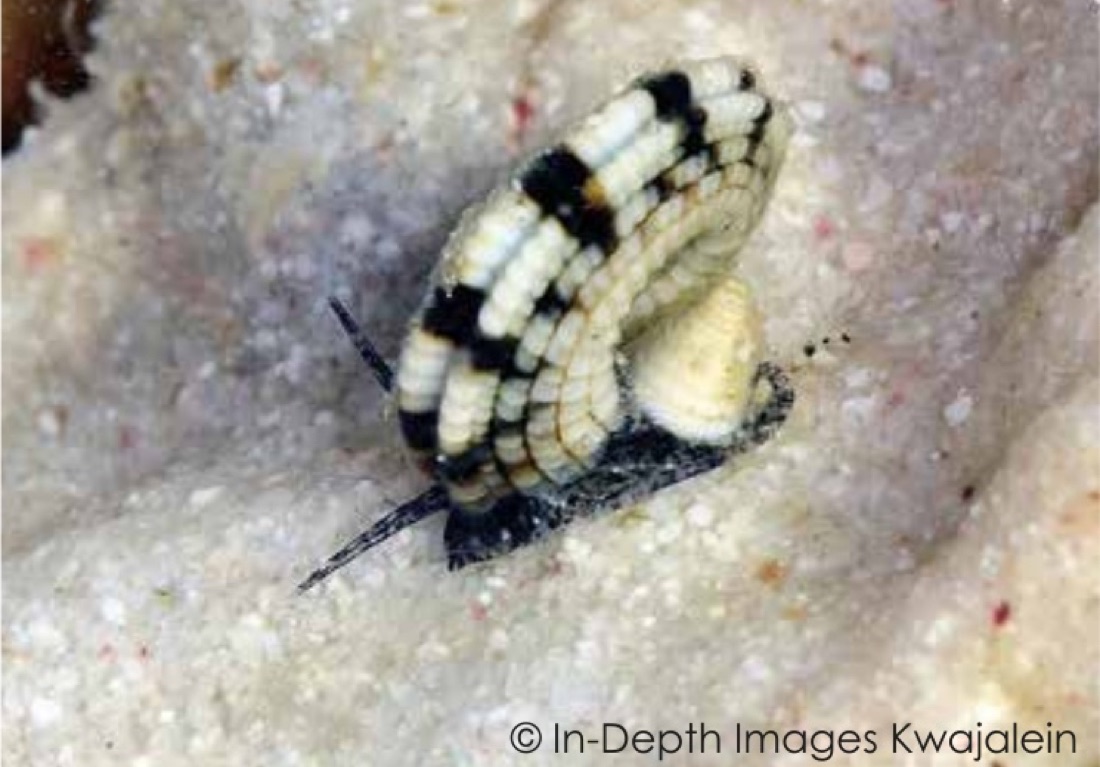
Tap a number on the photo: the key explains what to look for.
Life in the wild
In the aquarium
From the experience of the BallingMania community.
This small but fearsome snail is called “sundial snail” by aquarists overseas; it can reach a diameter of about 1 or 1.5 cm; the whorls of the shell are flattened into a disc with a flat base, which allows the snails to burrow into the sand, and it has a distinctive colour pattern with a white base and a black chequered design. It feeds on sea anemones, corals and zoanthids, where it is often seen grazing. The mouth region is lined with a tough cuticle whose function is to protect it against coral stings.
These snails are hermaphrodites: each has both male and female reproductive organs. They lay many eggs in capsules embedded in a jelly anchored to the substrate, which hatch as planktonic larvae. If spotted they must be removed immediately, as they are not reef safe.
good or bad? VERDICT:
Key: Good! An organism beneficial to the system. Reef Safe!
An organism whose benign or harmful nature is not yet known, to be kept an eye on.
Bad! The organism is a threat to the other inhabitants of the aquarium or could become a pest.
A food source for the other inhabitants of the aquarium.
A potentially toxic or venomous organism.
© In-Depth Images Kwajalein · © In-Depth Images Kwajalein
Did you know?
Sources
- MolluscaBase eds. (2026). Heliacus A. d'Orbigny, 1842. World Register of Marine Species.
- Bieler R., Petit R.E. (2005). Catalogue of Recent and fossil taxa of the family Architectonicidae Gray, 1850 (Mollusca: Gastropoda). Zootaxa 1101: 1-119.
- Robertson R. (1967). Heliacus (Gastropoda: Architectonicidae) symbiotic with Zoanthiniaria (Coelenterata). Science 156(3772): 246-248.
- Healy J.M., Potter D.G., Carless T.A. (2010). Preliminary checklist of the marine gastropods (Mollusca: Gastropoda) of Moreton Bay, Queensland. Memoirs of the Queensland Museum - Nature 54(3).
Sources checked on 5 November 2026. Community texts and ratings are kept separate from the scientific data.