Eunice aphroditois
Eunice is a genus of marine polychaete worms of the family Eunicidae, with a long, segmented body and strong, toothed jaws. 1 5 It is one of the most species-rich polychaete genera, and some species become giants, over 2-3 m long. 3 The name Eunice aphroditois, used for many of these worms, is uncertain: in all likelihood it covers several different species. 2 3
At a glance
Data from the scientific sources listed at the bottom.
Size
up to 60 cm
very different between species: some exceed 3 m; the Australian Museum holds a specimen that was almost 6 m long when collected
Conservation
IUCN Red List: not evaluated. In the Adriatic Sea these worms are sought by fishermen as bait, because they are bloody and phosphorescent; in Brazil some eunicid species are protected from unregulated collection. 3
Where it lives
The family lives in the tropical and temperate seas of the Atlantic, Indian and Pacific Oceans, in shallow water and in the intertidal zone. 5 Giant worms of this genus are known from the Indian Ocean, the Red Sea, the Pacific, the Caribbean and the Mediterranean. 3 Eunice aphroditois was described from a specimen from Sri Lanka, now lost; distant records, such as Réunion, Japan and New Zealand, are considered doubtful or are given only as similar forms. 2
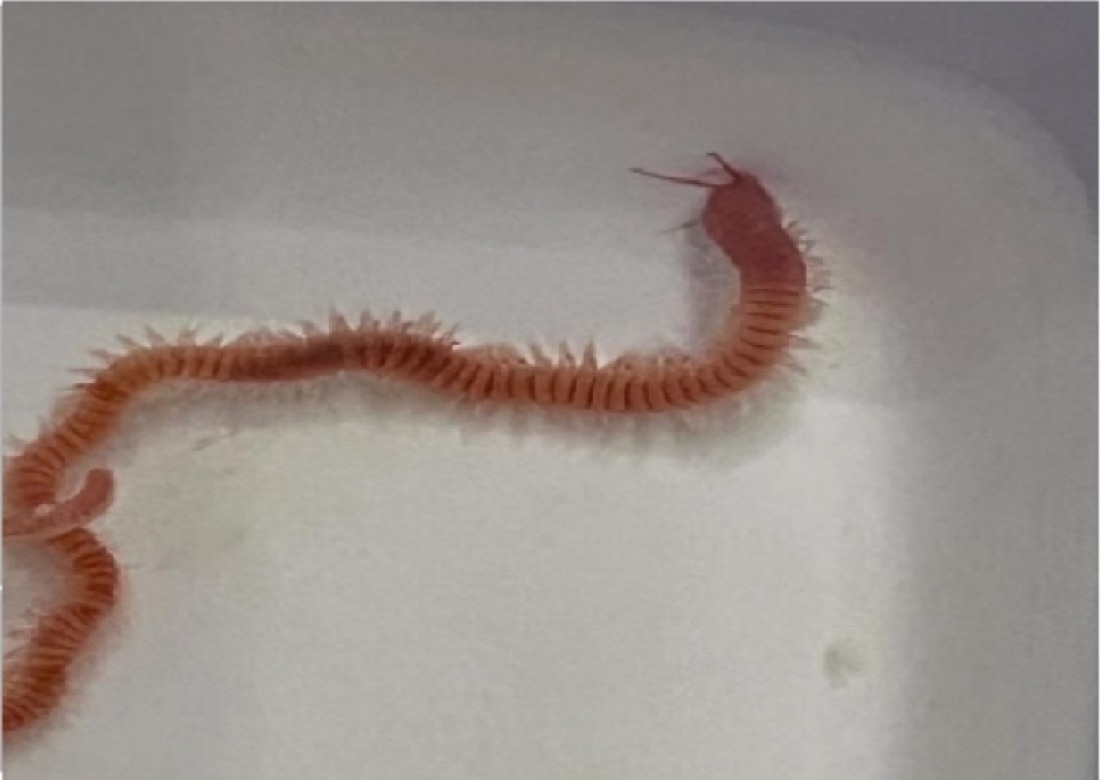
How to recognise it
Tap a number on the photo: the key explains what to look for.
Life in the wild
What it eats
The bobbit worm (Eunice aphroditois in the broad sense) ambushes fish, bivalves and other worms. 5 Not all these worms eat the same things, however: as early as the 19th century, only algae were found in the gut of a specimen from Sydney, and mud, crustacean remains, algae and spicules in one from the Philippines. 3
Behaviour
The bobbit worm waits hidden in its burrow; when prey passes close by, it shoots out, seizes it with its everted pharynx and sharp jaws and drags it under the sand while still alive. 5 Some build a permanent mucus-lined burrow after sexual maturity, and some wiggle an antenna like a small worm to lure prey. 5
In the aquarium
From the experience of the BallingMania community.
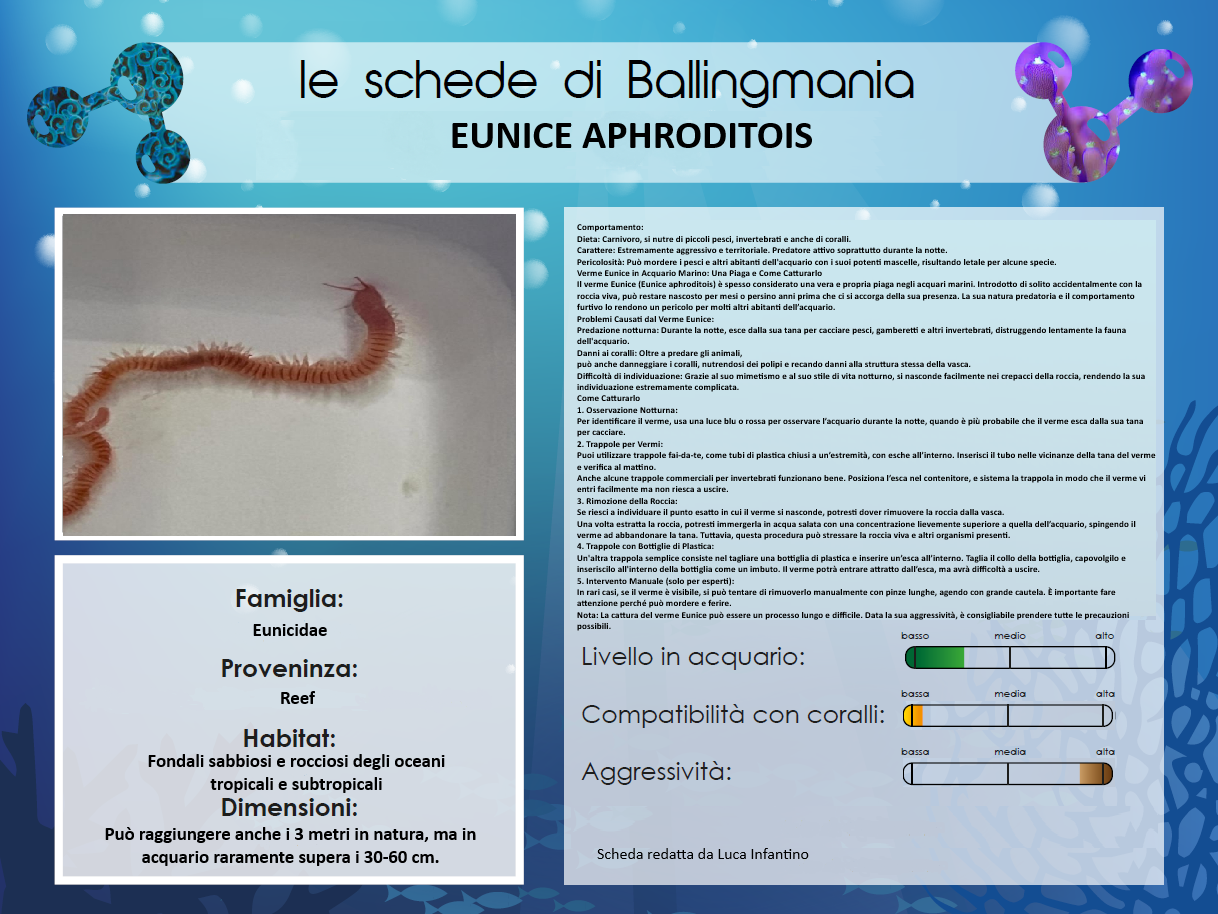
Behaviour:
Diet: carnivorous, it feeds on small fish, invertebrates and even corals.
Temperament: extremely aggressive and territorial. An active predator, especially at night.
Danger: it can bite fish and other aquarium inhabitants with its powerful jaws, proving lethal to some species.
The Eunice worm in the marine aquarium: a plague and how to catch it. The Eunice worm (Eunice aphroditois) is often considered a real plague in marine aquariums. Usually introduced by accident with live rock, it can stay hidden for months or even years before its presence is noticed. Its predatory nature and stealthy behaviour make it a danger to many other aquarium inhabitants.
Problems caused by the Eunice worm:
Night-time predation: at night it comes out of its burrow to hunt fish, shrimp and other invertebrates, slowly destroying the aquarium's fauna.
Damage to corals: besides preying on animals, it can also damage corals, feeding on their polyps and damaging the structure of the tank itself.
Hard to detect: thanks to its camouflage and nocturnal lifestyle, it easily hides in crevices in the rock, making it extremely difficult to find.
How to catch it 1. Night-time observation:
To identify the worm, use a blue or red light to watch the aquarium at night, when the worm is most likely to come out of its burrow to hunt.
2. Worm traps:
You can use home-made traps, such as plastic tubes closed at one end, with bait inside. Place the tube near the worm's burrow and check it in the morning.
Some commercial invertebrate traps also work well. Put the bait in the container and set the trap so that the worm can get in easily but cannot get out.
3. Removing the rock:
If you manage to find the exact spot where the worm is hiding, you may have to take the rock out of the tank.
Once the rock is out, you could immerse it in salt water at a slightly higher concentration than the aquarium's, pushing the worm to leave its burrow. However, this procedure can stress the live rock and the other organisms living on it.
4. Plastic bottle traps:
Another simple trap consists of cutting a plastic bottle and putting bait inside. Cut off the neck of the bottle, turn it upside down and insert it into the bottle like a funnel. The worm will be able to get in, attracted by the bait, but will find it hard to get out.
5. Manual removal (experts only):
In rare cases, if the worm is visible, you can try to remove it by hand with long tweezers, acting with great caution. It is important to be careful, because it can bite and injure.
Note: catching the Eunice worm can be a long and difficult process. Given its aggressiveness, it is advisable to take every possible precaution.
Species sheet written by Luca Infantino
What studies say about keeping it
Two scientific papers report that these worms often turn up in marine aquariums by accident, hidden in live rock, and that they are a serious problem because of the damage they do to fish, corals and other inhabitants. 3 4 In 2009 a specimen found in a British aquarium measured 1.2 m and had eaten other animals in the tank. 3
Did you know?
Sources
- WoRMS Editorial Board (2026). Eunice Cuvier, 1817. World Register of Marine Species.
- WoRMS Editorial Board (2026). Eunice aphroditois (Pallas, 1788). World Register of Marine Species.
- Salazar-Vallejo S.I., Carrera-Parra L.F., de León-González J.A. (2011). Giant Eunicid Polychaetes (Annelida) in shallow tropical and temperate seas. Revista de Biología Tropical 59(4): 1463-1474.
- Schulze A. (2011). The Bobbit worm dilemma: a case for DNA. Revista de Biología Tropical 59(4): 1475-1477.
- Pan Y.-Y., Nara M., Löwemark L., Miguez-Salas O., Gunnarson B., Iizuka Y., Chen T.-T., Dashtgard S.E. (2021). The 20-million-year old lair of an ambush-predatory worm preserved in northeast Taiwan. Scientific Reports 11: 1174.
Sources checked on 5 November 2026. Community texts and ratings are kept separate from the scientific data.