
Anfipodi
Amphipods are a whole order of crustaceans without a carapace, with about 11,000 species divided into six suborders. 1 2 3 They are common above all on the bottom and carry energy from primary producers up to the higher levels of food webs. 7 Their diet varies a great deal between species. 5
At a glance
Data from the scientific sources listed at the bottom.
Conservation
IUCN Red List: not evaluated.
Where it lives
They are found all over the world, in the sea, in fresh water and even on land. 3
How to recognise it
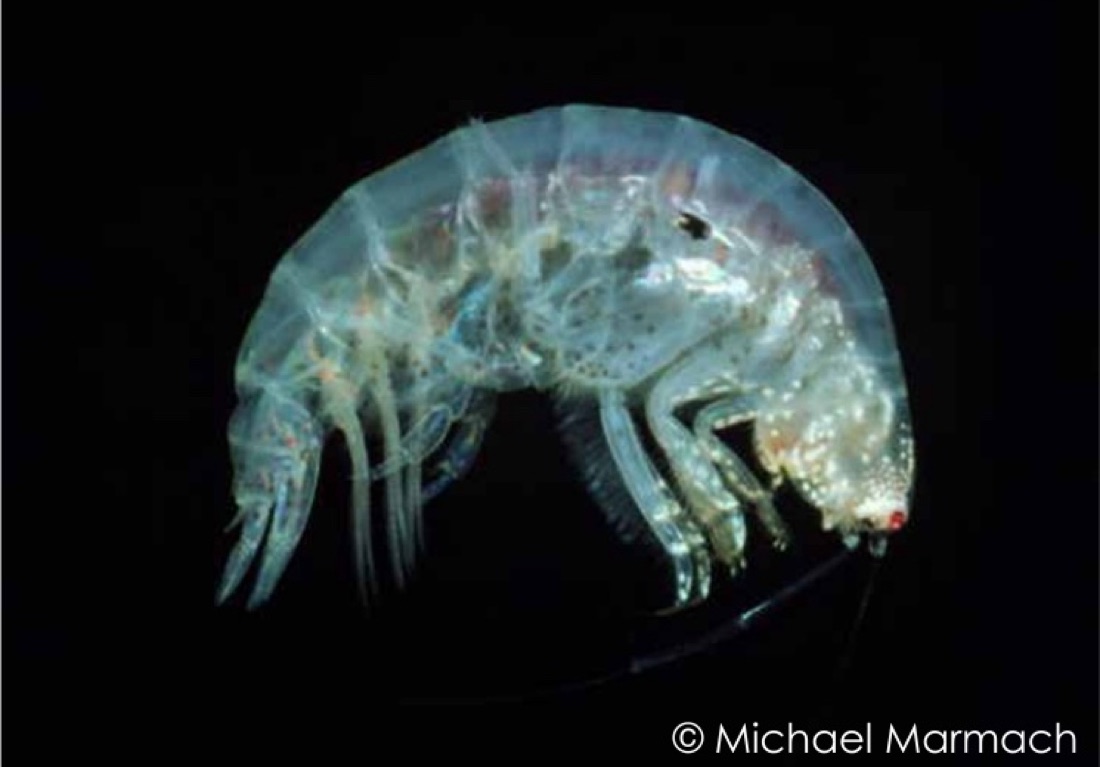
Tap a number on the photo: the key explains what to look for.
Life in the wild
In the aquarium
From the experience of the BallingMania community.
They are small crustaceans that scurry over the rocks and the sand; essentially they are scavengers that feed on phytoplankton and detritus.
Having them in the tank is a good sign: it shows that the whole aquarium system is in excellent health. They are a food source for everything that feeds on small crustaceans (including Synchiropus fish and wrasses).
In a well-established refugium they breed prolifically. They are easy to recognise because they are shaped like a tiny shrimp.
good or bad?
VERDICT:
Key: Good! An organism beneficial to the system. Reef Safe!
An organism whose benign or harmful nature is not yet known, to be kept an eye on.
Bad! The organism is a threat to the other inhabitants of the aquarium or could become a pest.
A food source for the other inhabitants of the aquarium.
A potentially toxic or venomous organism.
© Michael Marmach · © Marc Levenson
What studies say about keeping it
In aquaculture studies amphipods are proposed as live food alternative to Artemia, for example for seahorses, because they are rich in the fatty acids EPA and DHA. 6 7 Parhyale hawaiensis bred easily in the laboratory, but Elasmopus pectenicrus did not: there are still no established rearing techniques. 6
Did you know?
Sources
- Horton T., Lowry J., De Broyer C. et al. (eds.) (2026). Amphipoda Latreille, 1816. World Register of Marine Species.
- Horton T., Lowry J., De Broyer C. et al. (2026). World Amphipoda Database. WoRMS.
- Lowry J.K. (1999). Crustacea, the Higher Taxa: Amphipoda. Australian Museum.
- Lincoln 1979 and McLaughlin 1980, via Naturalis (2026). Zooplankton and Micronekton of the North Sea 2.0: Subordo Gammaridea. Naturalis Biodiversity Center.
- Guerra-García J.M., Tierno de Figueroa J.M., Navarro-Barranco C., Ros M., Sánchez-Moyano J.E., Moreira J. (2014). Dietary analysis of the marine Amphipoda (Crustacea: Peracarida) from the Iberian Peninsula. Journal of Sea Research 85.
- Vargas-Abúndez J.A., López-Vázquez H.I., Mascaró M., Martínez-Moreno G.L., Simões N. (2021). Marine amphipods as a new live prey for ornamental aquaculture: exploring the potential of Parhyale hawaiensis and Elasmopus pectenicrus. PeerJ 9:e10840.
- Suhaimi H., Abdul Rahman M.I., Ashaari A., Ikhwanuddin M., Wan Rasdi N. (2024). Adaptation and potential culture of wild Amphipods and Mysids as potential live feed in aquaculture: a review. PeerJ 12:e17092.
- Patel K. (2006). Synchiropus splendidus, Mandarin-fish. Animal Diversity Web, University of Michigan.
Sources checked on 5 November 2026. Community texts and ratings are kept separate from the scientific data.