
At a glance
Data from the scientific sources listed at the bottom.
Conservation
IUCN Red List: not evaluated. The Red List assesses individual species, not the genus; on SeaLifeBase A. burtoni is listed as not evaluated. 4
Where it lives
The species are known from the Red Sea and the Persian Gulf to East Africa, from the Maldives to Japan and Australia, as far as Samoa and the Cook Islands. 2 In the eastern Mediterranean there are populations that in all likelihood arrived from the Red Sea. 2 Many species have a limited range, and some species with a very wide range may turn out to be more than one. 2
How to recognise it
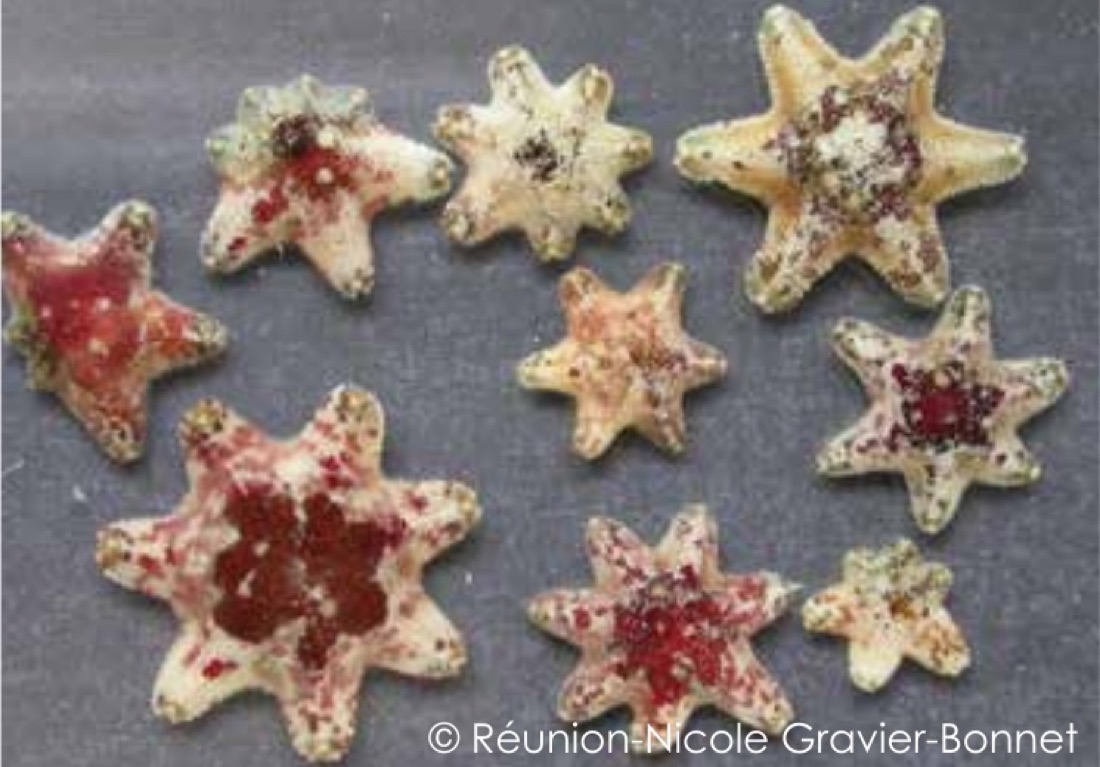
Tap a number on the photo: the key explains what to look for.
Life in the wild
Where it is found
The genus includes species living in different habitats. A. richmondi lives under boulders and in crevices in rocks and live corals, at 0-20 m; A. conandae on rocky and coral bottoms, at 0-10 m. 2 Depth ranges vary a lot from species to species: from 0-2 m in A. oharai to 0-37 m in A. anomala. 2
Behaviour
In Palau, A. anomala is secretive and usually stays under coral blocks or in crevices, in the intertidal zone; A. corallicola, on the other hand, lives in groups, below the tide line. 3
Reproduction
The genus includes species that split and species that do not. 2 A. anomala, which splits, also has genital openings on its upper surface. 2 On the Mediterranean coast of Israel small specimens are rare, and the population seems to be maintained mainly by splitting, which is more frequent in summer. 5 Species that split do not later become regular 5-armed forms. 2
In the aquarium
From the experience of the BallingMania community.
A small sea star belonging to the family Asterinidae (a family that includes a great many species); in our tanks they generally appear spontaneously from the rocks and multiply easily, thanks partly to their ability to reproduce asexually. They are flattened on the upper side with very short arms, which often give the body a pentagonal shape (except in some species that have more than 5 arms). Most species feed on food fragments and on the algal or bacterial film covering the substrate and the glass. Unfortunately some species can also feed on soft and hard corals. For this reason it is advisable to keep an eye on them if they settle on corals.
good or bad?
VERDICT:
Key: Good! An organism beneficial to the system. Reef Safe!
An organism whose benign or harmful nature is not yet known, to be kept an eye on.
Bad! The organism is a threat to the other inhabitants of the aquarium or could become a pest.
A food source for the other inhabitants of the aquarium.
A potentially toxic or venomous organism.
© Réunion-Nicole Gravier-Bonnet · © Philippe Bourjon
What studies say about keeping it
Study results, not advice for the tank. In a four-month laboratory experiment with A. corallicola, in groups of 5, 15 and 30 individuals, the denser the population, the less the species multiplied by splitting. 6
Did you know?
Sources
- WoRMS Editorial Board (2026). Aquilonastra O'Loughlin in O'Loughlin & Waters, 2004. World Register of Marine Species.
- O'Loughlin, P.M.; Rowe, F.W.E. (2006). A systematic revision of the asterinid genus Aquilonastra O'Loughlin, 2004 (Echinodermata: Asteroidea). Memoirs of Museum Victoria 63(2): 257-287.
- Marsh, L.M. (1977). Coral reef asteroids of Palau, Caroline Islands. Micronesica 13(2): 251-281.
- SeaLifeBase (2026). Aquilonastra burtoni (Gray, 1840). SeaLifeBase.
- Achituv, Y.; Sher, E. (1991). Sexual reproduction and fission in the sea star Asterina burtoni from the Mediterranean coast of Israel. Bulletin of Marine Science 48(3): 670-678.
- Sterling, K.A.; Shuster, S.M. (2011). Rates of fission in Aquilonastra corallicola Marsh (Echinodermata: Asteroidea) as affected by population density. Invertebrate Reproduction and Development 55(1): 1-5.
Sources checked on 5 November 2026. Community texts and ratings are kept separate from the scientific data.