
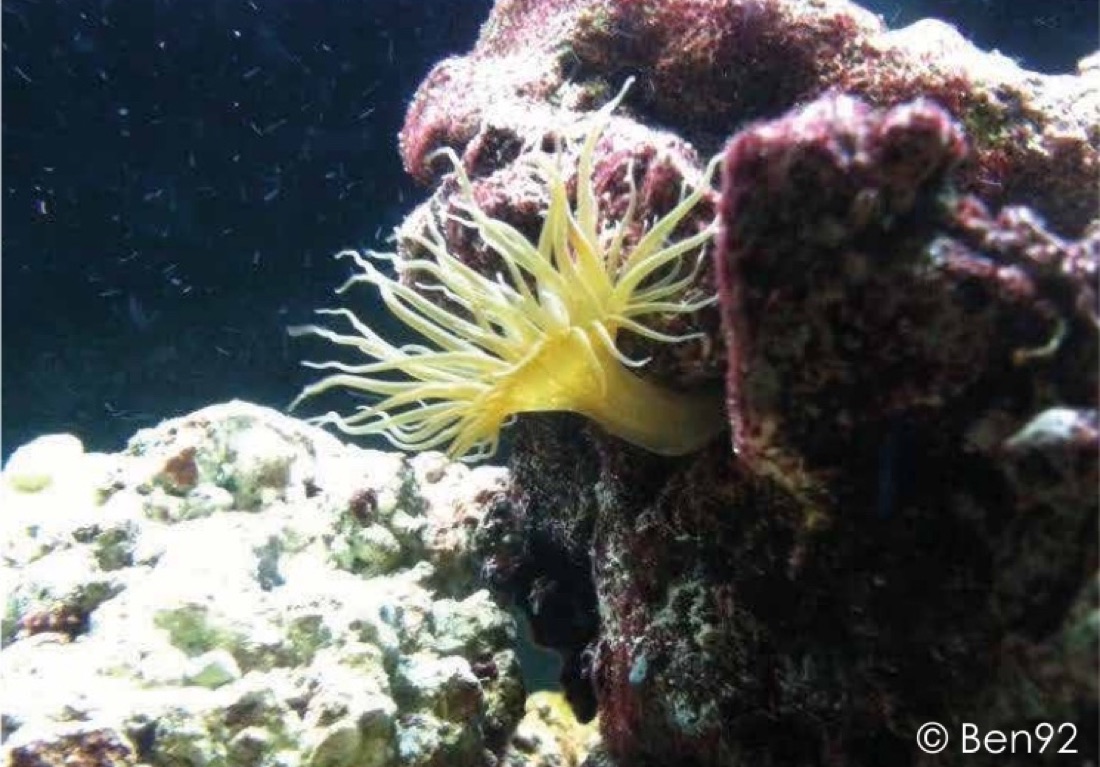
Aiptasia sp.
With 'Aiptasia' aquarists and many researchers mean small sea anemones of the family Aiptasiidae; for recent studies this is mainly Exaiptasia diaphana, separated from the genus Aiptasia in 2014. 3 7 Like corals, it hosts microscopic photosynthetic algae in its cells, but it has no skeleton. 4 Reef aquarists regard it as a pest anemone. 9
At a glance
Data from the scientific sources listed at the bottom.
Conservation
IUCN Red List: not evaluated.
Where it lives
Exaiptasia diaphana lives in tropical and subtropical waters all over the world. 3 4 WoRMS records it as an introduced species, carried attached to ships, in the Galápagos and Madeira. 2 The genus Aiptasia in the strict sense, on the other hand, includes a few species from the temperate and subtropical waters of the eastern Atlantic and the Mediterranean. 1 3
How to recognise it
Tap a number on the photo: the key explains what to look for.
Life in the wild
Reproduction
It reproduces both sexually and asexually. 6 Often, as it moves, it leaves small fragments of its basal disc on the bottom, which grow tentacles and become new polyps, usually in about a week; starvation can also encourage this. 5 In the genus Aiptasia in the strict sense, asexual reproduction takes place by the body splitting lengthwise or crosswise. 3
In the aquarium
From the experience of the BallingMania community.
Aiptasia, or glass anemone, is a real plague for our marine tanks. It is a small, semi-transparent, light brown anemone shaped like a “palm tree”, made up of a stalk and an oral disc surrounded by stinging tentacles; each tentacle is very stinging and can sting nearby corals, invertebrates or even small fish, injuring or killing them.
Aiptasia is photosynthetic: inside it live flagellate microalgae that, through photosynthesis, provide nourishment to the anemone, but it can also eat small meaty foods that it is able to catch with its tentacles. Anemones of the genus Aiptasia reproduce like a pest, both sexually and asexually, which is why it is essential to remove them as soon as they are spotted in the tank. The natural predators of these anemones are shrimp such as Lysmata wurdemanni or boggessi, the fish Chelmon rostratus or Acreichthys tomentosus, and the nudibranch Berghia. There are also various commercial or home-made products that kill Aiptasia by injecting the chemical directly into its mouth with a syringe or by covering the whole anemone.
good or bad? VERDICT:
Key: Good! An organism beneficial to the system. Reef Safe!
An organism whose benign or harmful nature is not yet known, to be kept an eye on.
Bad! The organism is a threat to the other inhabitants of the aquarium or could become a pest.
A food source for the other inhabitants of the aquarium.
A potentially toxic or venomous organism.
© Ben92 · © Omard
What studies say about keeping it
Peppermint shrimp from the western Atlantic, sold mainly as Lysmata wurdemanni, have been used for many years against these pest anemones. 9 The same study showed that several different species were being sold under that name, now described separately, including L. boggessi. 9 The nudibranch Berghia stephanieae eats only Exaiptasia and can complete its life cycle feeding on these anemones; it can survive up to 48 days without food. 6 10
Did you know?
Sources
- Rodríguez E., Fautin D., Daly M. (World List of Actiniaria) (2026). Aiptasia Gosse, 1858. World Register of Marine Species.
- Rodríguez E., Fautin D., Daly M. (World List of Actiniaria) (2026). Exaiptasia diaphana (Rapp, 1829). World Register of Marine Species.
- Grajales A., Rodríguez E. (2014). Morphological revision of the genus Aiptasia and the family Aiptasiidae (Cnidaria, Actiniaria, Metridioidea). Zootaxa 3826(1): 55-100.
- Roberty S., Weis V.M., Davy S.K., Voolstra C.R. (2024). Editorial: Aiptasia: a model system in coral symbiosis research. Frontiers in Marine Science 11: 1370814.
- Presnell J.S., Wirsching E., Weis V.M. (2022). Tentacle patterning during Exaiptasia diaphana pedal lacerate development differs between symbiotic and aposymbiotic animals. PeerJ 10: e12770.
- Silva R.X.G., Madeira D., Cartaxana P., Calado R. (2023). Assessing the trophic impact of bleaching: the model pair Berghia stephanieae/Exaiptasia diaphana. Animals 13(2): 291.
- Costa R.M., Cárdenas A., Loussert-Fonta C., Toullec G., Meibom A., Voolstra C.R. (2021). Surface topography, bacterial carrying capacity, and the prospect of microbiome manipulation in the sea anemone coral model Aiptasia. Frontiers in Microbiology 12: 637834.
- Di Camillo C.G., Arossa S., Pica D., Bastari A., Torsani F., Cerrano C. (2021). Phenology of Anemonia viridis and Exaiptasia diaphana (Cnidaria: Anthozoa) from marine temperate ecosystems. Mediterranean Marine Science 22(1): 40-50 (record on Zenodo).
- Rhyne A.L., Lin J. (2006). A western Atlantic peppermint shrimp complex: redescription of Lysmata wurdemanni, description of four new species, and remarks on Lysmata rathbunae. Bulletin of Marine Science 79(1): 165-204.
- Melo Clavijo J. et al. (2021). The complete mitochondrial genome of the photosymbiotic sea slug Berghia stephanieae (Valdés, 2005) (Gastropoda, Nudibranchia). Mitochondrial DNA Part B 6(8): 2281-2284.
Sources checked on 5 November 2026. Community texts and ratings are kept separate from the scientific data.