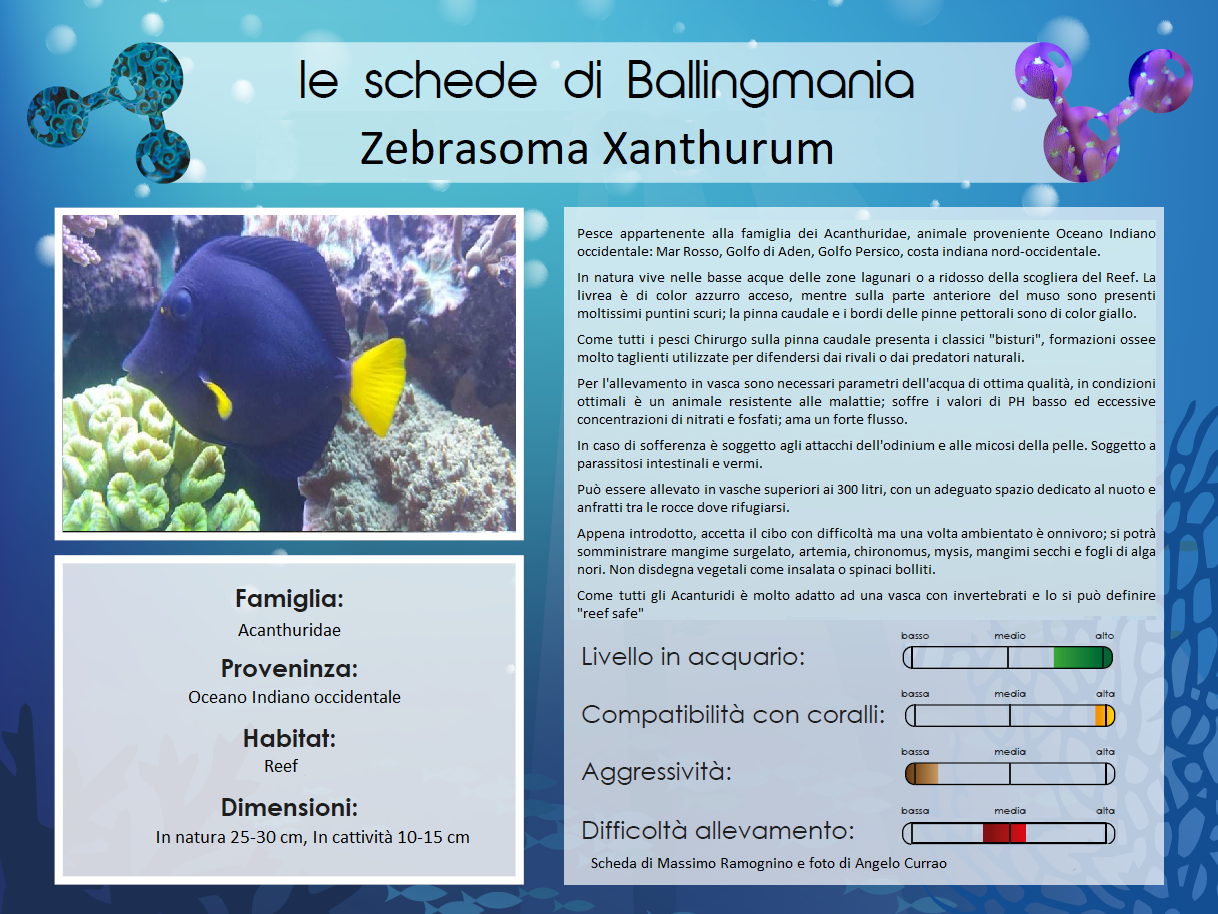
Zebrasoma xanthurum
Zebrasoma xanthurum is a surgeonfish (family Acanthuridae) 1 with a dark blue or deep purple body and bright yellow edges on the tail and pectoral fins. 4 It lives from the Red Sea to the Persian Gulf, where it grazes mainly on algae. 2 6 It is one of the fish most exported from the Red Sea for aquariums. 9 10
At a glance
Data from the scientific sources listed at the bottom.
Depth in the wild
2–20 m
Size
up to 22 cm
maximum length according to CIESM and Reef Life Survey; FishBase reports a limit of 36.7 cm
Temperature in the wild
24–28 °C
Where it lives
Western Indian Ocean, from the Red Sea to the Persian Gulf, with an isolated record from the Maldives. 2 In a survey on reefs in Jordan, Egypt, Saudi Arabia, Yemen and Djibouti it was counted at all the latitudes studied and was most abundant in Djibouti, between 11° and 12° North. 8 In the Mediterranean only one sighting is known, in Italy: see the curiosities. 4
Conservation
IUCN Red List: least concern (2010). Red List data taken from FishBase. 2 FishBase states that the species is not assessed by CITES, and a search on Species+ gives no results. 2 11 In live fish exports to the United States it was the leading species from Yemen (48.2% in 2008, 47.6% in 2009) and Eritrea (23.2% and 24.6%); in 2011 it was also the leading species from Egypt (31.7%) and the United Arab Emirates (63.6%). 10
How to recognise it
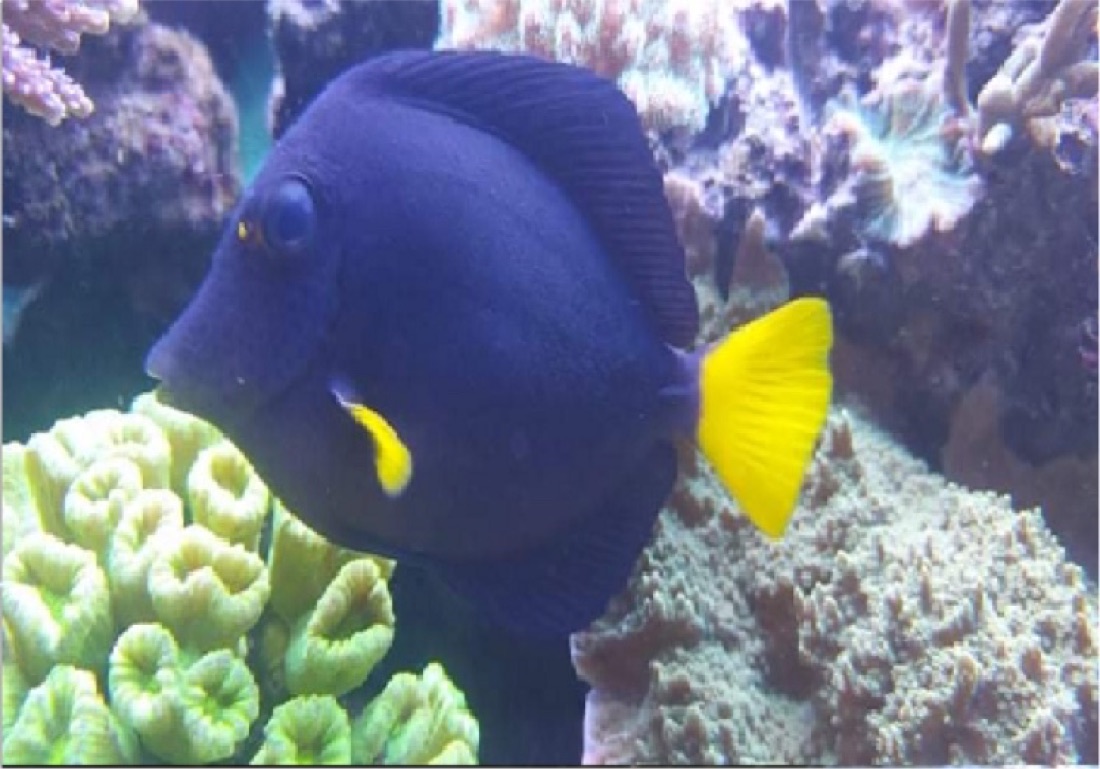
Tap a number on the photo: the key explains what to look for.
Life in the wild
What it eats
An algae grazer. 6 In a 13-month study in Naama Bay (Gulf of Aqaba), the stomach contained 44.4% brown algae, 26.4% red algae, 18.2% blue-green algae, 4.7% green algae and 2.4% diatoms, with only 2.1% animal food. 6 It feeds throughout the day, little in the morning and more in the second half of the day. 6 A study in the central Red Sea classes it among feeders on red and green filamentous algae and algal turf. 7
In the aquarium
From the experience of the BallingMania community.
A fish belonging to the family Acanthuridae, an animal coming from the western Indian Ocean: the Red Sea, the Gulf of Aden, the Persian Gulf and the north-western coast of India. In the wild it lives in the shallow waters of lagoon areas or close to the reef cliff. The livery is bright blue, while on the front of the snout there are a great many dark dots; the caudal fin and the edges of the pectoral fins are yellow. Like all surgeonfish, on the caudal fin it has the classic "scalpels", very sharp bony structures used to defend itself from rivals or natural predators.
To keep it in a tank, excellent water quality is needed; in optimal conditions it is an animal resistant to disease; it suffers from low pH and excessive concentrations of nitrate and phosphate; it loves a strong flow.
When stressed it is prone to attacks of Oodinium and to fungal skin infections. Prone to intestinal parasites and worms.
It can be kept in tanks larger than 300 litres, with adequate room for swimming and crevices among the rocks to take refuge in.
Once introduced it accepts food with difficulty, but once settled in it is omnivorous; it can be given frozen food, Artemia, chironomus, mysis, dry foods and sheets of Nori seaweed. It does not refuse vegetables such as lettuce or boiled spinach.
Like all Acanthurids it is very well suited to a tank with invertebrates and can be called "reef safe"
Species sheet by Massimo Ramognino and photo by Angelo Currao
Did you know?
Sources
- Froese R., Pauly D. (eds.), via WoRMS (2026). Zebrasoma xanthurum (Blyth, 1852). World Register of Marine Species.
- Froese R., Pauly D. (eds.) (2026). Zebrasoma xanthurum, Yellowtail tang. FishBase.
- Froese R., Pauly D. (eds.) (2026). Reproduction of Zebrasoma xanthurum. FishBase.
- CIESM (2017). Zebrasoma xanthurum, atlas of exotic fishes in the Mediterranean. CIESM, The Mediterranean Science Commission.
- Reef Life Survey (2026). Zebrasoma xanthurum. Reef Life Survey.
- Fudah M.M., al-Sayyid A.A. (1996). Distribution and feeding habits of two surgeonfish, Zebrasoma xanthurum and Ctenochaetus striatus in the Gulf of Aqaba, Red Sea. Journal of King Abdulaziz University: Marine Science.
- Miyake S., Ngugi D.K., Stingl U. (2016). Phylogenetic Diversity, Distribution, and Cophylogeny of Giant Bacteria (Epulopiscium) with their Surgeonfish Hosts in the Red Sea. Frontiers in Microbiology.
- Khalaf M.A., Abdallah M. (2014). Spatial distribution of fifty ornamental fish species on coral reefs in the Red Sea and Gulf of Aden. ZooKeys.
- Rhyne A.L., Tlusty M.F., Schofield P.J., Kaufman L., Morris J.A., Bruckner A.W. (2012). Revealing the Appetite of the Marine Aquarium Fish Trade: The Volume and Biodiversity of Fish Imported into the United States. PLoS ONE.
- Rhyne A.L., Tlusty M.F., Szczebak J.T., Holmberg R.J. (2017). Expanding our understanding of the trade in marine aquarium animals. PeerJ.
- UNEP-WCMC (2026). Search for Zebrasoma xanthurum in the CITES lists. Species+.
Sources checked on 5 November 2026. Community texts and ratings are kept separate from the scientific data.