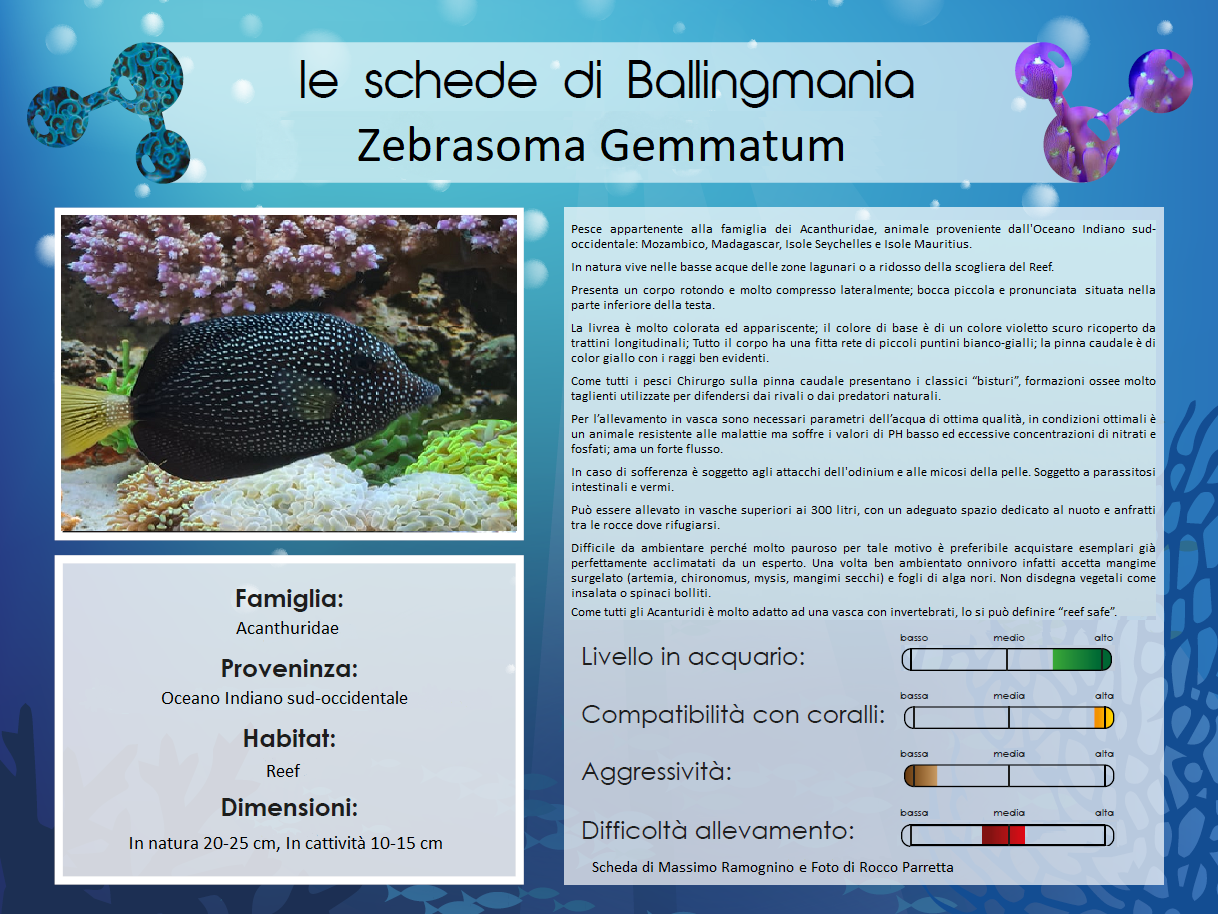
Zebrasoma gemmatum
Gem tang
The gem tang, known in Italian as pesce chirurgo mauriziano 4, is a surgeonfish (Acanthuridae) 1 from the south-western Indian Ocean, up to 22 cm long. 2 It is dark brown with small white spots and a yellow tail, 3 very territorial and usually solitary. 2 It usually stays deeper than 25 m. 2
At a glance
Data from the scientific sources listed at the bottom.
Depth in the wild
25–61 m
Size
up to 22 cm
maximum total length according to FishBase; the Oregon Coast Aquarium gives 18 cm
Temperature in the wild
24–28 °C
Where it lives
Mozambique and South Africa, then Madagascar, Réunion and Mauritius. 2 The Oregon Coast Aquarium gives the Natal area for South Africa. 3 The specimen on which the description is based came from Mauritius. 5
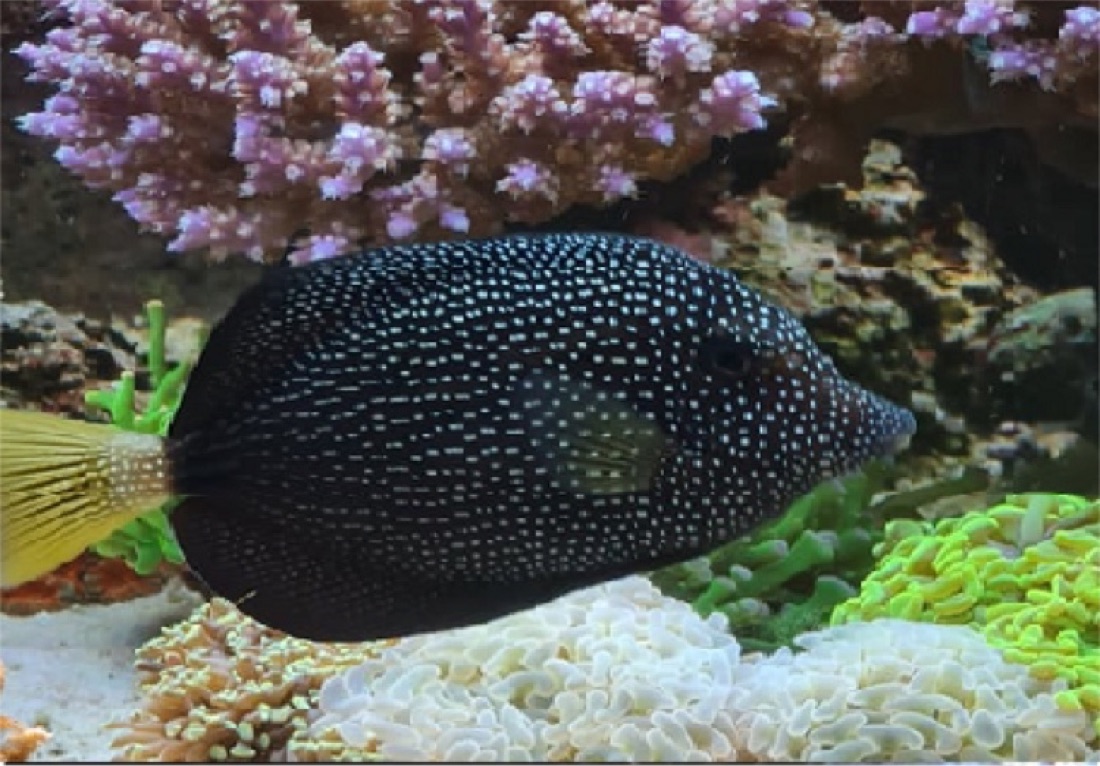
How to recognise it
Tap a number on the photo: the key explains what to look for.
Life in the wild
In the aquarium
From the experience of the BallingMania community.
A fish belonging to the family Acanthuridae, an animal coming from the south-western Indian Ocean: Mozambique, Madagascar, the Seychelles and Mauritius.
In the wild it lives in the shallow waters of lagoon areas or close to the reef cliff.
It has a round body, strongly compressed laterally; a small, prominent mouth on the lower part of the head.
The livery is very colourful and striking; the base colour is a dark violet covered with lengthwise dashes; the whole body has a dense network of small whitish-yellow dots; the caudal fin is yellow with clearly visible rays.
Like all surgeonfish, on the caudal fin they have the classic "scalpels", very sharp bony structures used to defend themselves from rivals or natural predators.
To keep it in a tank, excellent water quality is needed; in optimal conditions it is an animal resistant to disease, but it suffers from low pH and excessive concentrations of nitrate and phosphate; it loves a strong flow.
When stressed it is prone to attacks of Oodinium and to fungal skin infections. Prone to intestinal parasites and worms.
It can be kept in tanks larger than 300 litres, with adequate room for swimming and crevices among the rocks to take refuge in.
Difficult to settle in because it is very fearful; for this reason it is better to buy specimens already perfectly acclimatised by an expert. Once well settled in it is omnivorous: in fact it accepts frozen food (Artemia, chironomus, mysis, dry foods) and sheets of Nori seaweed. It does not refuse vegetables such as lettuce or boiled spinach.
Like all Acanthurids it is very well suited to a tank with invertebrates; it can be called "reef safe".
Species sheet by Massimo Ramognino and photo by Rocco Parretta
What studies say about keeping it
The Oregon Coast Aquarium, accredited by the AZA, keeps it in its Connected Coasts exhibit, but does not publish husbandry data. 3
Did you know?
Sources
- WoRMS Editorial Board (2026). Zebrasoma gemmatum (Valenciennes, 1835). World Register of Marine Species.
- Froese R., Pauly D. (eds.) (2026). Zebrasoma gemmatum, Spotted tang. FishBase.
- Oregon Coast Aquarium (2026). Gem Tang, Zebrasoma gemmatum. Oregon Coast Aquarium.
- GBIF Secretariat, da Catalogue of Life (2026). Zebrasoma gemmatum, common names and Red List category. GBIF.
- Eschmeyer's Catalog of Fishes (2026). Eschmeyer's Catalog of Fishes, genere Zebrasoma. California Academy of Sciences.
- UNEP-WCMC, Segretariato CITES (2026). Search for Zebrasoma gemmatum in the CITES lists. Species+.
Sources checked on 5 November 2026. Community texts and ratings are kept separate from the scientific data.