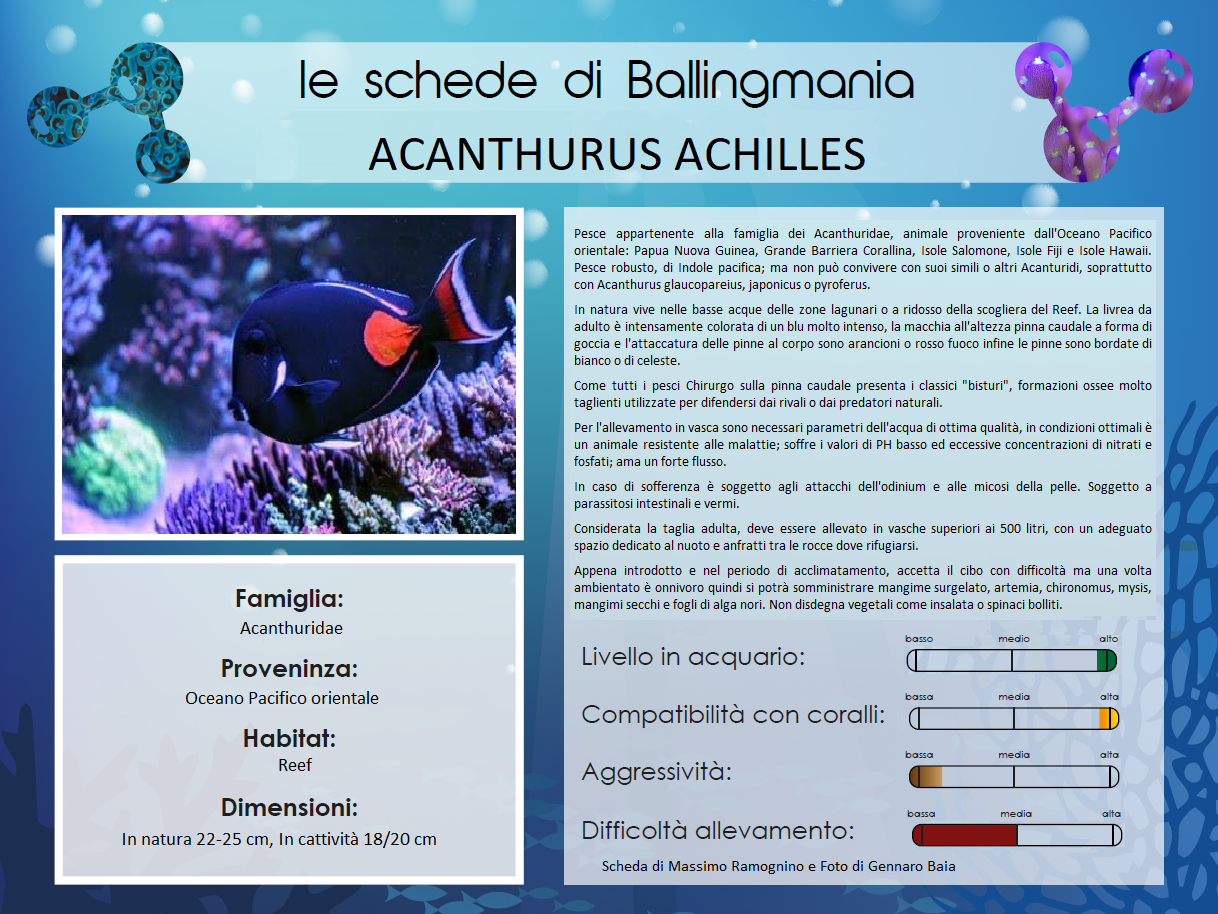
Acanthurus achilles
Achilles tang
The Achilles tang, known in Italian as pesce chirurgo di Achille 8, is a Pacific surgeonfish (Acanthuridae) 1 of about 24 cm, very dark brown with a large orange teardrop-shaped patch towards the tail. 2 3 It lives in groups on the outer side of reefs, in clear and very shallow water, and feeds on small algae. 2 In Hawaii it can live to 39 years, but a sharp decline led to fishing being suspended in one area. 4
At a glance
Data from the scientific sources listed at the bottom.
Depth in the wild
0–4 m
Size
up to 24 cm
maximum total length according to FishBase and Reef Life Survey; in Hawaii measured up to 26.4 cm to the fork of the tail
Temperature in the wild
24.1–30 °C
Where it lives
Oceanic islands of Oceania as far as Hawaii and Pitcairn, including Wake, Marcus and the Marianas; in the eastern Pacific it reaches the southern tip of Baja California and other offshore islands. 2 FishBase notes that the distribution still needs to be verified. 2
Conservation
IUCN Red List: least concern (2010). Red List data taken from FishBase and GBIF. 2 7 It does not appear in the CITES lists checked on Species+. 9 In the west of the island of Hawai'i biomass, density and average size have fallen sharply, and in December 2022 a two-year moratorium on fishing was decided. 4 A climate assessment for the Pacific islands places it between high and moderate vulnerability, with little certainty. 5 Between 2014 and 2021 the European Union imported 371,596 specimens, with a clear drop after 2017. 6
How to recognise it
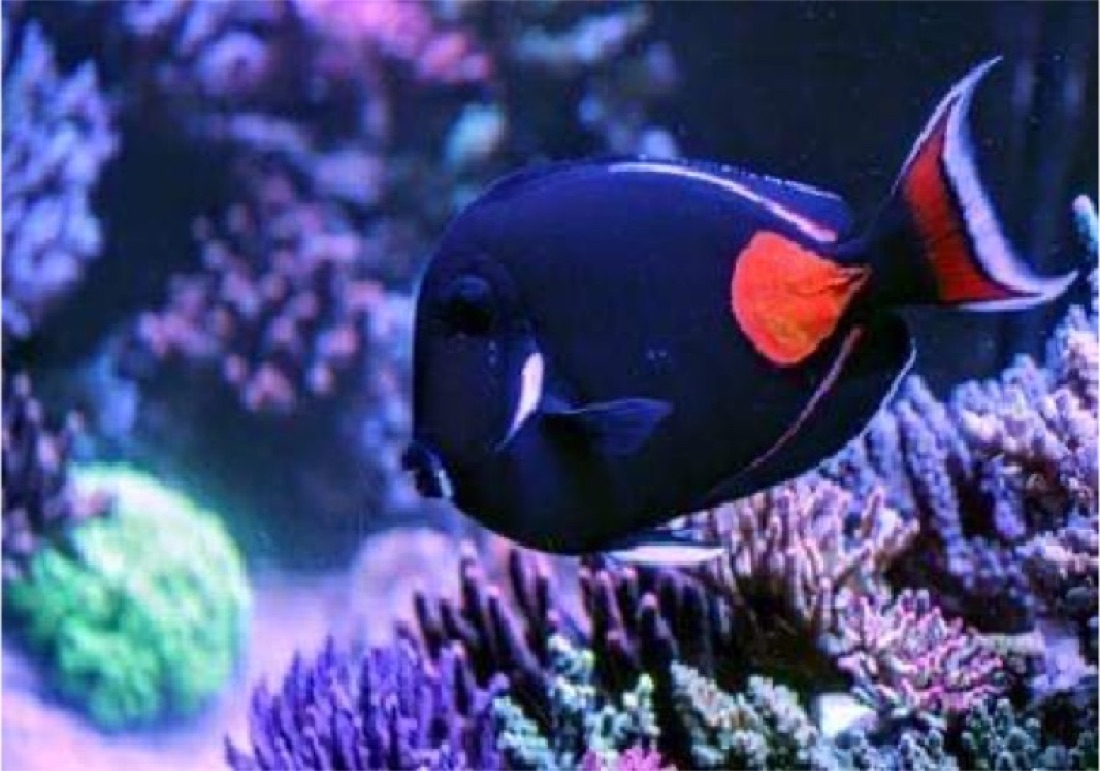
Tap a number on the photo: the key explains what to look for.
- 1Orange teardrop large, towards the tail; in juveniles it is a stripe or is missing 2 3
- 2Orange and white tail the same colours also brighten the dorsal and anal fins 3
- 3Spot on the gill cover pale, at the corner of the gill opening 2
- 4Ring on the chin light blue 2
- 5Pale line on the dorsal fin in contrast with the almost black body 3
Life in the wild
In the aquarium
From the experience of the BallingMania community.
A fish belonging to the family Acanthuridae, an animal coming from the eastern Pacific Ocean: Papua New Guinea, the Great Barrier Reef, the Solomon Islands, the Fiji Islands and the Hawaiian Islands. A hardy fish with a peaceful temperament, but it cannot live with others of its kind or other Acanthurids, especially Acanthurus glaucopareius, japonicus or pyroferus.
In the wild it lives in the shallow waters of lagoon areas or close to the reef cliff. The adult livery is a very intense, deep blue; the teardrop-shaped patch near the caudal fin and the bases of the fins are orange or fiery red, and finally the fins are edged with white or light blue.
Like all surgeonfish, on the caudal fin it has the classic "scalpels", very sharp bony structures used to defend itself from rivals or natural predators.
To keep it in a tank, excellent water quality is needed; in optimal conditions it is an animal resistant to disease; it suffers from low pH and excessive concentrations of nitrate and phosphate; it loves a strong flow.
When stressed it is prone to attacks of Oodinium and to fungal skin infections. Prone to intestinal parasites and worms.
Considering its adult size, it must be kept in tanks larger than 500 litres, with adequate room for swimming and crevices among the rocks to take refuge in.
Once introduced and during acclimatisation it accepts food with difficulty, but once settled in it is omnivorous, so it can be given frozen food, Artemia, chironomus, mysis, dry foods and sheets of Nori seaweed. It does not refuse vegetables such as lettuce or boiled spinach.
Species sheet by Massimo Ramognino and photo by Gennaro Baia
Did you know?
Sources
- Froese R., Pauly D. (eds.), via WoRMS (2026). Acanthurus achilles Shaw, 1803. World Register of Marine Species.
- Froese R., Pauly D. (eds.) (2026). Acanthurus achilles, Achilles tang. FishBase.
- Reef Life Survey (2026). Acanthurus achilles. Reef Life Survey.
- Grabowski T.B., Massey R., McSwain D., Larson A., Raz L., Schemmel E., Bartz D., Rodriguez N. (2025). Age, growth, and reproductive biology of Achilles tang (Acanthurus achilles) around Hawai'i Island, USA. Environmental Biology of Fishes.
- Giddens J., Kobayashi D.R., Mukai G.N.M. et al. (2022). Assessing the vulnerability of marine life to climate change in the Pacific Islands region. PLoS ONE.
- Biondo M.V., Burki R.P., Aguayo F., Calado R. (2024). An Updated Review of the Marine Ornamental Fish Trade in the European Union. Animals.
- GBIF Secretariat (2026). Acanthurus achilles, IUCN Red List category. GBIF.
- GBIF Secretariat, da Catalogue of Life (2026). Acanthurus achilles, nomi comuni. GBIF.
- UNEP-WCMC, Segretariato CITES (2026). Search for Acanthurus achilles in the CITES lists. Species+.
Sources checked on 5 November 2026. Community texts and ratings are kept separate from the scientific data.