
Zebrasoma flavescens
Yellow tang
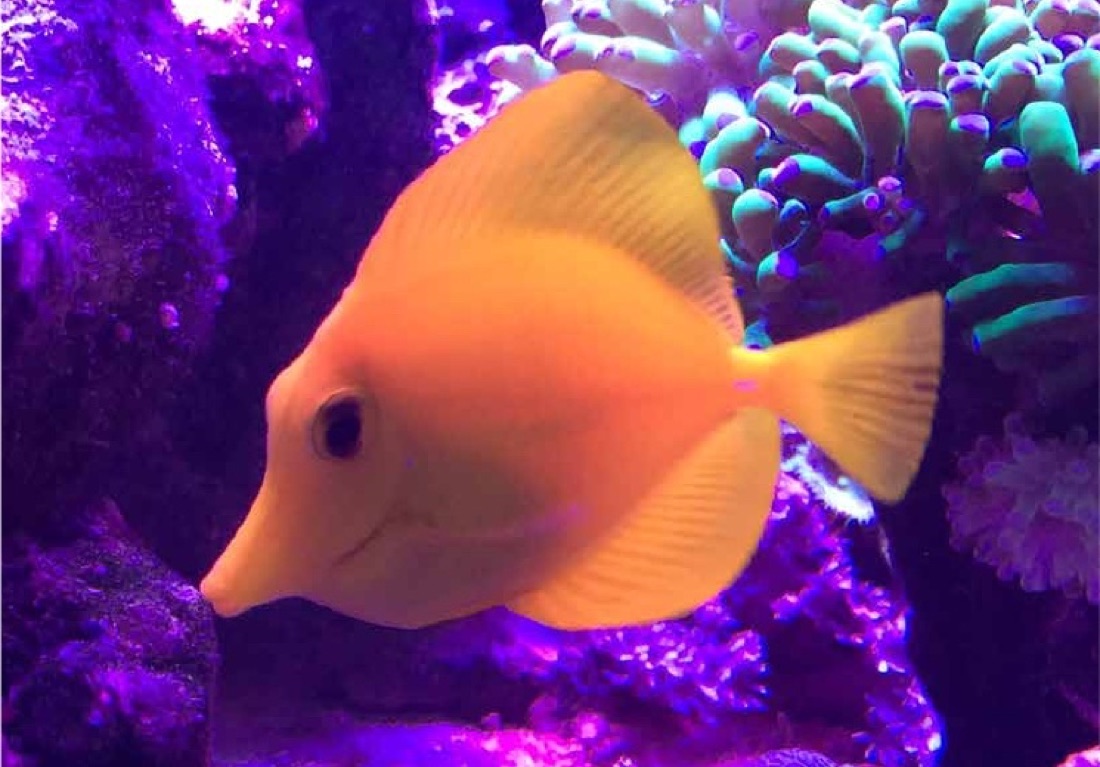
The yellow tang, known in Italian as pesce chirurgo giallo 21, belongs to the surgeonfish family (Acanthuridae). 1 It is entirely yellow, with a very deep body, a protruding snout and a blade on either side of the base of the tail. 2 3 It lives in the northern Pacific, grazes on algae on the bottom and is the marine fish most exported from Hawaii for aquariums. 2 3
At a glance
Data from the scientific sources listed at the bottom.
Depth in the wild
3–46 m
Size
up to 20 cm
maximum total length; commonly up to 16 cm
Temperature in the wild
24–28 °C
Where it lives
Northern Pacific: the Ryukyu and Ogasawara Islands, the Marianas, the Marshalls, Wake, Marcus (Minami Tori Shima) and Hawaii, where it is abundant. 2 3 The rare reports of all-yellow fish in the southern hemisphere may concern abnormal specimens of the related species Zebrasoma scopas. 3 Outside its natural range it has been recorded in Florida and, in 2008, on the north-east coast of Spain. 2 7
Conservation
IUCN Red List: least concern (2010). Red List data taken from FishBase and GBIF. 2 19 It does not appear in the CITES lists checked on Species+. 20 Almost 400,000 are collected every year from the reefs of Hawaii. 16 In 1999 a network of nine areas closed to collection was set up along the Kohala-Kona coast; by 2007 they held five times more fish of the sought-after size and 48% more adults than the open areas. 10 11 A genetic study tracked larvae dispersed over 15-184 km, in two cases from a protected area to unprotected areas. 11
How to recognise it
Tap a number on the photo: the key explains what to look for.
- 1All-yellow body a single colour on body and fins; here the lights make it look more orange 2 3
- 2Protruding snout drawn forwards, with a small mouth 3
- 3Tail blade at the base of the tail, with a white sheath: here it looks pinkish because of the lights 2 3
- 4Tall dorsal fin continuous, without notches 3
- 5Tall anal fin as high as the dorsal fin 3
Life in the wild
Where it is found
Coral-rich areas, both in sheltered lagoons and on the outer side of the reef, below the surge zone. 2 3 In calm water it can be found as shallow as 1 m; FAO gives it down to at least 50 m and FishBase cites a limit of 81 m over rocky bottom. 2 3 In Reef Life Survey counts it was observed in the sea between 22.9 and 30.6 °C. 4
Reproduction
It scatters its eggs in open water and does not care for its young. 5 It spawns in groups or in pairs, when a territorial male courts passing females. 2 In Hawaii egg production peaks at every full moon and, over the year, between late spring and summer; it is lowest from November to February but never stops completely. 8 A single spawning ranges from 44 to over 24,000 eggs: females of at least 12 cm standard length can exceed 20,000, and the yearly total is estimated at about one million. 8 Off Oahu maturity is given as 6.3 cm for females and 6.7 cm for males, a smaller size than expected. 6 9 The larval phase in the open sea lasts about 54-55 days. 11 12
In the aquarium
From the experience of the BallingMania community.
Zebrasoma flavescens is one of the most common aquarium fish because of its striking colour (lemon yellow), which makes it highly sought after by aquarists.
Young and adult specimens can live together if introduced at the same time; obviously the tank must be large enough to allow the territory to be divided adequately. Being a herbivorous fish, its diet will consist mainly of algae, on which it feeds constantly, searching for them in the crevices of the rocks in our aquariums, but it is strongly recommended to supplement it with plant-based foods, such as Nori seaweed, spirulina, spinach, courgettes and lightly blanched lettuce. In any case, being a very greedy fish, it will willingly accept every kind of frozen food (brine shrimp and mysis) and granular and/or flake foods.
This is a fish that is very skilled at using its sharp blades (scalpels) to defend itself and/or attack other fish. These blades (typical of Acanthurids) are located on both sides of the caudal peduncle.
photo by: Ciro Murino
What studies say about keeping it
Data from aquaculture studies, not advice for a home aquarium. In a 2018 study all specimens on the market were still wild-caught. 17 Rearing from eggs has succeeded, but with low yields: survival was 0.13-0.29% in 200 L tanks and 1.9% in a 1,000 L pilot trial; with a revised diet of copepod nauplii, rotifers, Artemia nauplii and then dry and frozen foods, 41% of the fish had full juvenile colour 70 days after hatching. 16 Between 3 and 5 days after hatching the larvae ate more with 12 or 16 hours of light and survived better with 16 hours; turbid water improved both feeding and survival compared with clear water. 18 Adding wild zooplankton to cultured copepod nauplii reduced survival from 18.5% to 6.9%. 17
Did you know?
Sources
- Froese R., Pauly D. (eds.), via WoRMS (2026). Zebrasoma flavescens (Bennett, 1828). World Register of Marine Species.
- Froese R., Pauly D. (eds.) (2026). Zebrasoma flavescens, Yellow tang. FishBase.
- Randall J.E., in Carpenter K.E., Niem V.H. (eds.) (2001). Acanthuridae. The living marine resources of the Western Central Pacific, vol. 6. FAO.
- Reef Life Survey (2026). Zebrasoma flavescens, Yellow tang. Reef Life Survey.
- Froese R., Pauly D. (eds.) (2026). Reproduction of Zebrasoma flavescens. FishBase.
- Froese R., Pauly D. (eds.) (2026). Maturity studies for Zebrasoma flavescens. FishBase.
- Froese R., Pauly D. (eds.) (2026). Introductions of Zebrasoma flavescens. FishBase.
- Bushnell M.E., Claisse J.T., Laidley C.W. (2010). Lunar and seasonal patterns in fecundity of an indeterminate, multiple-spawning surgeonfish, the yellow tang Zebrasoma flavescens. Journal of Fish Biology.
- Schemmel E. (2021). Size at maturity for yellow tang (Zebrasoma flavescens) from the Oahu, HI, aquarium fishery. Environmental Biology of Fishes, NOAA record.
- Williams I.D., Walsh W.J., Claisse J.T., Tissot B.N., Stamoulis K.A. (2009). Impacts of a Hawaiian marine protected area network on the abundance and fishery sustainability of the yellow tang, Zebrasoma flavescens. Biological Conservation.
- Christie M.R., Tissot B.N., Albins M.A., Beets J.P., Jia Y., Ortiz D.M., Thompson S.E., Hixon M.A. (2010). Larval connectivity in an effective network of marine protected areas. PLoS ONE.
- Eble J.A., Toonen R.J., Sorenson L., Basch L.V., Papastamatiou Y.P., Bowen B.W. (2011). Escaping paradise: Larval export from Hawaii in an Indo-Pacific reef fish, the Yellow Tang (Zebrasoma flavescens). Marine Ecology Progress Series.
- Bernardi G., Nelson P., Paddack M., Rulmal J. Jr, Crane N. (2018). Genomic islands of divergence in the Yellow Tang and the Brushtail Tang Surgeonfishes. Ecology and Evolution.
- Munday E.S., Tissot B.N., Heidel J.R., Miller-Morgan T. (2015). The effects of venting and decompression on Yellow Tang (Zebrasoma flavescens) in the marine ornamental aquarium fish trade. PeerJ.
- van Hall E.S., Korsmeyer K.E. (2025). Aerobic scope and temperature preference in yellow tang (Zebrasoma flavescens) at current and elevated sea temperatures. Journal of Comparative Physiology B.
- Callan C.K., Burgess A.I., Rothe C.R., Touse R. (2018). Development of Improved Feeding Methods in the Culture of Yellow Tang, Zebrasoma flavescens. Journal of the World Aquaculture Society.
- Burgess A.I., Callan C.K. (2018). Effects of supplemental wild zooplankton on prey preference, mouth gape, osteological development and survival in first feeding cultured larval yellow tang (Zebrasoma flavescens). Aquaculture.
- Pereira-Davison E., Callan C.K. (2018). Effects of photoperiod, light intensity, turbidity and prey density on feed incidence and survival in first feeding yellow tang (Zebrasoma flavescens)(Bennett). Aquaculture Research.
- GBIF Secretariat (2026). Zebrasoma flavescens, IUCN Red List category. GBIF.
- UNEP-WCMC (2026). Search for Zebrasoma flavescens in the CITES lists. Species+.
- GBIF Secretariat (2026). Zebrasoma flavescens, nomi comuni. GBIF.
Sources checked on 4 November 2026. Community texts and ratings are kept separate from the scientific data.