Zebrasoma desjardini
Currently accepted name: Zebrasoma desjardinii
Zebrasoma desjardinii is a surgeonfish (family Acanthuridae) 1 up to 40 cm long, with a disc-shaped body, a dorsal fin as tall as a sail and pale and dark bands on the flanks. 2 5 6 It lives from the Red Sea and East Africa to western Indonesia and grazes on algae, but it can also attack jellyfish. 2 7 8
At a glance
Data from the scientific sources listed at the bottom.
Depth in the wild
3–30 m
Size
up to 40 cm
maximum total length; commonly around 32 cm
Conservation
IUCN Red List: least concern (2010). Red List data taken from FishBase. 2 FishBase states that the species is not assessed by CITES, and a search on Species+ gives no results. 2 11 It is traded for aquariums and fished commercially. 2 5 In Reef Life Survey counts it appears at 4% of the sites checked within its range. 10
Where it lives
Indian Ocean, from East Africa and the Red Sea to the Andaman Sea, including the Andaman and Nicobar Islands, Myanmar and Thailand; it is also found west of Sumatra and is rare at Christmas Island. 2 Fishes of Australia also records it at the Cocos (Keeling) Islands. 5 In the Pacific it is replaced by the very similar species Zebrasoma veliferum. 4
How to recognise it
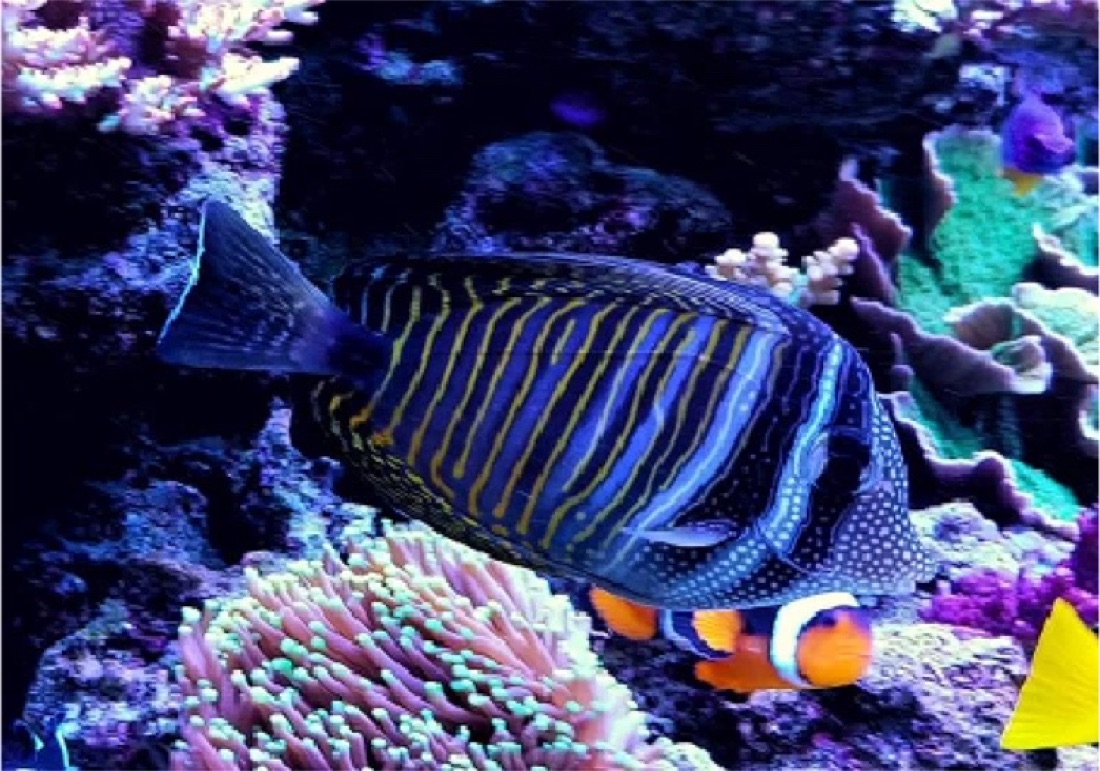
Tap a number on the photo: the key explains what to look for.
Life in the wild
What it eats
It grazes on algae: a study in the central Red Sea, based on stomach contents, classes it among feeders on red and green filamentous algae and algal turf. 8 In the northern Red Sea, however, between 2010 and 2015 it was seen hunting moon jellyfish (Aurelia aurita) and comb jellies in late spring and early summer, often two or more against the same prey; it made 24% of the attacks on the jellyfish and 17% of those on the comb jellies. 7
In the aquarium
From the experience of the BallingMania community.
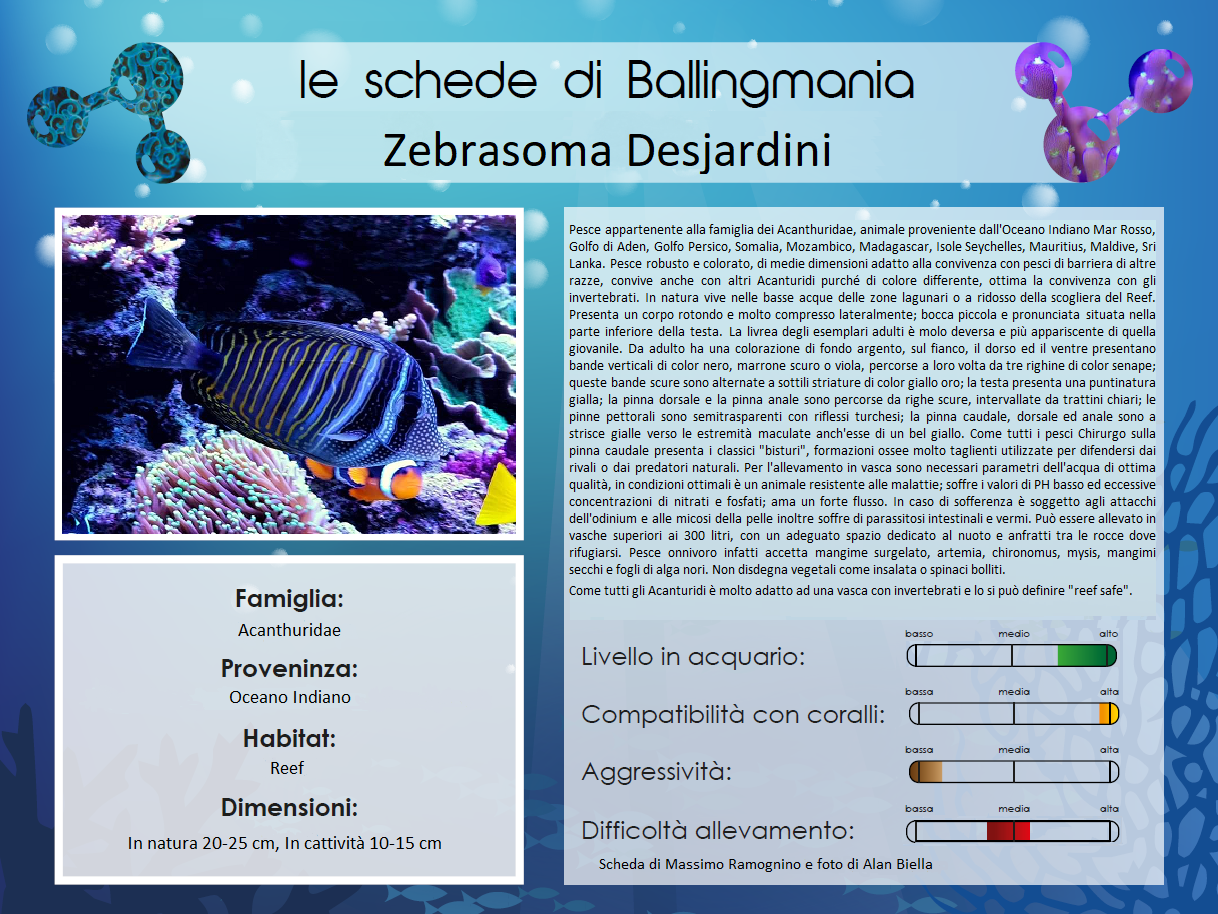
A fish belonging to the family Acanthuridae, an animal coming from the Indian Ocean: the Red Sea, the Gulf of Aden, the Persian Gulf, Somalia, Mozambique, Madagascar, the Seychelles, Mauritius, the Maldives and Sri Lanka. A hardy, colourful, medium-sized fish suitable for living with reef fish of other kinds; it also lives with other Acanthurids as long as they are a different colour, and it gets on very well with invertebrates. In the wild it lives in the shallow waters of lagoon areas or close to the reef cliff. It has a round body, strongly compressed laterally; a small, prominent mouth on the lower part of the head. The livery of adults is very different from, and more striking than, the juvenile one. As an adult its base colour is silver; on the flank, back and belly there are black, dark brown or purple vertical bands, each crossed in turn by three thin mustard-coloured lines; these dark bands alternate with thin golden yellow streaks; the head has yellow dotting; the dorsal and anal fins are crossed by dark lines, interspersed with pale dashes; the pectoral fins are semi-transparent with turquoise highlights; the caudal, dorsal and anal fins are striped yellow towards the tips, which are also spotted with a beautiful yellow. Like all surgeonfish, on the caudal fin it has the classic "scalpels", very sharp bony structures used to defend itself from rivals or natural predators. To keep it in a tank, excellent water quality is needed; in optimal conditions it is an animal resistant to disease; it suffers from low pH and excessive concentrations of nitrate and phosphate; it loves a strong flow. When stressed it is prone to attacks of Oodinium and to fungal skin infections, and it also suffers from intestinal parasites and worms. It can be kept in tanks larger than 300 litres, with adequate room for swimming and crevices among the rocks to take refuge in. An omnivorous fish: in fact it accepts frozen food, Artemia, chironomus, mysis, dry foods and sheets of Nori seaweed. It does not refuse vegetables such as lettuce or boiled spinach.
Like all Acanthurids it is very well suited to a tank with invertebrates and can be called "reef safe".
Species sheet by Massimo Ramognino and photo by Alan Biella
Did you know?
Sources
- Froese R., Pauly D. (eds.), via WoRMS (2026). Zebrasoma desjardinii (Bennett, 1836). World Register of Marine Species.
- Froese R., Pauly D. (eds.) (2026). Zebrasoma desjardinii, Indian sail-fin surgeonfish. FishBase.
- Froese R., Pauly D. (eds.) (2026). Reproduction of Zebrasoma desjardinii. FishBase.
- Randall J.E., in Carpenter K.E., Niem V.H. (eds.) (2001). Acanthuridae. The living marine resources of the Western Central Pacific, vol. 6. FAO.
- Bray D.J. (2019). Indian Sailfin Tang, Zebrasoma desjardinii (Bennett 1836). Fishes of Australia, Museums Victoria.
- National Museum of Nature and Science (2026). Zebrasoma desjardinii, Fishes of Andaman Sea. National Museum of Nature and Science, Tokyo.
- Bos A.R., Cruz-Rivera E., Sanad A.M. (2017). Herbivorous fishes Siganus rivulatus (Siganidae) and Zebrasoma desjardinii (Acanthuridae) feed on Ctenophora and Scyphozoa in the Red Sea. Marine Biodiversity.
- Miyake S., Ngugi D.K., Stingl U. (2016). Phylogenetic Diversity, Distribution, and Cophylogeny of Giant Bacteria (Epulopiscium) with their Surgeonfish Hosts in the Red Sea. Frontiers in Microbiology.
- Randall J.E. (2005). A Review of Mimicry in Marine Fishes. Zoological Studies.
- Reef Life Survey (2026). Zebrasoma desjardinii. Reef Life Survey.
- UNEP-WCMC (2026). Search for Zebrasoma desjardinii in the CITES lists. Species+.
Sources checked on 5 November 2026. Community texts and ratings are kept separate from the scientific data.