Zanclus cornutus
Moorish idol
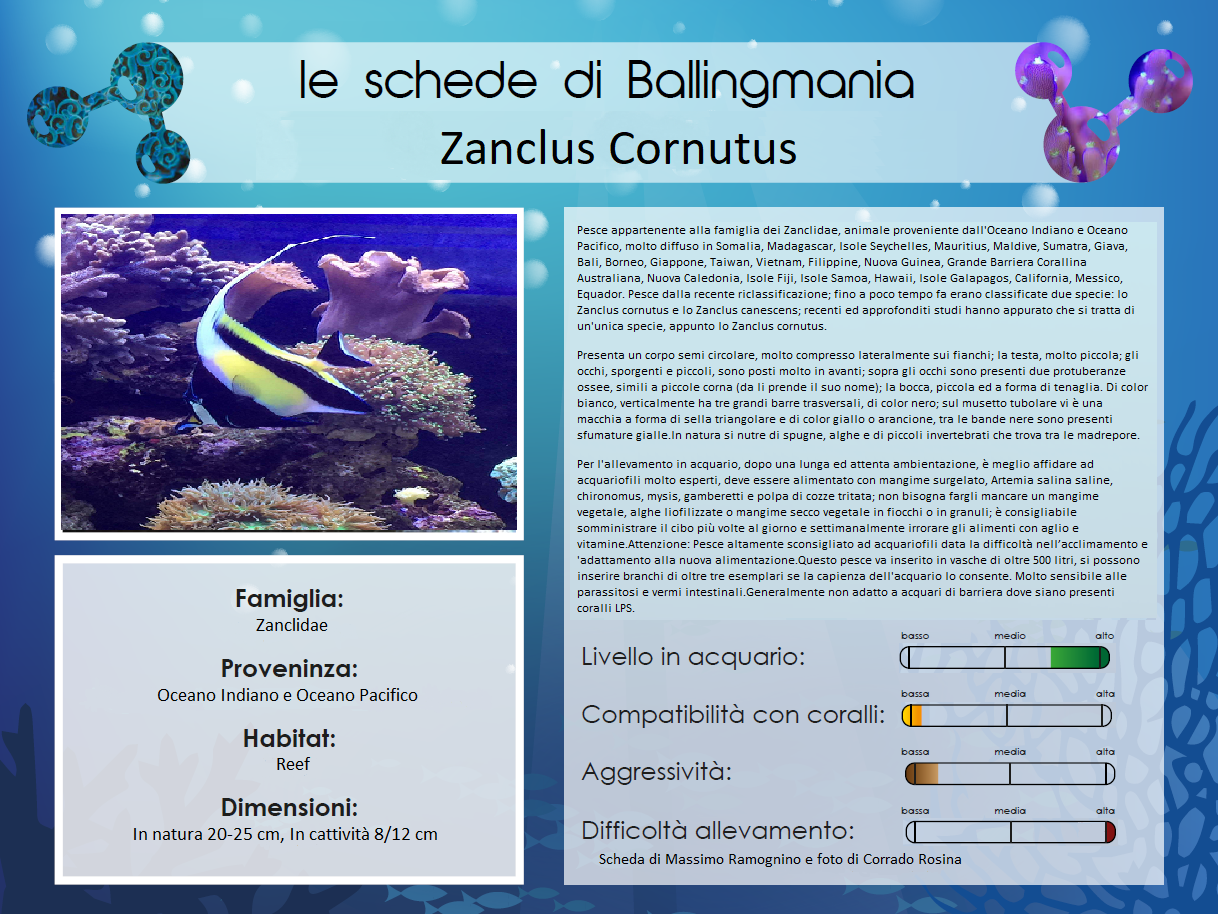
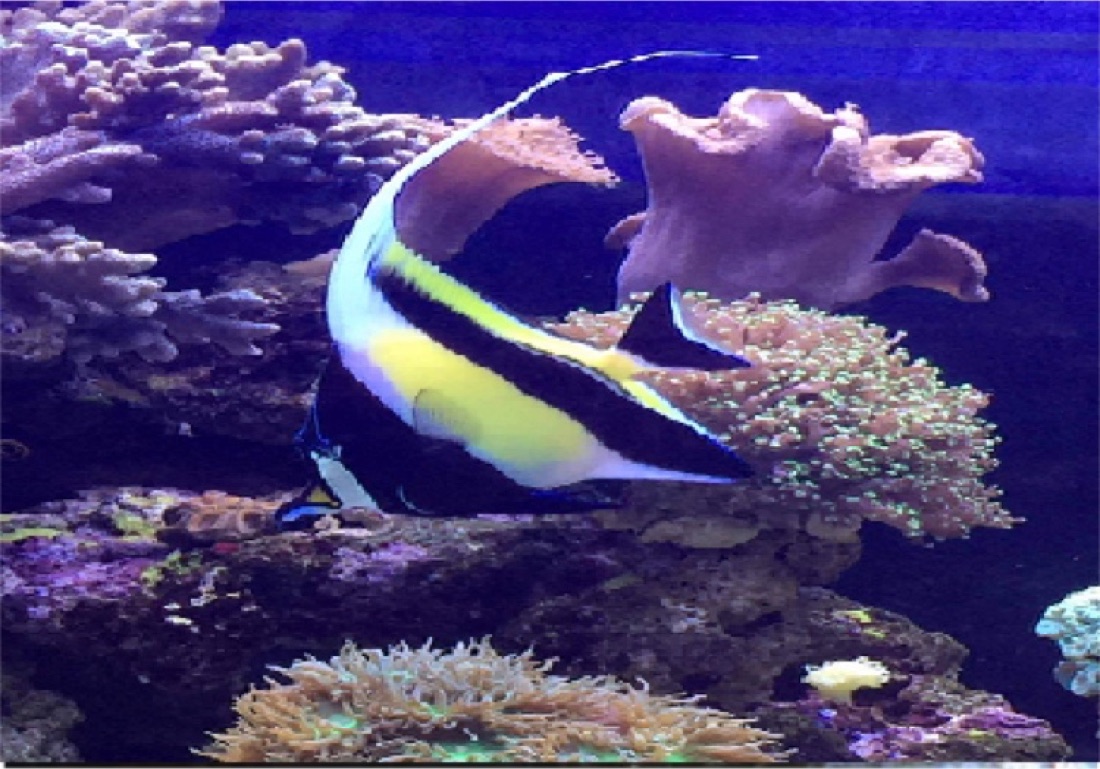
The Moorish idol, known in Italian as idolo moresco 14, is the only species in the family Zanclidae. 1 3 It has a tall body, strongly flattened from side to side, a tube-like snout, a very long white filament on the dorsal fin and large black, white and yellow bands. 3 4 It lives on coral and rocky reefs across much of the Indo-Pacific and eats mainly sponges. 3
At a glance
Data from the scientific sources listed at the bottom.
Size
up to 23 cm
maximum total length; FAO gives up to 16 cm as a common size
Temperature in the wild
24–28 °C
Conservation
IUCN Red List: least concern (2015). Red List data taken from FishBase, GBIF and Fishes of Australia. 2 5 12 It does not appear in the CITES lists checked on Species+ or in the Smithsonian database. 7 13 For the trade only the smallest specimens are collected, because adults are too large and adapt poorly to life in a tank. 3 FishBase estimates a low vulnerability to fishing. 2
Where it lives
Indo-Pacific, excluding the Red Sea and the Persian Gulf: from East Africa to Rapa and Ducie Islands, north to southern Japan and Hawaii, south to Lord Howe. 2 3 In the eastern Pacific it ranges from the southern Gulf of California to Peru and reaches the oceanic islands. 2 7 The most northerly records in Japan and the most southerly in Australia are explained by warm currents, which carry the postlarvae outside the area where the species breeds. 3
How to recognise it
Tap a number on the photo: the key explains what to look for.
- 1Dorsal filament it is the third spiny ray of the dorsal fin, usually longer than the body 3
- 2First black bar it starts at the eye and widens over the chest, pelvic fins and half the belly 3
- 3Second black bar in the rear half, it extends into the dorsal and anal fins 3
- 4Mostly black tail with a white rear margin 3 7
- 5Saddle on the snout orange or yellow with a black edge; here it looks yellow 3 6
Life in the wild
What it eats
Omnivore, but it eats more animals than algae. Sponges dominate among the animals; bryozoans, small molluscs and crustaceans, hydroids and tunicates have also been found in the stomachs. 3 Fishes of Australia adds coral polyps. 5 It uses its long snout to reach food in crevices. 6 In juveniles studied in Hawaii and Okinawa, bottom-dwelling animals made up 85-87% of the diet. 10
Reproduction
It scatters its eggs in open water and does not care for its young. 11 The long larval phase in the open sea explains its very wide range. 2 8 The postlarva reaches 7.5-8 cm, an unusual size for a reef fish, and has on each side of the head a curved spine that it loses when it turns into a juvenile. 2 3 8
In the aquarium
From the experience of the BallingMania community.
A fish belonging to the family Zanclidae, an animal coming from the Indian Ocean and the Pacific Ocean, very widespread in Somalia, Madagascar, the Seychelles, Mauritius, the Maldives, Sumatra, Java, Bali, Borneo, Japan, Taiwan, Vietnam, the Philippines, New Guinea, the Australian Great Barrier Reef, New Caledonia, the Fiji Islands, the Samoa Islands, Hawaii, the Galápagos Islands, California, Mexico and Ecuador. A recently reclassified fish; until recently two species were recognised, Zanclus cornutus and Zanclus canescens; recent in-depth studies have established that they are a single species, namely Zanclus cornutus.
It has a semicircular body, strongly compressed on the flanks; the head is very small; the eyes, protruding and small, are set far forward; above the eyes there are two bony protuberances, like small horns (hence its name); the mouth is small and pincer-shaped. White in colour, it has three large black vertical bars; on the tubular snout there is a triangular saddle-shaped patch, yellow or orange, and between the black bands there are yellow shadings. In the wild it feeds on sponges, algae and small invertebrates that it finds among the stony corals. For keeping in an aquarium, after a long and careful settling-in, it is best left to very experienced aquarists; it must be fed frozen food, brine shrimp, chironomus, mysis, shrimp and minced mussel flesh; it must never go without plant food, freeze-dried algae or dry vegetable food in flakes or granules; it is advisable to give food several times a day and, every week, to soak the food in garlic and vitamins. Warning: this fish is highly not recommended for aquarists, given the difficulty of acclimatisation and of adapting to the new diet. This fish should be placed in tanks of over 500 litres; groups of more than three specimens can be kept if the capacity of the aquarium allows. Very susceptible to parasites and intestinal worms. Generally not suitable for reef aquariums containing LPS corals.
Species sheet by Massimo Ramognino and photo by Corrado Rosina
Did you know?
Sources
- Froese R., Pauly D. (eds.), via WoRMS (2026). Zanclus cornutus (Linnaeus, 1758). World Register of Marine Species.
- Froese R., Pauly D. (eds.) (2026). Zanclus cornutus, Moorish idol. FishBase.
- Randall J.E., in Carpenter K.E., Niem V.H. (eds.) (2001). Zanclidae. The living marine resources of the Western Central Pacific, vol. 6. FAO.
- Reef Life Survey (2026). Zanclus cornutus, Moorish idol. Reef Life Survey.
- Bray D.J. (2018). Moorish Idol, Zanclus cornutus (Linnaeus 1758). Fishes of Australia, Museums Victoria.
- McGrouther M. (2021). Moorish Idol, Zanclus cornutus (Linnaeus, 1758). Australian Museum.
- Smithsonian Tropical Research Institute (contatto: Robertson D.R.) (2024). Zanclus cornutus, Moorish idol. Shorefishes of the Eastern Pacific online information system. Smithsonian Tropical Research Institute.
- Australian Museum (2026). Moorish Idol (Zanclus cornutus), Lizard Island Field Guide. Australian Museum.
- Berendzen P.B.Z., Tang K.L., Wiley E.O., Morrissey J.F., Winterbottom R., Johnson G.D. (1999). The Phylogenetic Relationships of the Suborder Acanthuroidei (Teleostei: Perciformes) Based on Molecular and Morphological Evidence. Molecular Phylogenetics and Evolution.
- Froese R., Pauly D. (eds.) (2026). Food and Feeding Habits: Diet Composition, Zanclus cornutus. FishBase.
- Froese R., Pauly D. (eds.) (2026). Reproduction of Zanclus cornutus. FishBase.
- GBIF Secretariat (2026). Zanclus cornutus, IUCN Red List category. GBIF.
- UNEP-WCMC (2026). Search for Zanclus cornutus in the CITES lists. Species+.
- GBIF Secretariat (2026). Zanclus cornutus, nomi comuni. GBIF.
Sources checked on 4 November 2026. Community texts and ratings are kept separate from the scientific data.