Synchiropus splendidus
Mandarinfish
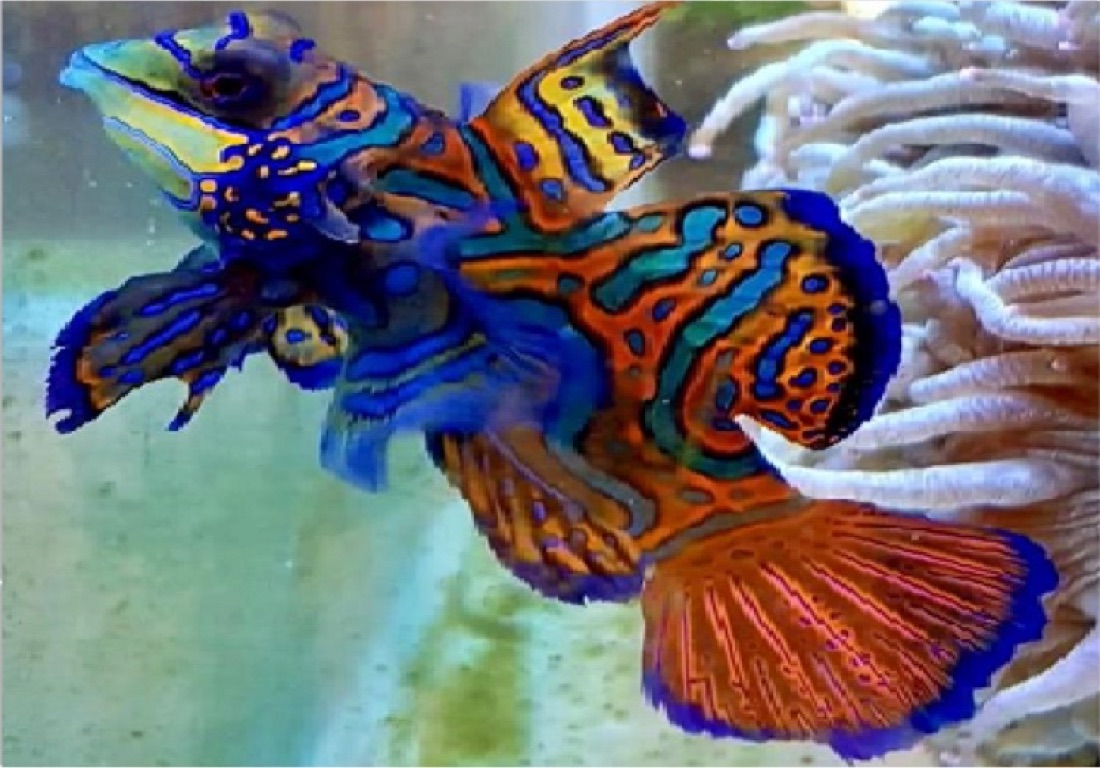
A small bottom-dwelling fish of the dragonet family (Callionymidae), known in Italian as pesce mandarino, reaching at most about 7 cm. 1 2 4 It has a pattern of green, blue and orange swirls and scaleless skin covered in mucus. 3 14 By day it stays hidden in the reef and shows itself mainly at dusk, when it gathers to spawn. 3 15
At a glance
Data from the scientific sources listed at the bottom.
Depth in the wild
1–18 m
Size
up to 7 cm
maximum total length
Temperature in the wild
27.4–31.4 °C
Where it lives
Western Pacific, from the Ryukyu Islands to Australia. 2 Also recorded in the Philippines, Indonesia, Hong Kong and New Guinea. 14 In Palau and on the Philippine island of Bohol, specimens were collected for a genetic study. 7
Conservation
IUCN Red List: least concern (2018). Red List data taken from FishBase and GBIF. 2 5 It does not appear in the CITES lists checked on Species+. 6 Collection for the aquarium hobby is unregulated and mainly hits males: at Bohol, in the Philippines, at four sites out of five there were 0.12-0.30 males per female, compared with 2.3 in Palau, where the species is not exploited. 7
How to recognise it
Tap a number on the photo: the key explains what to look for.
- 1Throat with yellow spots an area dotted with yellow between throat and cheek 3
- 2Swirl pattern green, blue and orange markings that curl around the body 3
- 3Tall first dorsal fin highly developed in the male, which is why males are caught more 7 15
- 4Fan-shaped pelvic fin broad, it uses it to walk on the bottom 14
Life in the wild
Behaviour
It hides in the reef during the day; at dusk it swims above coral branches and rubble in short bursts. 3 It usually lives in small groups spread over a small area. 2 As an adult it is sedentary. 7 There is a size-based hierarchy among males: the largest mate much more often. 15 In the aquarium two males together tend to attack each other. 14
Reproduction
The eggs are released into open water and the parents do not care for them. 14 Every evening males and females meet at small fixed spots on the reef: the pair lines up, rises slowly for about a metre and releases eggs and sperm. 15 A female spawns at most once a night, while a male can do so up to 8 times. 8 Each spawning contains 12 to 205 eggs, and larval life lasts about 14 days, one of the shortest known among fish with pelagic eggs. 7 At hatching the larvae measure about 1.5 mm. 13 Females prefer larger males, which release more sperm on average. 9
In the aquarium
From the experience of the BallingMania community.
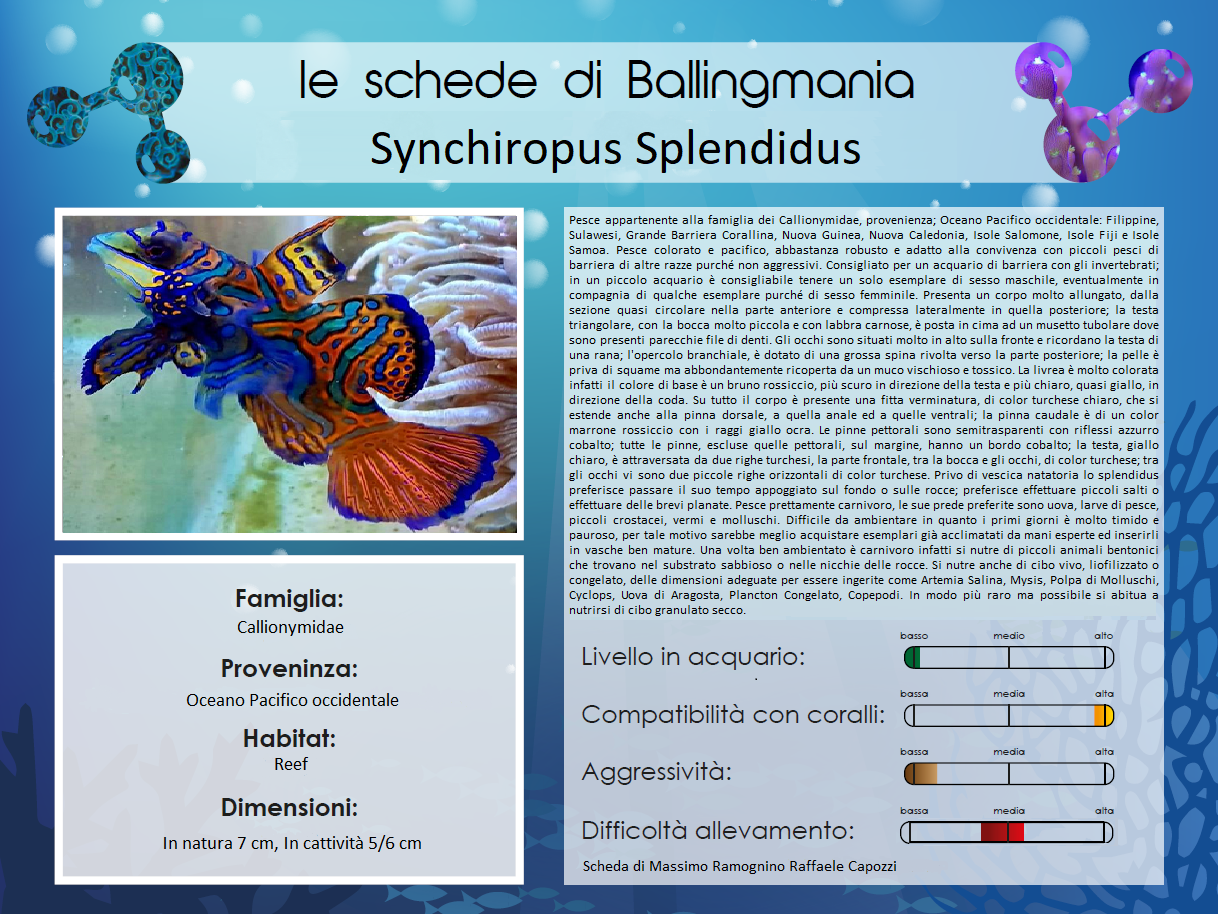
A fish belonging to the family Callionymidae, origin: the western Pacific Ocean: the Philippines, Sulawesi, the Great Barrier Reef, New Guinea, New Caledonia, the Solomon Islands, the Fiji Islands and the Samoa Islands. A colourful, peaceful, fairly hardy fish, suitable for living with small reef fish of other kinds as long as they are not aggressive. Recommended for a reef aquarium with invertebrates; in a small aquarium it is advisable to keep only one male, possibly together with a few other specimens as long as they are female. It has a very elongated body, almost circular in cross-section at the front and laterally compressed at the rear; the triangular head, with a very small mouth and fleshy lips, sits at the tip of a small tubular snout with several rows of teeth. The eyes are set very high on the forehead and recall the head of a frog; the gill cover has a large spine pointing backwards; the skin has no scales but is abundantly covered with a sticky, toxic mucus. The livery is very colourful: the base colour is a reddish brown, darker towards the head and paler, almost yellow, towards the tail. All over the body there is a dense pale turquoise vermiculated pattern, which also extends to the dorsal, anal and pelvic fins; the caudal fin is reddish brown with ochre-yellow rays. The pectoral fins are semi-transparent with cobalt blue highlights; all the fins except the pectorals have a cobalt edge; the head, pale yellow, is crossed by two turquoise lines, and the front part, between the mouth and the eyes, is turquoise; between the eyes there are two small horizontal turquoise lines. Lacking a swim bladder, splendidus prefers to spend its time resting on the bottom or on the rocks; it prefers to make small hops or short glides. A strictly carnivorous fish, its favourite prey are eggs, fish larvae, small crustaceans, worms and molluscs. Difficult to settle in, as in the first days it is very shy and fearful; for this reason it would be better to buy specimens already acclimatised by expert hands and introduce them into well-matured tanks. Once well settled in it is carnivorous: in fact it feeds on small bottom-dwelling animals found in the sandy substrate or in the niches of the rocks. It also feeds on live, freeze-dried or frozen food of a suitable size to be swallowed, such as brine shrimp, Mysis, mollusc flesh, Cyclops, lobster eggs, frozen plankton and copepods. More rarely, but possibly, it gets used to eating dry granular food.
Species sheet by Massimo Ramognino Raffaele Capozzi
What studies say about keeping it
Data from rearing studies, not advice for a home aquarium. The trade still relies largely on wild-caught specimens, because breeding it in captivity is difficult. 11 12 Larval trials show that rotifers alone are not enough: survival at 11 days stayed below 3.3%, and rose to around 50% when copepods (Parvocalanus crassirostris) were added, with at least 1 copepod per millilitre. 12 Switching directly from copepods to Artemia nauplii at 18-21 days gave the best survival and, after settling on the bottom, live prey worked better than dead prey. 13
Did you know?
Sources
- Froese R., Pauly D. (FishBase) (2026). Synchiropus splendidus (Herre, 1927). World Register of Marine Species.
- Froese R., Pauly D. (eds.) (2026). Synchiropus splendidus, Mandarinfish. FishBase.
- Reef Life Survey (2026). Synchiropus splendidus - Mandarinfish. Reef Life Survey.
- GBIF Secretariat (da Catalogue of Life) (2026). Synchiropus splendidus, nomi comuni. GBIF.
- GBIF Secretariat (2026). Synchiropus splendidus, IUCN Red List category. GBIF.
- UNEP-WCMC (2026). Search for Synchiropus splendidus in the CITES lists. Species+.
- Leung P.T.Y., Ma K.Y., Liu M., Planes S., de Mitcheson Y.S. (2020). Population Genetic Structure of A Marine Pelagic Egg Producer and Popular Marine Aquarium Species, the Mandarinfish Synchiropus splendidus. Zoological Studies.
- Sadovy de Mitcheson Y., Mitcheson G., Rasotto M.B. (2022). Mating system in a small pelagic spawner: field case study of the mandarinfish, Synchiropus splendidus. Environmental Biology of Fishes.
- Rasotto M.B. et al. (2010). Male body size predicts sperm number in the mandarinfish. Journal of Zoology.
- Sadovy Y., Randall J.E., Rasotto M.B. (2005). Skin structure in six dragonet species (Gobiesociformes; Callionymidae): interspecific differences in glandular cell types and mucus secretion. Journal of Fish Biology.
- Stervander M., Cresko W.A. (2021). A highly contiguous nuclear genome assembly of the mandarinfish Synchiropus splendidus (Syngnathiformes: Callionymidae). G3: Genes, Genomes, Genetics.
- Zeng C., Shao L., Ricketts A., Moorhead J. (2018). The importance of copepods as live feed for larval rearing of the green mandarin fish Synchiropus splendidus. Aquaculture.
- Shao L. (2016). Development of larval fish rearing techniques and nutrient requirements for the green mandarin, Synchiropus splendidus (PhD thesis). James Cook University.
- Patel K. (2006). Synchiropus splendidus. Animal Diversity Web, University of Michigan.
- Sadovy Y. (2001). When being female is better. Porcupine! 23, University of Hong Kong.
Sources checked on 4 November 2026. Community texts and ratings are kept separate from the scientific data.