At a glance
Data from the scientific sources listed at the bottom.
How to recognise it
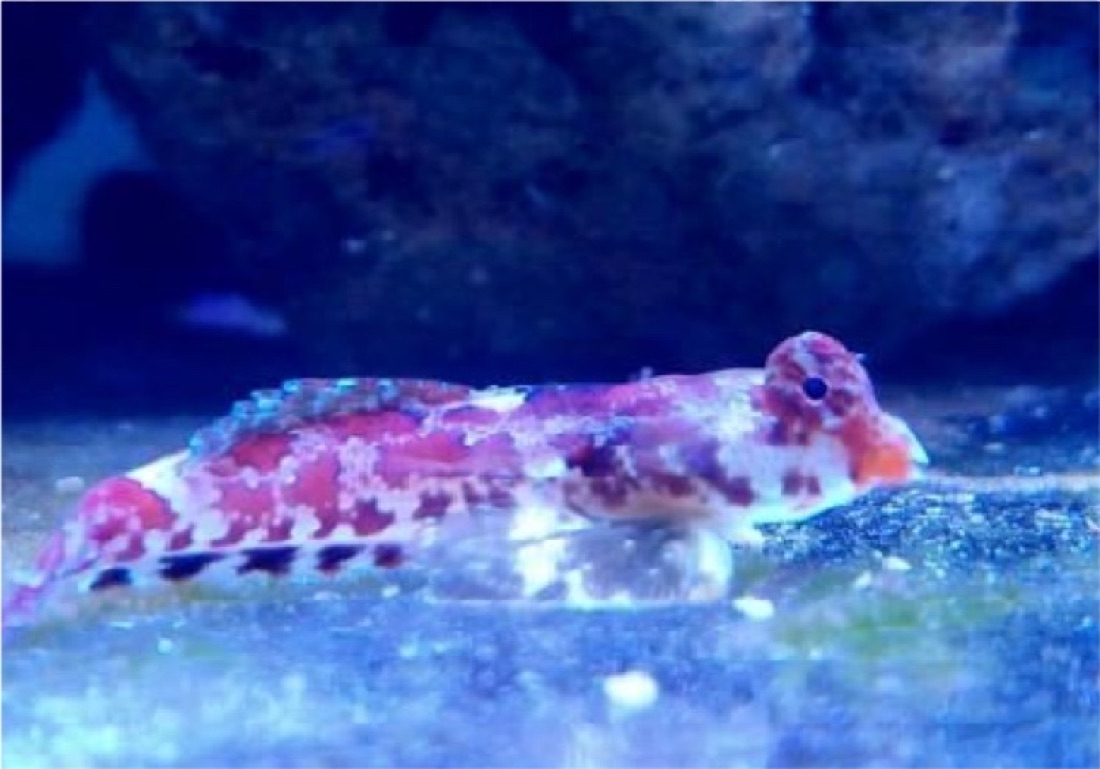
Tap a number on the photo: the key explains what to look for.
Life in the wild
Behaviour
Like other Callionymidae it is a small fish that lives on the bottom. Almost all species in the family have different colours in the two sexes. 6
Reproduction
It has separate sexes and fertilisation is external. It does not care for its eggs, which are scattered in open water or on the bottom. FishBase has no data on the frequency and mode of spawning. 3
In the aquarium
From the experience of the BallingMania community.
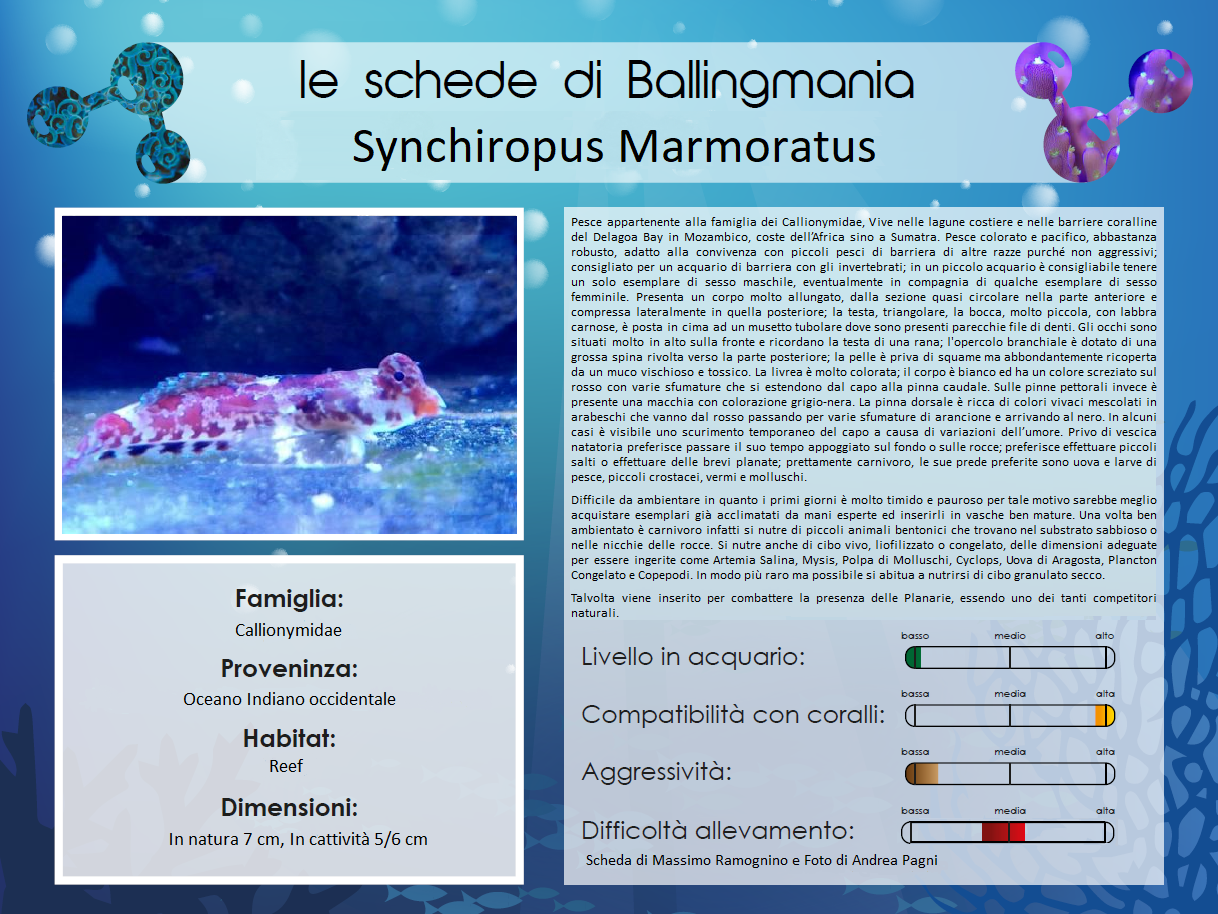
A fish belonging to the family Callionymidae. It lives in coastal lagoons and coral reefs from Delagoa Bay in Mozambique, along the coasts of Africa as far as Sumatra. A colourful, peaceful and fairly hardy fish, suitable for living with small reef fish of other kinds as long as they are not aggressive; recommended for a reef aquarium with invertebrates; in a small aquarium it is advisable to keep only one male, possibly together with a few females. It has a very elongated body, almost circular in cross-section at the front and laterally compressed at the rear; the head is triangular; the mouth, very small, with fleshy lips, sits at the tip of a small tubular snout with several rows of teeth. The eyes are set very high on the forehead and recall the head of a frog; the gill cover has a large spine pointing backwards; the skin has no scales but is abundantly covered with a sticky, toxic mucus. The livery is very colourful; the body is white with red mottling in various shades that extend from the head to the caudal fin. On the pectoral fins, on the other hand, there is a greyish-black patch. The dorsal fin is rich in bright colours mixed in arabesques ranging from red, through various shades of orange, to black. In some cases a temporary darkening of the head can be seen, due to changes in mood. Lacking a swim bladder, it prefers to spend its time resting on the bottom or on the rocks; it prefers to make small hops or short glides; strictly carnivorous, its favourite prey are fish eggs and larvae, small crustaceans, worms and molluscs.
Difficult to settle in, as in the first days it is very shy and fearful; for this reason it would be better to buy specimens already acclimatised by expert hands and introduce them into well-matured tanks. Once well settled in it is carnivorous: in fact it feeds on small bottom-dwelling animals found in the sandy substrate or in the niches of the rocks. It also feeds on live, freeze-dried or frozen food of a suitable size to be swallowed, such as brine shrimp, Mysis, mollusc flesh, Cyclops, lobster eggs, frozen plankton and copepods. More rarely, but possibly, it gets used to eating dry granular food. It is sometimes introduced to combat flatworms, being one of their many natural competitors.
Species sheet by Massimo Ramognino and photo by Andrea Pagni
What studies say about keeping it
The only data found: FishBase lists it as a species in the aquarium trade. 2
Did you know?
Sources
- WoRMS Editorial Board (2026). Synchiropus marmoratus (Peters, 1855). World Register of Marine Species.
- Froese R., Pauly D. (eds.) (2026). Synchiropus marmoratus, Marbled dragonet. FishBase.
- Froese R., Pauly D. (eds.) (2026). Reproduction of Synchiropus marmoratus. FishBase.
- Fricke R., Eschmeyer W.N., van der Laan R. (eds.) (2026). Synchiropus marmoratus, Eschmeyer's Catalog of Fishes. California Academy of Sciences.
- Fricke R. (2016). Synchiropus novaehiberniensis, a new species of dragonet from New Ireland, Papua New Guinea, western Pacific Ocean, with a review of subgenus Synchiropus (Neosynchiropus) and description of a new subgenus (Teleostei: Callionymidae). Journal of Natural History.
- Fricke R. (1983). FAO Species Identification Sheets, Fishing Area 51: Callionymidae. FAO.
- Sadovy Y., Randall J.E., Rasotto M.B. (2005). Skin structure in six dragonet species (Gobiesociformes; Callionymidae): interspecific differences in glandular cell types and mucus secretion. Journal of Fish Biology.
- UNEP-WCMC (2026). Search for Synchiropus marmoratus in the CITES lists. Species+.
Sources checked on 5 November 2026. Community texts and ratings are kept separate from the scientific data.