
Pseudoanthias squamipinnis
Currently accepted name: Pseudanthias squamipinnis
Pseudanthias squamipinnis, of the family Anthiadidae, 1 is a small reef fish that forms large schools above corals and feeds on zooplankton. 2 It is born female: females are golden orange, up to 7 cm, while males are pinkish purple, reach 15 cm and have a long ray on the dorsal fin. 2 5 When a male is missing, a female can change sex and take his place. 2 7
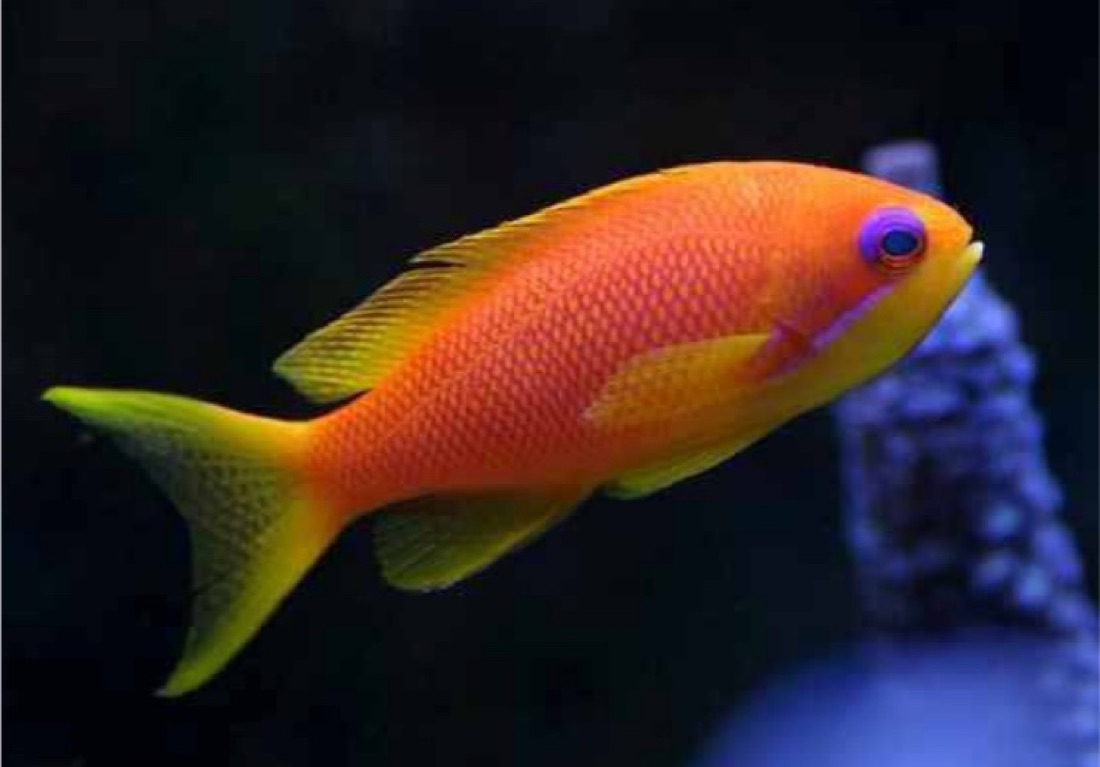
At a glance
Data from the scientific sources listed at the bottom.
Depth in the wild
5–35 m
Size
up to 15 cm
maximum total length of males; females up to 7 cm
Temperature in the wild
22–28 °C
Where it lives
Western Indo-Pacific: from the Red Sea and Natal, in South Africa, to Niue, north to Japan and south to Australia, with one record from Europa Island. 2 In Australia it ranges from the offshore reefs of Western Australia, and from the northern Great Barrier Reef, to Montague Island; it is also present at Christmas Island, Lord Howe and Norfolk. 5 According to Kuiter, cited by Fishes of Australia, the true P. squamipinnis would be found only in the western Indian Ocean and the Australian fish would be P. cheirospilos. 5
Conservation
IUCN Red List: least concern (2015). Red List data taken from FishBase, GBIF and Biondo et al., who give its population as stable. 2 9 10 It does not appear in the CITES lists checked on Species+. 11 Between 2014 and 2021 about 164,000 specimens were imported into the European Union, 0.9% of marine ornamental fish. 9
How to recognise it
Tap a number on the photo: the key explains what to look for.
- 1Violet eye the outer rim is violet in the female; in P. huchtii it is yellow 4
- 2Violet stripe from the eye to the base of the pectoral fin 5
- 3Large scales on a golden orange background, with a pale violet edge 4 5 6
- 4Dorsal fin without a long ray this is a female: in the male the third ray is greatly elongated 4 5
- 5Two-lobed tail in the male the lobes are longer 5 6
Life in the wild
Where it is found
Above coral heads or patch reefs in clear lagoons, channels and outer slopes. 2 5 It usually stays between 5 and 35 m; FishBase and Reef Life Survey give an overall range of 0-55 m. 2 4 In Reef Life Survey counts it was observed in the sea between 19 and 30.8 °C: a wider range than the 22-28 °C given by FishBase. 2 4
Behaviour
It forms large aggregations: where Reef Life Survey finds it, it counts an average of 103 fish per transect, and it is the most common Pseudanthias on shallow reefs. 2 4 In a survey of 50 ornamental fish in the Red Sea and the Gulf of Aden it was the second most abundant (34.7% of specimens) and the first in Jordan (40.7%). 8
Reproduction
All males come from females that have changed sex (protogynous hermaphroditism). 2 3 Males defend a territory with a harem and spawn every night with several females. 2 5 Fertilisation is external, the eggs are pelagic and there is no parental care; FishBase gives one seasonal peak a year. 3 If the male is removed, the sex change is completed in 2-4 weeks; in a group of females only, it takes 170-280 days instead. 2 3 The size given for the change is about 5 cm. 3 When 3 to 9 males were removed from large groups, the same number of females changed sex one after another, about 1.9 days apart. 7
In the aquarium
From the experience of the BallingMania community.
Pseudanthias squamipinnis is a very lively shoaling fish. All specimens are born female; later on the most dominant one changes and becomes male, controlling the whole harem.
Females are normally orange with a violet eye, while males are more reddish, with a long first ray on the dorsal fin.
These fish need to be fed 3-4 times a day, as they have a very fast metabolism; when first introduced into the aquarium they must be given frozen food such as Mysis and Artemia, and only later can they be weaned onto dry food.
A reef safe fish; it is advisable to keep them in groups of at least 10 specimens to enjoy them in the aquarium, which should be furnished with plenty of hiding places and crevices.
photo by: Matteo De Benedictis
What studies say about keeping it
Data from an aquaculture study, not advice for a home aquarium. In a 2026 study in Taiwan, two males and two females kept in a tank spawned 133 times between March and December 2024, with an average of 323 eggs per spawning and 71% fertilisation. 12 The eggs are buoyant and transparent, about 0.68 mm; the higher the temperature, the fewer the eggs. 12 Hatching was best at a salinity of 25 (87.5-99%), and 2-day-old larvae survived best at a salinity of 25 and between 21 and 25 °C. 12 On a copepod-based diet, metamorphosis was complete at 24 days and at 55 days the juveniles measured about 17.6 mm. 12
Did you know?
Sources
- Froese R., Pauly D. (eds.), via WoRMS (2026). Pseudanthias squamipinnis (Peters, 1855). World Register of Marine Species.
- Froese R., Pauly D. (eds.) (2026). Pseudanthias squamipinnis, Sea goldie. FishBase.
- Froese R., Pauly D. (eds.) (2026). Reproduction of Pseudanthias squamipinnis. FishBase.
- Reef Life Survey (2026). Pseudanthias squamipinnis, Orange seaperch. Reef Life Survey.
- Bray D.J. (2025). Pseudanthias squamipinnis in Fishes of Australia. Museums Victoria.
- Australian Museum (2026). Orange Basslet, Pseudanthias squamipinnis (Peters, 1855). Australian Museum.
- Shapiro D.Y. (1980). Serial female sex changes after simultaneous removal of males from social groups of a coral reef fish. Science.
- Khalaf M.A., Abdallah M. (2014). Spatial distribution of fifty ornamental fish species on coral reefs in the Red Sea and Gulf of Aden. ZooKeys.
- Biondo M.V., Burki R.P., Aguayo F., Calado R. (2024). An updated review of the marine ornamental fish trade in the European Union. Animals.
- GBIF Secretariat (2026). Pseudanthias squamipinnis, IUCN Red List category. GBIF.
- UNEP-WCMC, Segretariato CITES (2026). Search for Pseudanthias squamipinnis in the CITES lists. Species+.
- Chou T.C., Lu A., Lin Y.Y. et al. (2026). Captive breeding and early development of tank-reared lyretail anthias Pseudanthias squamipinnis (Peters, 1855): Assessments of hatching success, larval survival, and ontogeny. Aquaculture.
Sources checked on 5 November 2026. Community texts and ratings are kept separate from the scientific data.