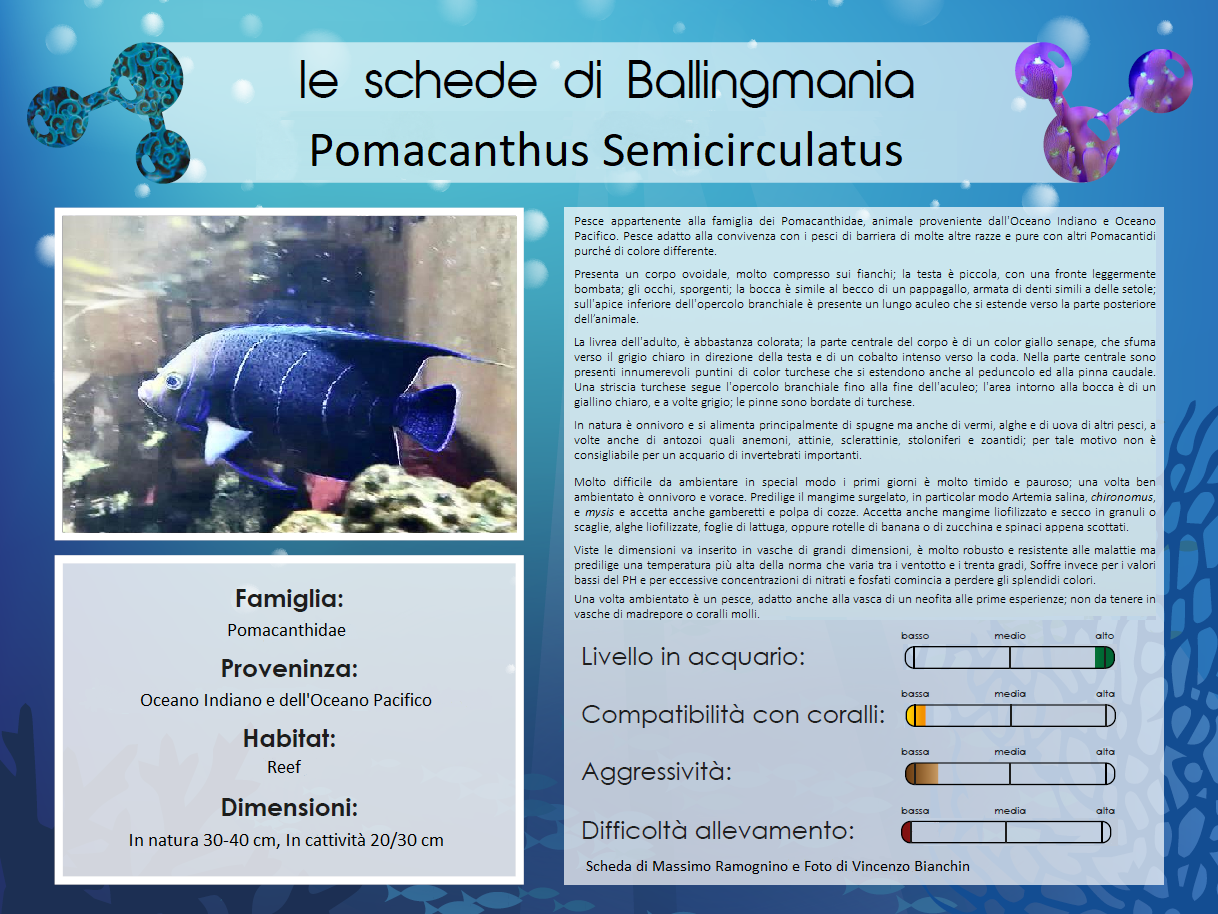
Pomacanthus semicirculatus
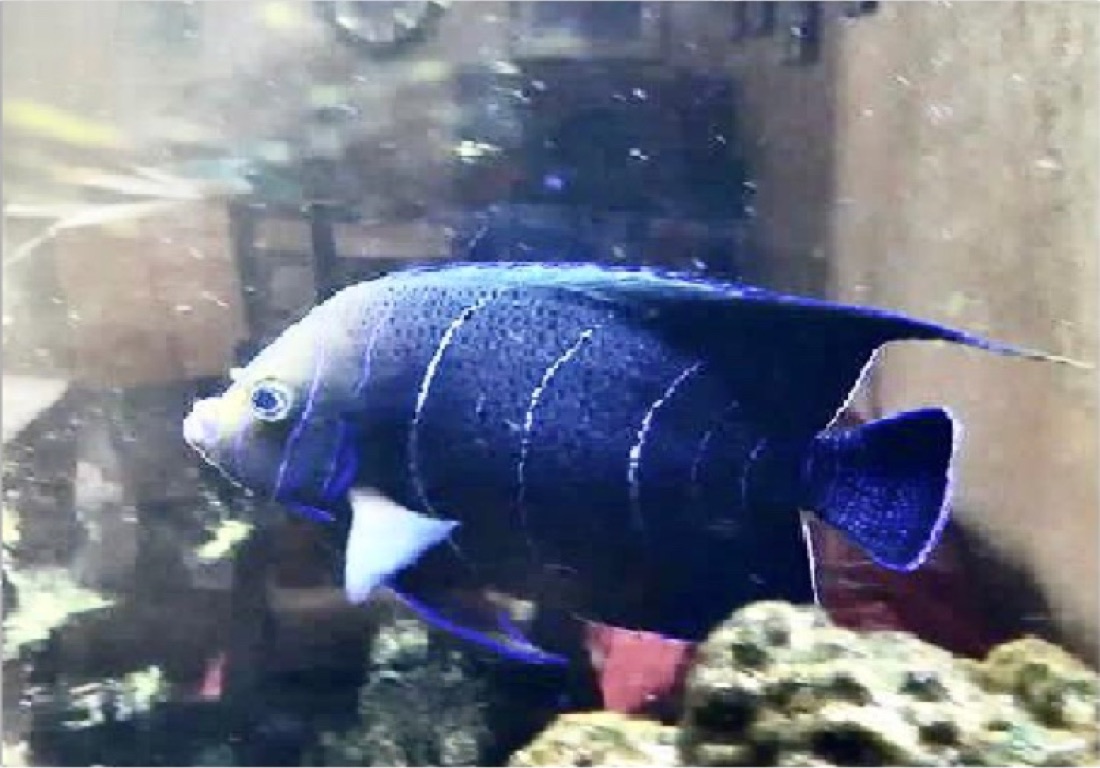
A large angelfish of the western Indo-Pacific, up to 40 cm long. 1 2 The juvenile is dark blue with thin curved blue and white bars; the adult is greenish brown, with the centre of the body paler and dotted with blue. 3 The name recalls the semicircular lines on the rear of the body of juveniles. 3
At a glance
Data from the scientific sources listed at the bottom.
Depth in the wild
1–40 m
Size
up to 40 cm
maximum standard length, that is, without the tail fin
Conservation
IUCN Red List: least concern (2009). Red List data taken from FishBase. 2 It does not appear in the CITES lists checked on Species+. 7
Where it lives
From the Red Sea and East Africa to Samoa; north to southern Japan, south to Western Australia, New South Wales and Lord Howe. 2 On the east coast of Australia it reaches at least as far as Sydney, and juveniles at least as far as Merimbula. 3
How to recognise it
Tap a number on the photo: the key explains what to look for.
Life in the wild
Reproduction
A natural spawning in captivity was described for the first time between September and October 2006. The eggs, buoyant and transparent, measured about 0.61 mm, and embryonic development took 18-21 hours at 28.5 °C. 5
In the aquarium
From the experience of the BallingMania community.
A fish belonging to the family Pomacanthidae, an animal coming from the Indian Ocean and the Pacific Ocean. A fish suitable for living with reef fish of many other kinds, and also with other angelfish as long as they are a different colour.
It has an oval body, strongly compressed on the flanks; the head is small, with a slightly domed forehead; the eyes are protruding; the mouth looks like a parrot's beak, armed with bristle-like teeth; at the lower tip of the gill cover there is a long spine extending towards the rear of the animal.
The adult livery is fairly colourful; the central part of the body is mustard yellow, fading to light grey towards the head and to a deep cobalt towards the tail. In the central part there are countless turquoise dots that also extend to the peduncle and the caudal fin. A turquoise stripe follows the gill cover to the end of the spine; the area around the mouth is pale yellow, and sometimes grey; the fins are edged with turquoise.
In the wild it is omnivorous and feeds mainly on sponges but also on worms, algae and the eggs of other fish, sometimes even on anthozoans such as anemones, sea anemones, stony corals, stoloniferans and zoanthids; for this reason it is not advisable for an aquarium with important invertebrates.
Very difficult to settle in, especially in the first days, when it is very shy and fearful; once well settled in it is omnivorous and greedy. It prefers frozen food, especially brine shrimp, chironomus and mysis, and also accepts shrimp and mussel flesh. It also accepts freeze-dried food and dry food in granules or flakes, freeze-dried algae, lettuce leaves, or rounds of banana or courgette and lightly blanched spinach. Given its size it should be placed in large tanks; it is very hardy and resistant to disease, but it prefers a higher than usual temperature, between twenty-eight and thirty degrees. It suffers, on the other hand, from low pH values, and with excessive concentrations of nitrate and phosphate it starts to lose its splendid colours.
Once settled in it is a fish suitable even for the tank of a complete beginner; not to be kept in tanks with stony corals or soft corals.
Species sheet by Massimo Ramognino and photo by Vincenzo Bianchin
What studies say about keeping it
Data from studies and databases, not advice for a home aquarium. In the study on spawning in captivity, larvae survived better on a mix of microalgae, small rotifers and dinoflagellates than on a single food, and the authors consider the species suitable for captive breeding programmes. 5 FishBase describes juveniles as excellent aquarium fish, suitable for community tanks. 2
Did you know?
Sources
- WoRMS Editorial Board (2026). Pomacanthus semicirculatus (Cuvier, 1831). World Register of Marine Species.
- Froese R., Pauly D. (eds.) (2026). Pomacanthus semicirculatus, Semicircle angelfish. FishBase.
- Bray D.J. (2023). Blue Angelfish, Pomacanthus semicirculatus (Cuvier 1831). Fishes of Australia.
- National Museum of Nature and Science, Tokyo (2026). Pomacanthus semicirculatus, Fishes of Andaman Sea. National Museum of Nature and Science, Tokyo.
- Leu M.-Y., Liou C.-H., Wang W.-H., Yang S.-D., Meng P.-J. (2009). Natural spawning, early development and first feeding of the semicircle angelfish [Pomacanthus semicirculatus (Cuvier, 1831)] in captivity. Aquaculture Research.
- Konow N., Bellwood D.R. (2005). Prey-capture in Pomacanthus semicirculatus (Teleostei, Pomacanthidae): functional implications of intramandibular joints in marine angelfishes. Journal of Experimental Biology.
- UNEP-WCMC (2026). Search for Pomacanthus semicirculatus in the CITES lists. Species+.
Sources checked on 5 November 2026. Community texts and ratings are kept separate from the scientific data.