
Pseudocheilinus hexataenia
Sixline wrasse
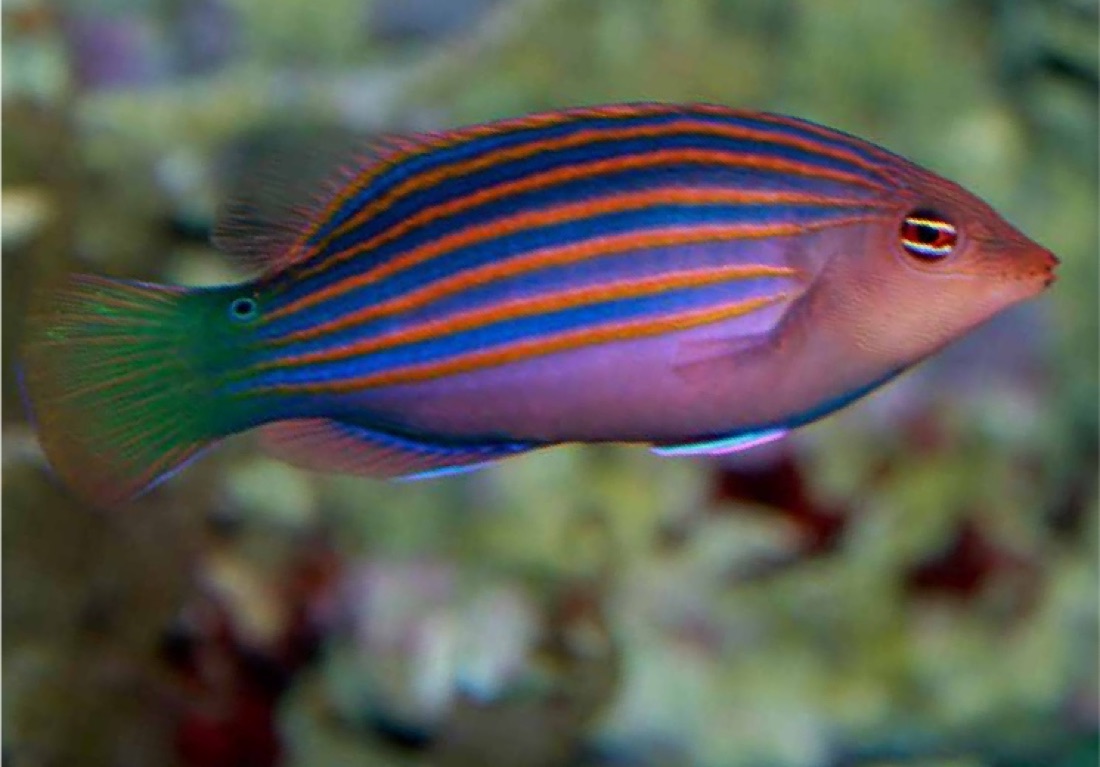
The sixline wrasse, known in Italian as labro a sei linee 11, is a small wrasse (family Labridae) 1 reaching at most 10 cm. 2 It has a violet body with six orange stripes and a small eyespot at the base of the tail. 4 It lives sheltered among coral branches, in small loose groups, and feeds mainly on small crustaceans. 2
At a glance
Data from the scientific sources listed at the bottom.
Depth in the wild
4–35 m
Size
up to 10 cm
maximum total length; Fishes of Australia gives 7.5 cm
Temperature in the wild
24–28 °C
Where it lives
Indo-Pacific: from the Red Sea to Natal, in South Africa, and east to the Tuamotus; north to the Ryukyu Islands, south to Lord Howe and the Austral Islands. 2 In Australia it ranges from Ningaloo and the offshore reefs of Western Australia to the Solitary Islands, in New South Wales, together with Christmas Island, the Coral Sea and Lord Howe. 4
Conservation
IUCN Red List: least concern (2009). Red List data taken from FishBase and GBIF. 2 10 It does not appear in the CITES lists checked on Species+. 12 In 2008, 2009 and 2011 it was among the 20 marine fish most imported into the United States for aquariums, making up 1.4-1.6% of the specimens. 7
How to recognise it
Tap a number on the photo: the key explains what to look for.
- 1Orange stripes six, along the flanks 2 4
- 2Small eyespot an eye-like spot on the upper part of the base of the tail 2 4
- 3Violet body the background against which the stripes stand out 4
- 4Blue stripe on the anal fin running along the base of the fin 4
- 5Blue mark on the pelvic fin a light blue streak on the fin 4
Life in the wild
Where it is found
Outer reefs, among coral branches, and clear coastal waters with dense coral, on the shallow crest or on slopes down to about 20 m. 2 It usually stays between 4 and 35 m, with a stated minimum of 1 m. 2 3 5 In Reef Life Survey counts it was observed in the sea between 19.1 and 31.3 °C: a wider range than the 24-28 °C given by FishBase. 2 5
What it eats
Mainly small crustaceans. 2
Behaviour
Shy and secretive: it swims in the shelter of coral branches and, even when it looks curious, always stays close to a hiding place. 2 5 It lives in small loose groups. 2 Reef Life Survey describes it as the most common Pseudocheilinus on shallow reefs; it is present at 48.8% of the sites in the regions where it has been observed, with few fish per transect. 5
In the aquarium
From the experience of the BallingMania community.
A fish belonging to the wrasse family (Labridae), native to the Indian and Pacific Oceans. It swims on coral reefs, specifically in the band between 5/35 metres deep. Like other wrasses, Pseudocheilinus hexataenia also produces a protective mucus at nightfall to defend itself from nocturnal predators.
This is a fish we can safely call “Reef Safe” (suitable for reef aquariums) because it does not bother and/or nip coral polyps, but it does not live peacefully with fish that are smaller and slower than it at swimming and catching food.
This fish is suitable for community aquariums, except for tanks containing triggerfish, groupers and Pterois volitans, which can prey on it.
The diet of this fish is based mainly on hunting copepods, amphipods, larvae, fish eggs and the benthos found on the rocks, but once acclimatised it does not refuse granular and flake food.
What studies say about keeping it
Up to a 2014 review, despite its popularity, there were no recorded cases of breeding, commercial or otherwise. 8 I found no studies from public aquariums or aquaculture with data on keeping it in a tank.
Did you know?
Sources
- Froese R., Pauly D. (eds.), via WoRMS (2026). Pseudocheilinus hexataenia (Bleeker, 1857). World Register of Marine Species.
- Froese R., Pauly D. (eds.) (2026). Pseudocheilinus hexataenia, Sixline wrasse. FishBase.
- Froese R., Pauly D. (eds.) (2026). Reproduction of Pseudocheilinus hexataenia. FishBase.
- Bray D.J. (2017). Pseudocheilinus hexataenia in Fishes of Australia. Museums Victoria.
- Reef Life Survey (2026). Pseudocheilinus hexataenia, Six-line wrasse. Reef Life Survey.
- Gerlach T., Theobald J., Hart N.S., Collin S.P., Michiels N.K. (2016). Fluorescence characterisation and visual ecology of pseudocheilinid wrasses. Frontiers in Zoology.
- Rhyne A.L., Tlusty M.F., Szczebak J.T., Holmberg R.J. (2017). Expanding our understanding of the trade in marine aquarium animals. PeerJ.
- Murray J.M., Watson G.J. (2014). A critical assessment of marine aquarist biodiversity data and commercial aquaculture: identifying gaps in culture initiatives to inform local fisheries managers. PLoS ONE.
- Nam S.E., Eom H.J., Park H.S., Rhee J.S. (2022). Complete mitochondrial genome of the six-line wrasse Pseudocheilinus hexataenia (Labriformes, Labridae). Mitochondrial DNA Part B.
- GBIF Secretariat (2026). Pseudocheilinus hexataenia, IUCN Red List category. GBIF.
- GBIF Secretariat, da Catalogue of Life (2026). Pseudocheilinus hexataenia, nomi comuni. GBIF.
- UNEP-WCMC, Segretariato CITES (2026). Search for Pseudocheilinus hexataenia in the CITES lists. Species+.
Sources checked on 5 November 2026. Community texts and ratings are kept separate from the scientific data.