
Pomacanthus navarchus
Majestic angelfish
A western Pacific angelfish, yellowish orange with blue dots and a broad dark blue band on the rear part of the body. 1 7 It is uncommon and feeds mainly on sponges and tunicates. 2 The Italian names on record include pesce angelo maestoso and pesce angelo cinto di blu. 11
At a glance
Data from the scientific sources listed at the bottom.
Depth in the wild
3–40 m
Size
up to 28 cm
maximum total length according to FishBase; FAO gives about 25 cm
Conservation
IUCN Red List: least concern (2009). Red List data taken from FishBase and GBIF. 2 10 It does not appear in the CITES lists checked on Species+. 12 FishBase describes it as highly sought after for export to aquariums, while FAO speaks of occasional export. 2 5
Where it lives
From Indonesia to Papua New Guinea, north to the Philippines and south to the Rowley Shoals and the southern part of the Great Barrier Reef; it includes Palau and Yap. 2 FAO adds the Solomon Islands. 5
How to recognise it
Tap a number on the photo: the key explains what to look for.
- 1Eye in the blue patch the blue area covers much of the head 6
- 2Pectoral fin in the blue an area of deep blue surrounds the fin 7
- 3Flanks with blue dots on a yellowish orange background 7
- 4Rear blue band from the anal fin, across the peduncle, to the base of the soft dorsal fin 6
- 5Yellowish orange tail like the dorsal fin 7
Life in the wild
Reproduction
FishBase classes it among fish that scatter their eggs without parental care. 4 No open-access data specific to spawning, eggs or larvae of this species were found.
In the aquarium
From the experience of the BallingMania community.
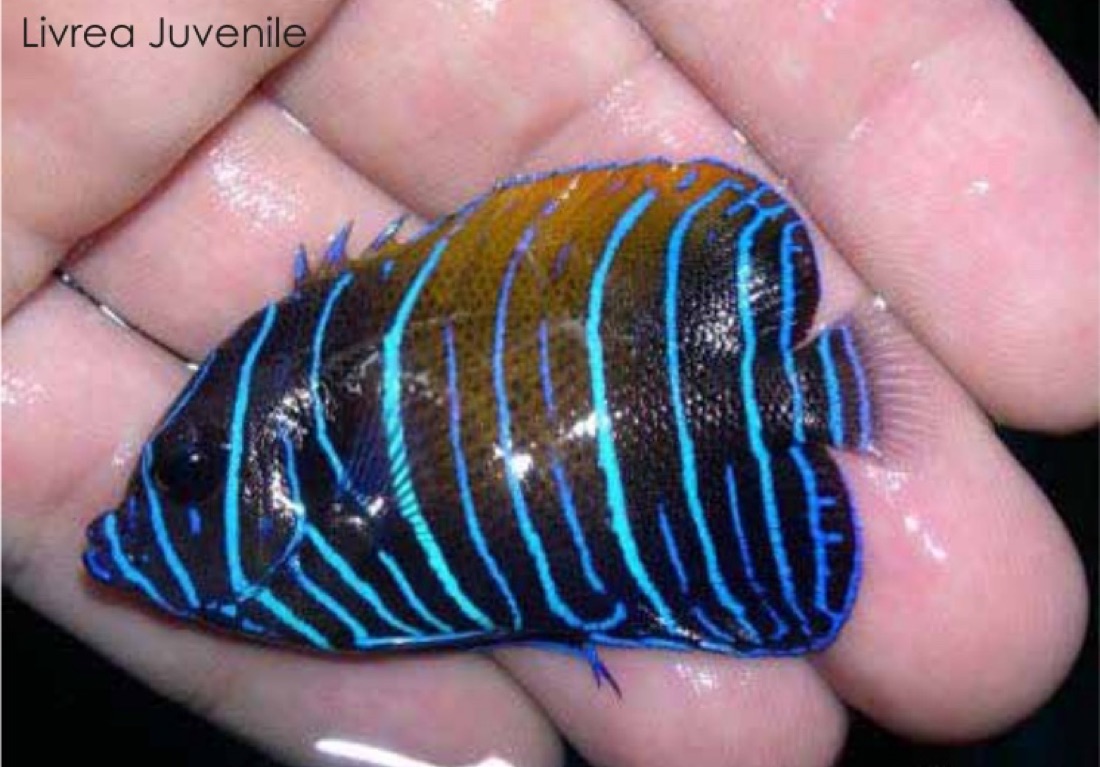
A very colourful fish belonging to the angelfish family (Pomacanthidae); it lives on the reef front in the Indo-Pacific Ocean. It is an omnivorous fish and one of the angelfish most sought after by hobbyists for its very distinctive colourful livery and because it does not grow to a large size (in the wild it does not exceed 30 cm) like its cousins in the same family; it is not difficult to acclimatise. In the tank it prefers large volumes, over 400 litres, even though it does not like swimming; in the wild it likes to position itself on the reef front. It too has a different juvenile livery, with a deep blue colour and white lines running right across its body, a livery that changes in a short time, taking on the stable adult colours. It is strongly not recommended for beginners, because of its aggressive temperament towards animals of the same family; absolutely not reef safe, because the polyps of SPS corals are part of its daily diet, as are mussels and soft corals.
Top photo: Florent De Gasperis - Bottom photo: Ken Bondy
What studies say about keeping it
A figure from a veterinary review, not advice for a home aquarium. Among marine ornamental fish that tested positive for megalocytiviruses is this species, with one case reported in Brazil in 2015. 9
Did you know?
Sources
- WoRMS Editorial Board (2026). Pomacanthus navarchus (Cuvier, 1831). World Register of Marine Species.
- Froese R., Pauly D. (eds.) (2026). Pomacanthus navarchus, Bluegirdle angelfish. FishBase.
- Froese R., Pauly D. (eds.) (2026). Food items reported for Pomacanthus navarchus. FishBase.
- Froese R., Pauly D. (eds.) (2026). Reproduction of Pomacanthus navarchus. FishBase.
- Pyle R. (2001). Pomacanthidae, species list. The living marine resources of the Western Central Pacific. Food and Agriculture Organization.
- Pyle R. (2001). Pomacanthidae, family and identification keys. The living marine resources of the Western Central Pacific. Food and Agriculture Organization.
- Bray D.J. (2026). Bluegirdle Angelfish, Pomacanthus navarchus (Cuvier 1831). Fishes of Australia.
- Satoh (Okihara) R., Saito T., Ogata H. et al. (2014). N-Methyltaurine N-acyl amidated bile acids and deoxycholic acid in the bile of angelfish (Pomacanthidae): a novel bile acid profile in Perciform fish. Steroids.
- Johan C.A.C., Zainathan S.C. (2020). Megalocytiviruses in ornamental fish: A review. Veterinary World.
- GBIF Secretariat (2026). Pomacanthus navarchus, IUCN Red List category. GBIF.
- GBIF Secretariat (2026). Pomacanthus navarchus, nomi comuni. GBIF.
- UNEP-WCMC (2026). Search for Pomacanthus navarchus in the CITES lists. Species+.
Sources checked on 5 November 2026. Community texts and ratings are kept separate from the scientific data.