
Pomacanthus imperator
Emperor angelfish
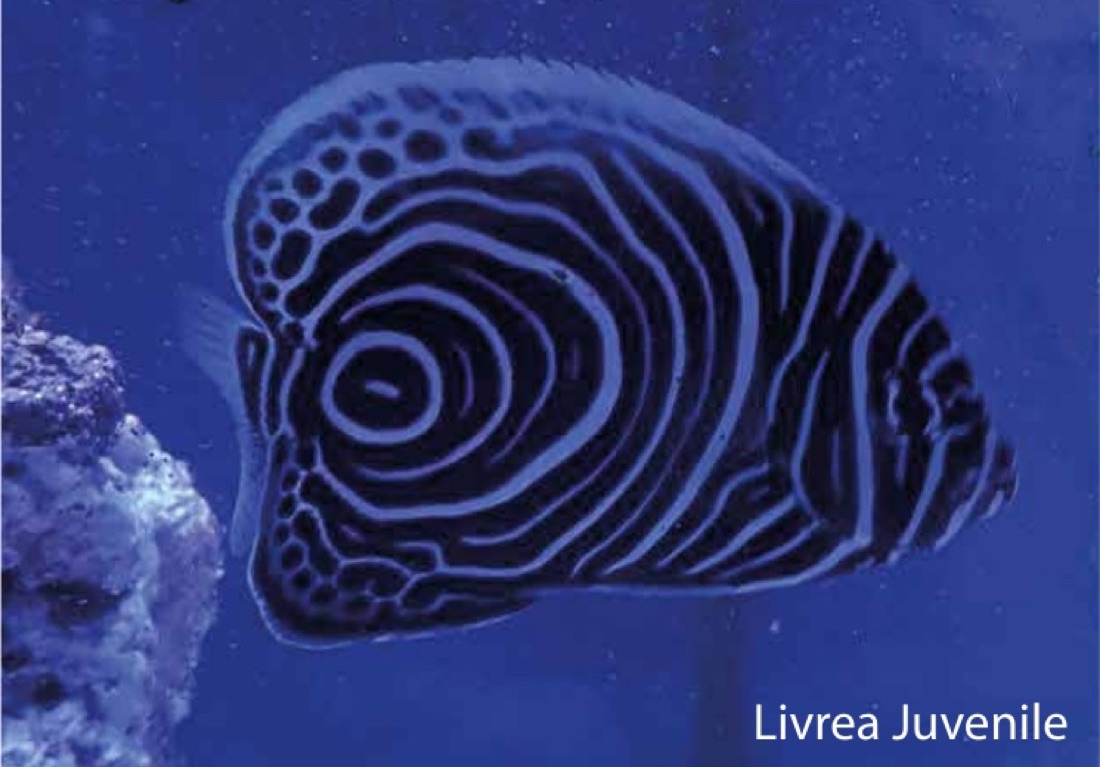
The emperor angelfish, known in Italian as pesce angelo imperatore 18, is a large reef fish of the family Pomacanthidae. 1 2 Juveniles and adults look like two different species: the adult is blue with thin yellow lines and a black mask over the eyes, while the juvenile is dark blue with pale rings. 4 6 It feeds mainly on sponges and tunicates. 3 5
At a glance
Data from the scientific sources listed at the bottom.
Depth in the wild
1–100 m
Size
up to 40 cm
maximum standard length (from the snout to the base of the tail)
Conservation
IUCN Red List: least concern (2009). Red List data taken from FishBase and GBIF. 2 16 It does not appear in the CITES lists checked on Species+. 17 FishBase estimates its vulnerability to fishing as high to very high, and the Kenyan study considers the species highly exposed to overexploitation, because it is caught both for aquariums and as food. 2 8 According to FAO, angelfish are the family with the highest overall value in the aquarium trade. 9
Where it lives
Indo-Pacific: from the Red Sea and East Africa to the Line Islands and the Tuamotus; north to southern Japan and the Ogasawara Islands, south to the Great Barrier Reef, New Caledonia and the Austral Islands. 2 It is absent from Easter Island, Rapa and the Marquesas. 2 3 In Hawaii it is very rare and the records may come from fish released from aquariums. 2 3 FishBase lists it as introduced and established in Puerto Rico and reports it at Haifa in 2009. 12 A study based on photos from Facebook groups also records it on the Mediterranean coast of Egypt. 13
How to recognise it
Tap a number on the photo: the key explains what to look for.
Life in the wild
Where it is found
Juveniles stay under ledges or in holes in outer lagoons and semi-sheltered areas; subadults move to holes and channels on the reef front; large adults live under ledges and in caves, where corals are rich and the water is clear. 2 Juveniles are often seen near cleaner shrimp. 6 In the Maldives it is recorded down to 25 m. 10 In Reef Life Survey counts it was observed in the sea between 22 and 31.4 °C. 4
Behaviour
FishBase and FAO describe it in pairs. 2 3 The Enewetak study, however, reports that the male defends a harem of 2-5 females. 7 A FAO guide to the Maldives describes it as solitary and territorial, with the two sexes meeting only to spawn. 10 Juveniles and adults may clean much larger fish, such as the ocean sunfish. 2
Reproduction
At Enewetak Atoll (Marshall Islands) courtship and spawning were observed at dusk for most of the lunar month: the male displays in front of the female, then the pair releases eggs and sperm into open water. 7 Along the coast of Kenya maturity was estimated at 25 cm total length for females and 28 cm for males; the number of eggs ranged from 17,790 to 266,472, with an average of 79,353, and the breeding season peaked in March-April. 8 No parental care is recorded. 14
In the aquarium
From the experience of the BallingMania community.
A fish belonging to the angelfish family (Pomacanthidae), native to the whole Pacific Ocean and the Red Sea, with an oval body and a marked snout and mouth. Like all the other fish in its family, it has two distinct liveries depending on age: as a juvenile it is entirely blue with white circular lines near the tail, while as an adult it has horizontal blue and yellow lines all over the body, except for the face, which is white and black. It can reach 40 cm in length, but in the tank it should not exceed 35 cm. This fish needs frozen foods, such as Artemia, chironomus and mysis, dry granular and flake foods, and also fresh vegetables such as lightly blanched lettuce and spinach. Buying acclimatised specimens is strongly recommended; once settled in the tank it becomes very resistant to disease, but if nitrate and phosphate levels are high it quickly loses its bright colours, so generous partial water changes are recommended.
Not a reef safe fish, as in the aquarium it may feed on corals, especially LPS.
photo by: Christian Lazzarino (top) and Silvestro Cuomo (bottom)
What studies say about keeping it
Data from a public aquarium and from laboratory analyses, not advice for a home aquarium. During quarantine at a US public aquarium, the intestinal parasite Enteromyxum leei struck a population of fish of 16 species, and genetic analysis also confirmed it in an emperor angelfish; the signs were severe weight loss, enteritis and death. The affected fish were treated orally with amprolium and salinomycin, and deaths fell. The authors stress the importance of checking fish during quarantine. 19 In Brazil, among samples from 25 ornamental species, the only one positive for lymphocystis virus was a specimen of this species. 20
Did you know?
Sources
- Froese R., Pauly D. (eds.), via WoRMS (2026). Pomacanthus imperator (Bloch, 1787). World Register of Marine Species.
- Froese R., Pauly D. (eds.) (2026). Pomacanthus imperator, Emperor angelfish. FishBase.
- Pyle R., in Carpenter K.E., Niem V.H. (eds.) (2001). Pomacanthidae, species list. The living marine resources of the Western Central Pacific, vol. 5. FAO.
- Reef Life Survey (2026). Pomacanthus imperator, Emperor angelfish. Reef Life Survey.
- Bray D.J. (2026). Emperor Angelfish, Pomacanthus imperator (Bloch 1787). Fishes of Australia, Museums Victoria.
- Australian Museum (2026). Emperor Angelfish, Pomacanthus imperator. Australian Museum.
- Thresher R.E. (1982). Courtship and spawning in the emperor angelfish Pomacanthus imperator, with comments on reproduction by other pomacanthid fishes. Marine Biology.
- Obota C.O., Fulanda B.M., Okemwa G.M., Kimani E.N. (2017). Reproductive biology and body condition of exploited populations of Emperor Angelfish, Pomacanthus imperator (Bloch, 1787) along the Kenyan Coast. Western Indian Ocean Journal of Marine Science.
- Pyle R., in Carpenter K.E., Niem V.H. (eds.) (2001). Pomacanthidae, family and identification keys. The living marine resources of the Western Central Pacific, vol. 5. FAO.
- Marine Research Section, Ministry of Fisheries and Agriculture, Maldives (1997). Fishes of the Maldives (BOBP/MAG/21), Pomacanthidae. FAO, Bay of Bengal Programme.
- Froese R., Pauly D. (eds.) (2026). Food items reported for Pomacanthus imperator. FishBase.
- Froese R., Pauly D. (eds.) (2026). Introductions of Pomacanthus imperator. FishBase.
- Al Mabruk S.A.A., Abdulghani A., Nour O.M., Adel M., Crocetta F., Doumpas N., Kleitou P., Tiralongo F. (2021). The role of social media in compensating for the lack of field studies: Five new fish species for Mediterranean Egypt. Journal of Fish Biology.
- Froese R., Pauly D. (eds.) (2026). Reproduction of Pomacanthus imperator. FishBase.
- Froese R., Pauly D. (eds.) (2026). Growth parameters for Pomacanthus imperator. FishBase.
- GBIF Secretariat (2026). Pomacanthus imperator, IUCN Red List category. GBIF.
- UNEP-WCMC (2026). Search for Pomacanthus imperator in the CITES lists. Species+.
- GBIF Secretariat (2026). Pomacanthus imperator, nomi comuni. GBIF.
- Hyatt M.W., Waltzek T.B., Kieran E.A., Frasca S., Lovy J. (2018). Diagnosis and treatment of multi-species fish mortality attributed to Enteromyxum leei while in quarantine at a US aquarium. Diseases of Aquatic Organisms.
- de Lucca Maganha S.R., Cardoso P.H.M., de Carvalho Balian S., de Almeida-Queiroz S.R., Fernandes A.M., de Sousa R.L.M. (2020). Detection and molecular characterization of Lymphocystivirus in Brazilian ornamental fish. Brazilian Journal of Microbiology.
Sources checked on 4 November 2026. Community texts and ratings are kept separate from the scientific data.