Pomacanthus chrysurus
Goldtail angelfish
The goldtail angelfish, known in Italian as pesce angelo a strisce 5, is a large angelfish 1 of the western Indian Ocean that lives on coral-rich reefs down to about 25 m. 2 4 Its biology is poorly documented: most of what is known about its habits applies to the whole family. 2 3
At a glance
Data from the scientific sources listed at the bottom.
Depth in the wild
1–25 m
Size
up to 33 cm
maximum standard length, that is, without the tail [2]
Conservation
IUCN Red List: least concern (2009). Red List data taken from FishBase and GBIF. 2 5 It does not appear in the CITES lists checked on Species+. 6 It is rarely seen in the aquarium trade, where it fetches a high price. 2
Where it lives
Western Indian Ocean, from the Gulf of Aden to KwaZulu-Natal in South Africa, including the Seychelles, the Comoros and Madagascar. 2 4
How to recognise it
Tap a number on the photo: the key explains what to look for.
Life in the wild
In the aquarium
From the experience of the BallingMania community.
A fish belonging to the family Pomacanthidae, an animal coming from the Indian Ocean: the Gulf of Aden, Madagascar, the Seychelles, Mauritius, the Maldives and the Great Barrier Reef.
A hardy but not very sociable fish; it is suitable for living with reef fish of other kinds, but not with other Pomacanthidae, even if they have a different livery. It is a quarrelsome and territorial fish; it can be kept in tanks larger than 500 litres, with adequate room for swimming and crevices among the rocks to take refuge in.
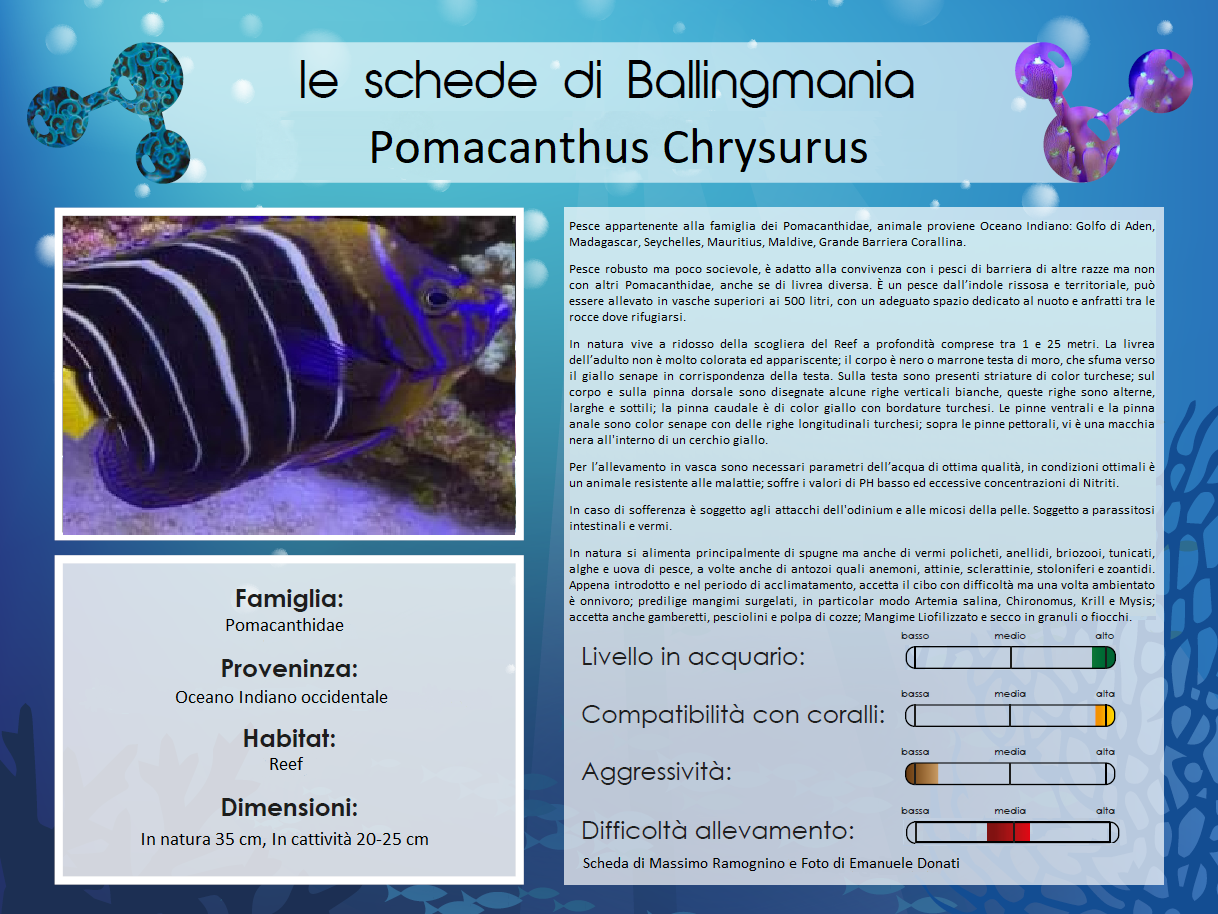
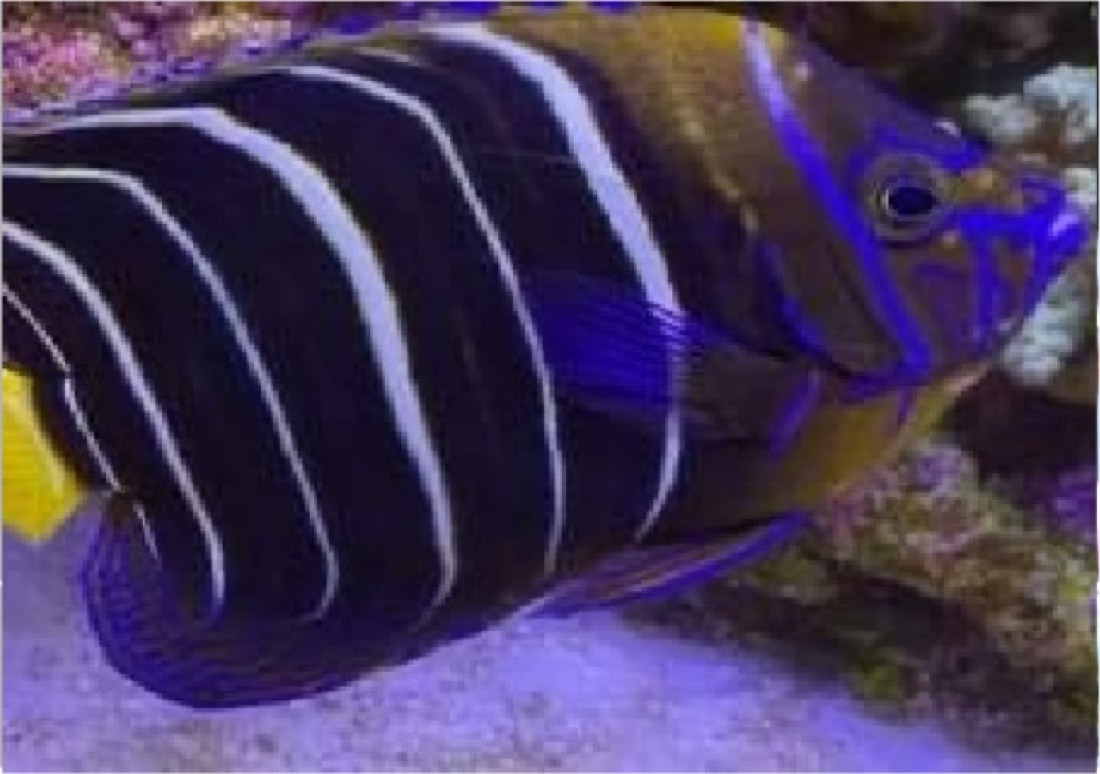
In the wild it lives close to the reef cliff at depths between 1 and 25 metres. The adult livery is not very colourful or striking; the body is black or dark chocolate brown, fading to mustard yellow at the head. On the head there are turquoise streaks; on the body and the dorsal fin there are a few white vertical lines, alternately broad and thin; the caudal fin is yellow with turquoise edges. The pelvic fins and the anal fin are mustard-coloured with turquoise lengthwise lines; above the pectoral fins there is a black spot inside a yellow ring.
To keep it in a tank, excellent water quality is needed; in optimal conditions it is an animal resistant to disease; it suffers from low pH and excessive concentrations of nitrite. When stressed it is prone to attacks of Oodinium and to fungal skin infections. Prone to intestinal parasites and worms.
In the wild it feeds mainly on sponges but also on polychaete worms, annelids, bryozoans, tunicates, algae and fish eggs, sometimes even on anthozoans such as anemones, sea anemones, stony corals, stoloniferans and zoanthids. Once introduced and during acclimatisation it accepts food with difficulty, but once settled in it is omnivorous; it prefers frozen foods, especially brine shrimp, Chironomus, krill and Mysis; it also accepts shrimp, small fish and mussel flesh, and freeze-dried food and dry food in granules or flakes.
Species sheet by Massimo Ramognino and photo by Emanuele Donati
Did you know?
Sources
- WoRMS Editorial Board (2026). Pomacanthus chrysurus (Cuvier, 1831). World Register of Marine Species.
- Froese R., Pauly D. (eds.) (2026). Pomacanthus chrysurus, Goldtail angelfish. FishBase.
- Pyle R., in Carpenter K.E., Niem V.H. (eds.) (2001). Pomacanthidae. The living marine resources of the Western Central Pacific, vol. 5. FAO.
- (2026). Holacanthus chrysurus, in Eschmeyer's Catalog of Fishes. California Academy of Sciences.
- GBIF Secretariat (2026). Pomacanthus chrysurus, common names and IUCN Red List category. GBIF.
- UNEP-WCMC (2026). Search for Pomacanthus chrysurus in the CITES lists. Species+.
Sources checked on 5 November 2026. Community texts and ratings are kept separate from the scientific data.