
Paracanthurus hepatus
Blue tang
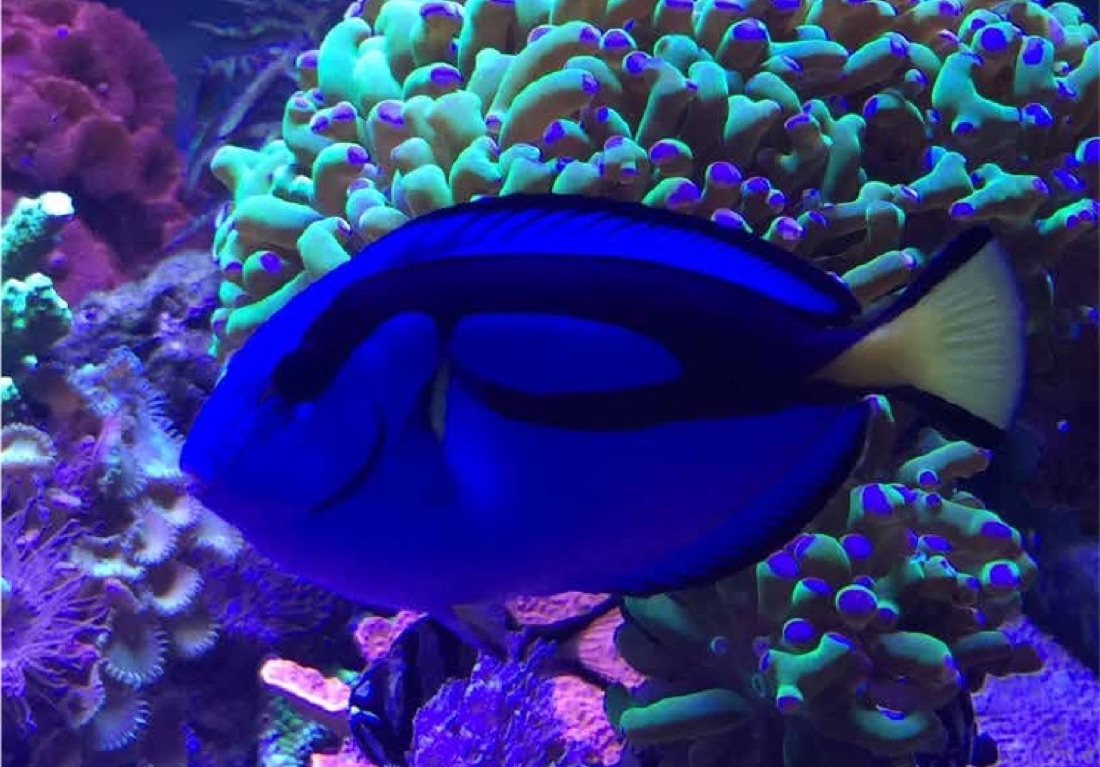
The blue tang, or palette surgeonfish, known in Italian as pesce chirurgo tavolozza 13, is the only species in its genus, in the surgeonfish family. 1 7 It is bright blue, with a black pattern on the flank and a yellow tail. 3 4 It feeds mainly on zooplankton and, when young, shelters among the branches of live corals. 2 3
At a glance
Data from the scientific sources listed at the bottom.
Depth in the wild
10–40 m
Size
up to 31 cm
maximum total length; commonly up to 20 cm
Conservation
IUCN Red List: least concern (2010). Red List data taken from FishBase and GBIF. 2 11 It does not appear in the CITES lists checked on Species+. 12 The United States imports about 100,000 a year from 25 countries, almost all from Indonesia and the Philippines: about half of all surgeonfish imported. 8 In the Vietnamese waters of Khanh Hoa it has been recommended that no more than 1,000 specimens a year be collected. 7
Where it lives
Indo-Pacific: from East Africa and the Mascarenes to Kiribati, the Line Islands and Samoa; north to southern Japan, south to the Great Barrier Reef, New Caledonia and New South Wales. 2 3 Its range is wide, but the species is known from few localities and is patchily distributed. 2 3
How to recognise it
Tap a number on the photo: the key explains what to look for.
- 1Bright blue body the background colour of head and body 3
- 2Black pattern covers the upper part of the flank 3 4
- 3Band to the eye the black narrows on the head and ends at the eye 3
- 4Yellow triangle in the middle of the tail; here the lights make it paler 3
- 5Black tail edges above and below the yellow, joined to the black of the body 3
Life in the wild
Where it is found
Current-swept terraces on the outer side of the reef and channels, in clear water. 2 3 It usually stays between 10 and 40 m, with a recorded minimum of 2 m. 2 Juveniles and subadults gather near isolated colonies of the coral Pocillopora eydouxi and, if frightened, slip in among the branches. 2 In Reef Life Survey counts it was observed in the sea between 19.9 and 30.7 °C. 4
Reproduction
It scatters its eggs in open water and does not care for its young. 14 In Vietnam, in about 15 wild females a month over a year, the gonad development index stayed high from April to July. 7 The same paper cites earlier work giving spawning all year round, with a peak from April to September, and maturity at 9-12 months of age. 7
In the aquarium
From the experience of the BallingMania community.
Paracanthurus hepatus is a very common species in the aquarium and can be kept with other Acanthurids in tanks of at least 400/600 litres. Keeping it with other specimens of the same species is recommended during the juvenile period. In any case, it is considered one of the least aggressive Acanthurids in the tank; in fact, at the slightest hint of danger it hides in the recesses of the rockwork, lying on its side and playing dead.
We can call this fish “Reef Safe” (suitable for reef aquariums); unfortunately it is susceptible to parasites, such as Oodinium; so, when buying a Paracanthurus hepatus, it is strongly recommended to check its state of health carefully, and a period of quarantine before introducing it into the main tank is highly recommended.
This fish needs to be fed generously several times a day, with dried algae (Nori seaweed) as the basis of its diet, but the diet must be completed with various types of food, including frozen food.
photo by: Giuseppe Rogliano
What studies say about keeping it
Data from aquaculture and veterinary studies, not advice for a home aquarium. In 2017 all specimens on the market were wild-caught, when the first successful breeding was documented: 50,000 eggs from a single broodstock group in a 1,000 L tank produced 27 juveniles. 5 The larvae were given copepod nauplii from the third day after hatching, rotifers from the twelfth, powdered feed from the twentieth and Artemia from the twenty-first; the largest die-offs occurred on day 7, from starvation, and on day 20, during flexion, and the first blue appeared on day 50. 5 In a study with eggs collected at four public aquariums, the larvae of this species did not reach metamorphosis. 6 In 11 specimens with lateral line depigmentation, a trial with naltrexone applied to the skin showed improvement in severe cases; the authors call for more data before judging its effectiveness. 10
Did you know?
Sources
- Froese R., Pauly D. (eds.), via WoRMS (2026). Paracanthurus hepatus (Linnaeus, 1766). World Register of Marine Species.
- Froese R., Pauly D. (eds.) (2026). Paracanthurus hepatus, Palette surgeonfish. FishBase.
- Randall J.E., in Carpenter K.E., Niem V.H. (eds.) (2001). Acanthuridae. The living marine resources of the Western Central Pacific, vol. 6. FAO.
- Reef Life Survey (2026). Paracanthurus hepatus, Blue Tang. Reef Life Survey.
- DiMaggio M.A., Cassiano E.J., Barden K.P., Ramee S.W., Ohs C.L., Watson C.A. (2017). First Record of Captive Larval Culture and Metamorphosis of the Pacific Blue Tang, Paracanthurus hepatus. Journal of the World Aquaculture Society.
- Cassiano E.J., Wittenrich M.L., Waltzek T.B., Steckler N.K., Barden K.P., Watson C.A. (2015). Utilizing public aquariums and molecular identification techniques to address the larviculture potential of Pacific blue tangs (Paracanthurus hepatus), semicircle angelfish (Pomacanthus semicirculatus), and bannerfish (Heniochus sp.). Aquaculture International.
- Sang H.M., Lam H.S., Hy L.H.K., Ky P.X., Minh-Thu P. (2019). Changes in Plasma and Ovarian Steroid Hormone Level in Wild Female Blue Tang Fish Paracanthurus hepatus during a Reproductive Cycle. Animals.
- Veríssimo D., Anderson S., Tlusty M. (2020). Did the movie Finding Dory increase demand for blue tang fish?. Ambio.
- Goda M., Fujii R. (1998). The Blue Coloration of the Common Surgeonfish, Paracanthurus hepatus-II. Color Revelation and Color Changes. Zoological Science.
- Strobel M.M., Baker K.C., Berliner A.L., Tang K.N., Hepps Keeney C.M., Lewbart G.A. (2023). Naltrexone as a promising treatment for clinical signs of lateral line depigmentation in palette surgeonfish (Paracanthurus hepatus). Journal of Zoo and Wildlife Medicine.
- GBIF Secretariat (2026). Paracanthurus hepatus, IUCN Red List category. GBIF.
- UNEP-WCMC (2026). Search for Paracanthurus hepatus in the CITES lists. Species+.
- GBIF Secretariat (2026). Paracanthurus hepatus, nomi comuni. GBIF.
- Froese R., Pauly D. (eds.) (2026). Reproduction of Paracanthurus hepatus. FishBase.
Sources checked on 4 November 2026. Community texts and ratings are kept separate from the scientific data.