At a glance
Data from the scientific sources listed at the bottom.
Depth in the wild
10–100 m
Size
up to 13 cm
maximum total length
Conservation
IUCN Red List: least concern (2015). Red List data taken from FishBase and GBIF. 2 6 It does not appear in the CITES lists checked on Species+. 7 It is of no interest to food fisheries, but it is caught for the aquarium. 2 3
Where it lives
From the Red Sea and South Africa to Hawaii, north to southern Japan and south to New Caledonia. 2 In the eastern Pacific it ranges from the Gulf of California to Colombia, including the Revillagigedo, Cocos, Malpelo and Galápagos Islands. 2 5 In most areas it is not common. 2 4
How to recognise it
Tap a number on the photo: the key explains what to look for.
Life in the wild
In the aquarium
From the experience of the BallingMania community.
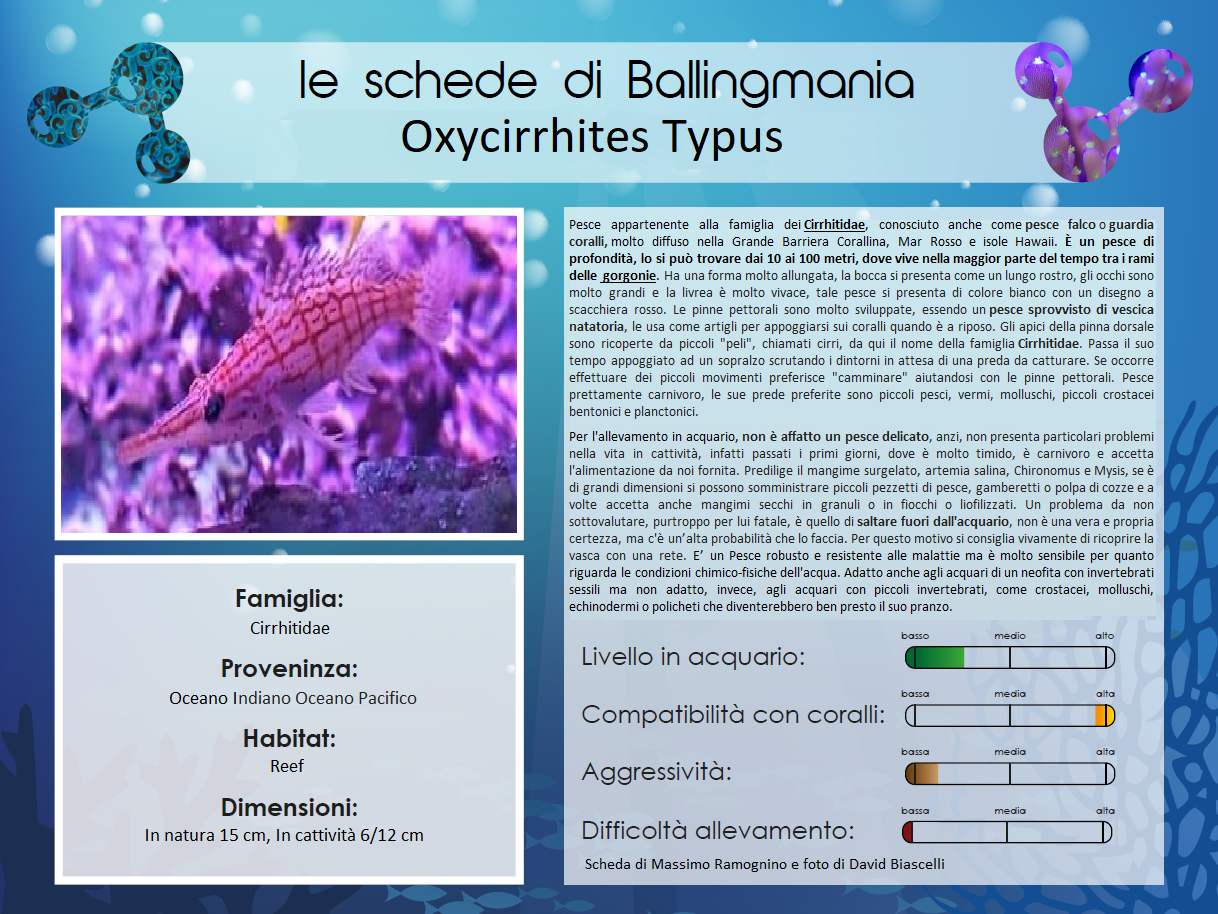
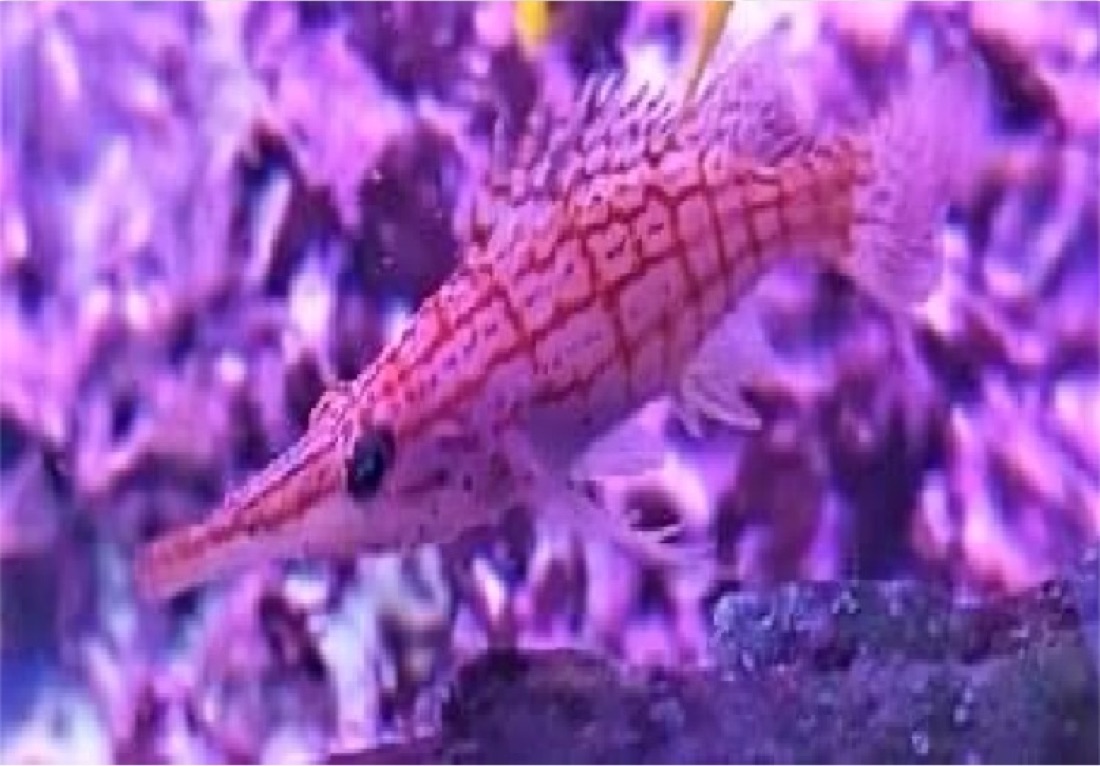
A fish belonging to the family Cirrhitidae, also known as hawkfish or coral guard, very widespread on the Great Barrier Reef, in the Red Sea and in the Hawaiian Islands. It is a deep-water fish, found from 10 to 100 metres, where it spends most of its time among the branches of sea fans. It has a very elongated shape, the mouth looks like a long beak, the eyes are very large and the livery is very lively: this fish is white with a red chequerboard pattern. The pectoral fins are very well developed; as it is a fish without a swim bladder, it uses them like claws to rest on corals. The tips of the dorsal fin are covered with small "hairs", called cirri, hence the name of the family Cirrhitidae. It spends its time resting on a raised perch, scanning its surroundings while waiting for prey to catch. If it needs to make small movements, it prefers to "walk" with the help of its pectoral fins. A strictly carnivorous fish, its favourite prey are small fish, worms, molluscs, and small bottom-dwelling and planktonic crustaceans.
As for keeping it in an aquarium, it is not a delicate fish at all; on the contrary, it poses no particular problems in captivity: after the first few days, when it is very shy, it is carnivorous and accepts the food we provide. It prefers frozen food, brine shrimp, Chironomus and Mysis; if it is large, small pieces of fish, shrimp or mussel flesh can be given, and sometimes it also accepts dry food in granules or flakes, or freeze-dried food. A problem not to be underestimated, unfortunately fatal for it, is jumping out of the aquarium; it is not an absolute certainty, but there is a high probability that it will. For this reason it is strongly recommended to cover the tank with a net. It is a hardy fish, resistant to disease, but very sensitive to the chemical and physical conditions of the water. Suitable even for a beginner's aquarium with sessile invertebrates, but not suitable for aquariums with small invertebrates, such as crustaceans, molluscs, echinoderms or polychaetes, which would soon become its lunch.
Species sheet by Massimo Ramognino and photo by David Biascelli
Did you know?
Sources
- WoRMS Editorial Board (2026). Oxycirrhites typus Bleeker, 1857. World Register of Marine Species.
- Froese R., Pauly D. (eds.) (2026). Oxycirrhites typus, Longnose hawkfish. FishBase.
- Randall J.E., in Carpenter K.E., Niem V.H. (eds.) (2001). Cirrhitidae. The living marine resources of the Western Central Pacific, vol. 5. FAO.
- Bray D.J. (2022). Oxycirrhites typus, in Fishes of Australia. Museums Victoria.
- Robertson D.R. (referente) (2024). Oxycirrhites typus, Longnose hawkfish. Shorefishes of the Tropical Eastern Pacific. Smithsonian Tropical Research Institute.
- GBIF Secretariat (2026). Oxycirrhites typus, common names and IUCN Red List category. GBIF.
- UNEP-WCMC (2026). Search for Oxycirrhites typus in the CITES lists. Species+.
Sources checked on 5 November 2026. Community texts and ratings are kept separate from the scientific data.