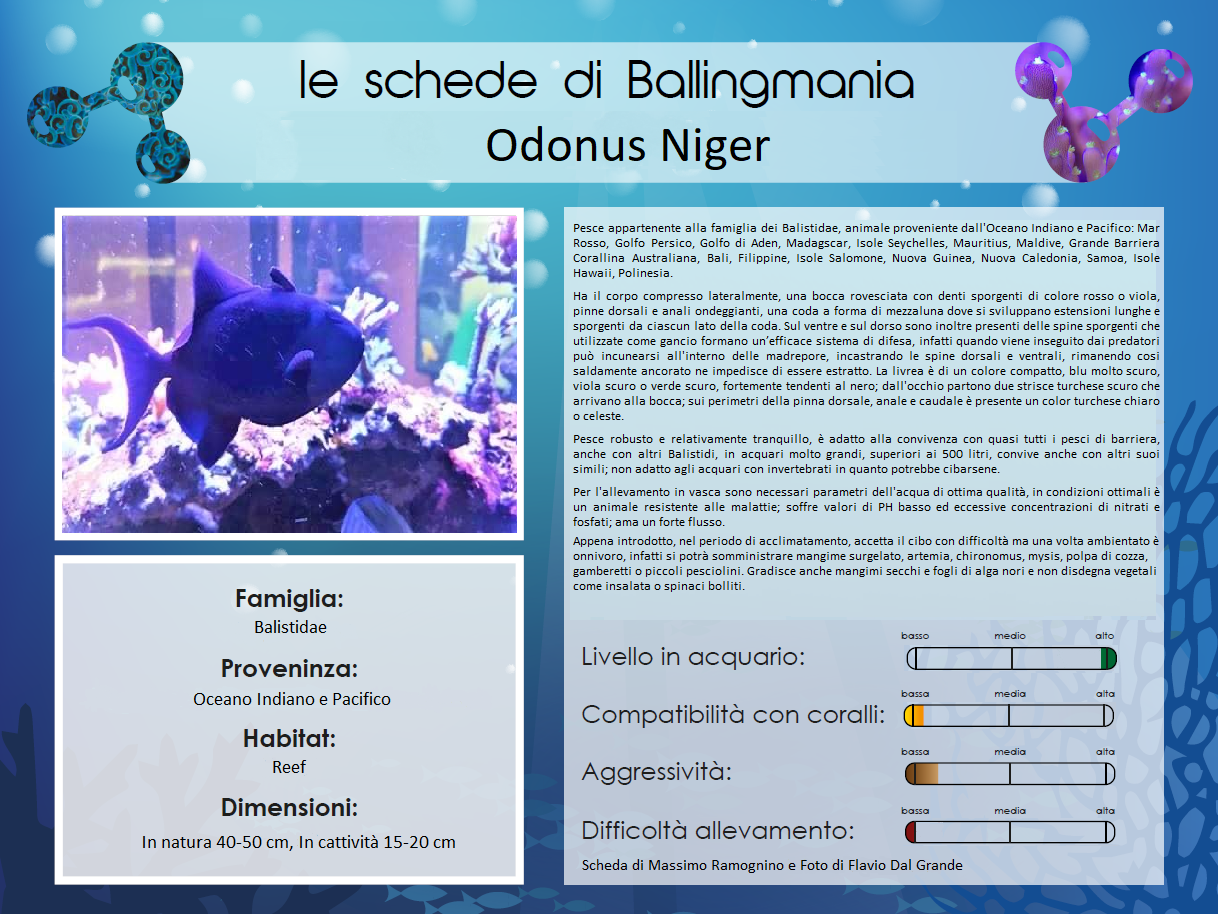
Odonus niger
Redtooth triggerfish
The redtooth triggerfish, known in Italian as pesce balestra denti rossi 6, is a dark blue triggerfish (Balistidae) 1 with reddish teeth and a tail with long lobes. 4 5 It lives in groups, often large ones, on current-swept reef slopes and channels, where it feeds mainly on zooplankton. 2 4 5
At a glance
Data from the scientific sources listed at the bottom.
Depth in the wild
5–40 m
Size
up to 50 cm
maximum total length, including the tail lobes; usually 30 cm
Conservation
IUCN Red List: least concern (2022). Red List data taken from FishBase and GBIF. 2 6 It does not appear in the CITES lists checked on Species+. 8 It is highly valued for the aquarium and is of minor importance to fisheries: it is sold fresh or dried and salted. 2 4
Where it lives
Indo-Pacific: from the Red Sea and East Africa through Indonesia to the Line, Marquesas and Society Islands, north to southern Japan and south to the southern Great Barrier Reef. 2 4 5
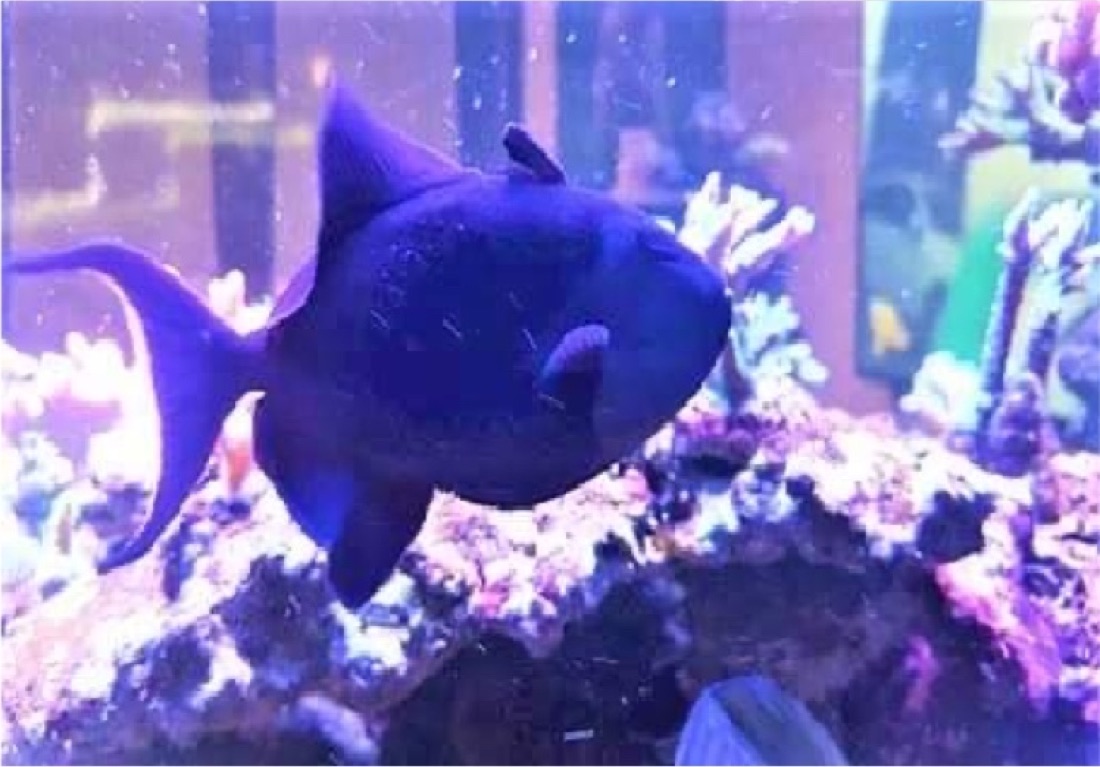
How to recognise it
Tap a number on the photo: the key explains what to look for.
Life in the wild
In the aquarium
From the experience of the BallingMania community.
A fish belonging to the family Balistidae, an animal coming from the Indian and Pacific Oceans: the Red Sea, the Persian Gulf, the Gulf of Aden, Madagascar, the Seychelles, Mauritius, the Maldives, the Australian Great Barrier Reef, Bali, the Philippines, the Solomon Islands, New Guinea, New Caledonia, Samoa, the Hawaiian Islands and Polynesia.
It has a laterally compressed body, an upturned mouth with protruding red or purple teeth, undulating dorsal and anal fins, and a crescent-shaped tail with long, protruding extensions on each side. On the belly and back there are also protruding spines that, used as hooks, form an effective defence system: when chased by predators it can wedge itself inside the stony corals, locking its dorsal and ventral spines, and by staying firmly anchored it prevents itself from being pulled out. The livery is a uniform colour, very dark blue, dark purple or dark green, strongly tending to black; two dark turquoise stripes run from the eye to the mouth; the edges of the dorsal, anal and caudal fins are pale turquoise or light blue.
A hardy and relatively peaceful fish, it is suitable for living with almost all reef fish, even other triggerfish; in very large aquariums, over 500 litres, it also lives with others of its kind; not suitable for aquariums with invertebrates, as it could feed on them.
To keep it in a tank, excellent water quality is needed; in optimal conditions it is an animal resistant to disease; it suffers from low pH and excessive concentrations of nitrate and phosphate; it loves a strong flow.
Once introduced, during acclimatisation, it accepts food with difficulty, but once settled in it is omnivorous; in fact it can be given frozen food, Artemia, chironomus, mysis, mussel flesh, shrimp or small fish. It also likes dry foods and sheets of Nori seaweed and does not refuse vegetables such as lettuce or boiled spinach.
Species sheet by Massimo Ramognino and photo by Flavio Dal Grande
Did you know?
Sources
- WoRMS Editorial Board (2026). Odonus niger (Rüppell, 1836). World Register of Marine Species.
- Froese R., Pauly D. (eds.) (2026). Odonus niger, Red-toothed triggerfish. FishBase.
- Matsuura K., in Carpenter K.E., Niem V.H. (eds.) (2001). Balistidae. The living marine resources of the Western Central Pacific, vol. 6. FAO.
- Matsuura K., in Carpenter K.E., Niem V.H. (eds.) (2001). Odonus niger. The living marine resources of the Western Central Pacific, vol. 6. FAO.
- Bray D.J. (2026). Odonus niger, in Fishes of Australia. Museums Victoria.
- GBIF Secretariat (2026). Odonus niger, common names and IUCN Red List category. GBIF.
- Suyani N.K., Rajesh M., Rajesh K.M. (2021). First report on the diet and reproductive biology of red-toothed triggerfish Odonus niger (Ruppell, 1836) from the south-eastern Arabian Sea. Journal of the Marine Biological Association of the United Kingdom.
- UNEP-WCMC (2026). Search for Odonus niger in the CITES lists. Species+.
Sources checked on 5 November 2026. Community texts and ratings are kept separate from the scientific data.