
Nemateleotris decora
Elegant firefish
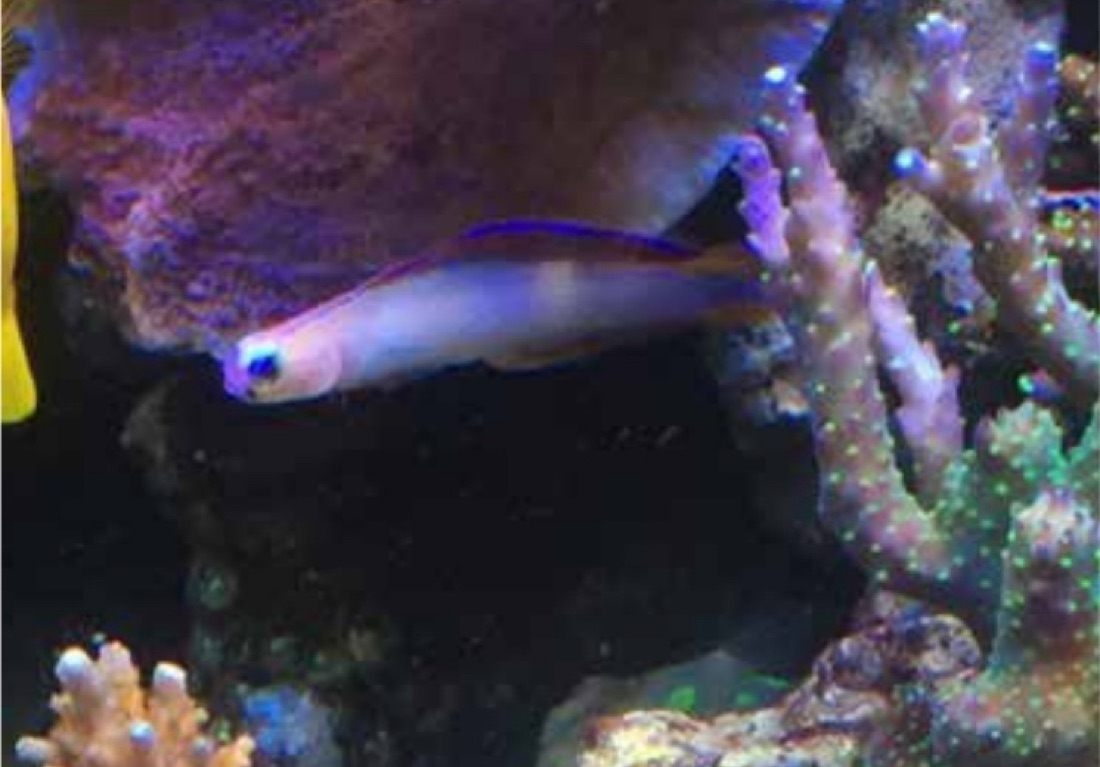
The elegant firefish, known in Italian as ghiozzo di fuoco elegante 9, is a small goby (family Gobiidae) 1 reaching at most 9 cm. 2 The front of the body is pale and the rear dark, the snout is violet and the fins carry red stripes edged with purple. 4 It often lives in pairs on open bottoms at the foot of deep reef slopes, where it eats zooplankton and dives into a burrow at the first sign of danger. 2 4
At a glance
Data from the scientific sources listed at the bottom.
Depth in the wild
25–70 m
Size
up to 9 cm
maximum total length
Temperature in the wild
23–27 °C
Where it lives
Indo-Pacific: from Mauritius to Samoa, north to the Ryukyu Islands and south to New Caledonia. 2 Fishes of Australia adds the Red Sea and, for Australia, the northern Great Barrier Reef, the Coral Sea and the Cocos (Keeling) and Christmas Islands. 4 It has also been recorded at Pohnpei, in Micronesia. 7 FishBase notes that the Indian Ocean and Red Sea population used to be considered a separate species, N. exquisita, 2 a name that WoRMS, however, still lists as valid. 11
How to recognise it
Tap a number on the photo: the key explains what to look for.
- 1Violet snout the violet continues as a stripe over the head; here the lights make it paler 4
- 2Pale front pale grey, here more lilac because of the blue lights 4
- 3Darker rear in the sources it is blackish purple; in the photo the contrast is weaker 4
- 4Dorsal fin stripe broad and red, edged with purple 4
- 5Anal fin stripe same pattern as the dorsal fin 4
Life in the wild
In the aquarium
From the experience of the BallingMania community.
A small, very colourful, hardy and peaceful fish belonging to the family Microdesmidae, coming from the Philippines and the north-eastern coast of Australia.
Acclimatisation and settling into the tank are fairly demanding, but once this phase is over it becomes hardy and fairly long-lived.
It adapts very well to living with fish of other kinds of the same size and peaceful temperament, but it becomes extremely aggressive with its own kind.
It is fairly resistant to parasites, but if the tank shows excessive nitrate and phosphate levels it loses colour and liveliness.
We can classify this fish as Reef Safe without any doubt, because it shows no interest in eating the invertebrates kept in the tank.
During the settling-in period it prefers frozen food (brine shrimp and mysis), but once acclimatised it does not refuse granular and/or flake food.
photo by: Ciro Murino
What studies say about keeping it
Data from an aquaculture study, not advice for a home aquarium. Madhu and Madhu report the first scientific captive breeding: fish of 6-10 cm in 500 L tanks at about 29 °C formed 4 pairs in 6 months; the pairs, moved to 250 L tanks, spawned after another 6 months. 5 Each spawning contained 400-500 eggs, guarded mainly by the male; hatching came after 96 hours at about 28 °C, with 93-98% success. 5 Newly hatched larvae measured about 1.9 mm: the best survival (66%) was achieved with Euplotes ciliates and then rotifers, followed by Artemia nauplii, and metamorphosis took place 35 to 40 days after hatching. 5 The adults were given cooked squid, shrimp and mussel, raw fish roe and live adult Artemia. 5
Did you know?
Sources
- Froese R., Pauly D. (eds.), via WoRMS (2026). Nemateleotris decora Randall & Allen, 1973. World Register of Marine Species.
- Froese R., Pauly D. (eds.) (2026). Nemateleotris decora, Elegant firefish. FishBase.
- Froese R., Pauly D. (eds.) (2026). Reproduction of Nemateleotris decora. FishBase.
- Bray D.J. (2025). Nemateleotris decora in Fishes of Australia. Museums Victoria.
- Madhu K., Madhu R. (2014). Captive spawning and embryonic development of marine ornamental purple firefish Nemateleotris decora (Randall & Allen, 1973). Aquaculture.
- Wang F.Y., Wang T.Y., Liao T.Y., Liu M.Y. (2016). The complete mitochondrial genome sequence of Nemateleotris decora (gobiiformes, gobiidae). Mitochondrial DNA Part A.
- Coleman R.R., Copus J.M., Coffey D.M., Whitton R.K., Bowen B.W. (2018). Shifting reef fish assemblages along a depth gradient in Pohnpei, Micronesia. PeerJ.
- GBIF Secretariat (2026). Nemateleotris decora, IUCN Red List category. GBIF.
- GBIF Secretariat, da Catalogue of Life (2026). Nemateleotris decora, nomi comuni. GBIF.
- UNEP-WCMC, Segretariato CITES (2026). Search for Nemateleotris decora in the CITES lists. Species+.
- Froese R., Pauly D. (eds.), via WoRMS (2026). Nemateleotris exquisita Randall & Connell, 2013. World Register of Marine Species.
Sources checked on 5 November 2026. Community texts and ratings are kept separate from the scientific data.