At a glance
Data from the scientific sources listed at the bottom.
Depth in the wild
2–75 m
Size
up to 25 cm
maximum total length; usually 15 cm [2]
Conservation
IUCN Red List: least concern (2009). Red List data taken from FishBase and GBIF. 2 9 It does not appear in the CITES lists checked on Species+. 10 It is of minor importance to fisheries and is frequently exported for aquariums. 2 4
Where it lives
Indo-Pacific: from the Persian Gulf, the Gulf of Oman and the coast from Tanzania to South Africa, through Madagascar, the Seychelles, the Mascarenes, Chagos and the Maldives, to Japan, Micronesia, Australia and French Polynesia. 2 FAO excludes Hawaii and the Marquesas. 4
How to recognise it
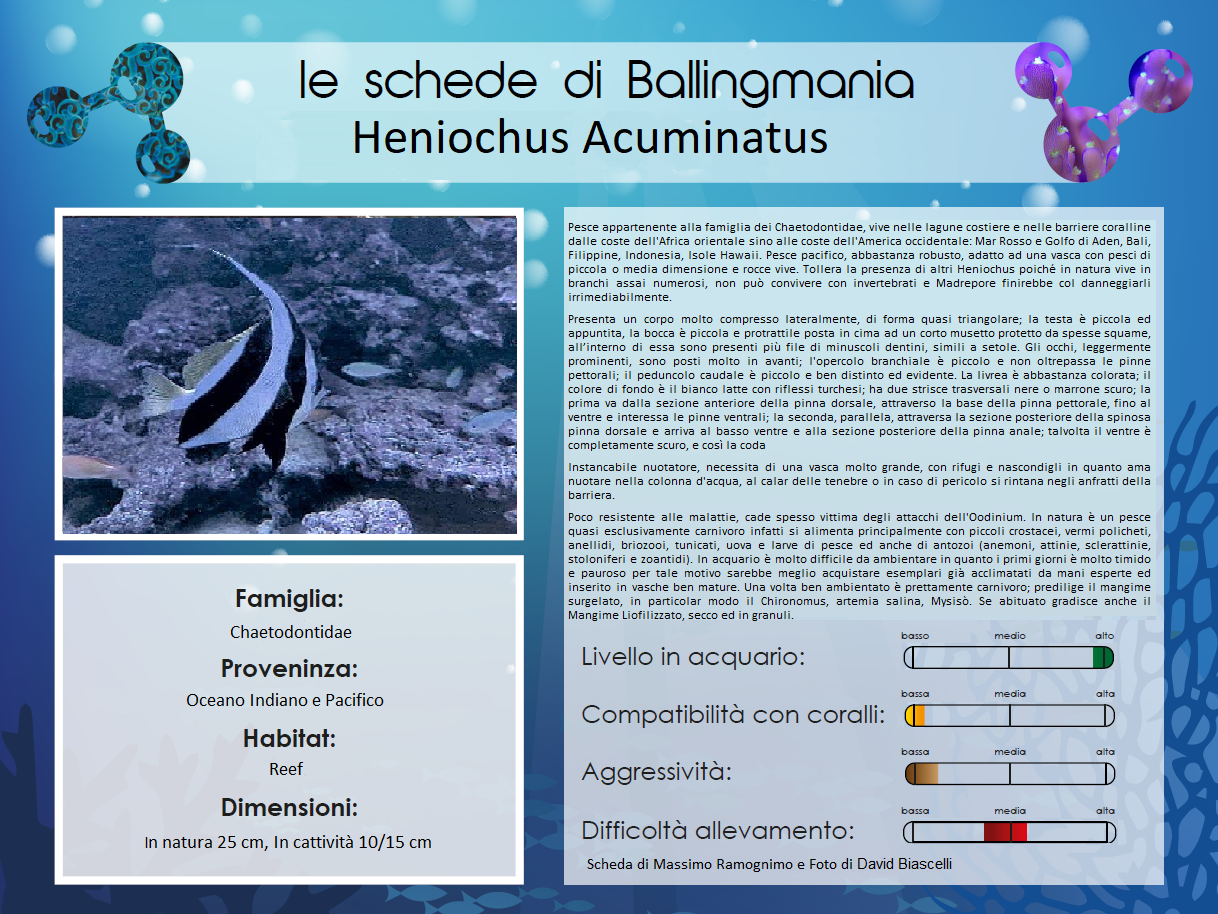
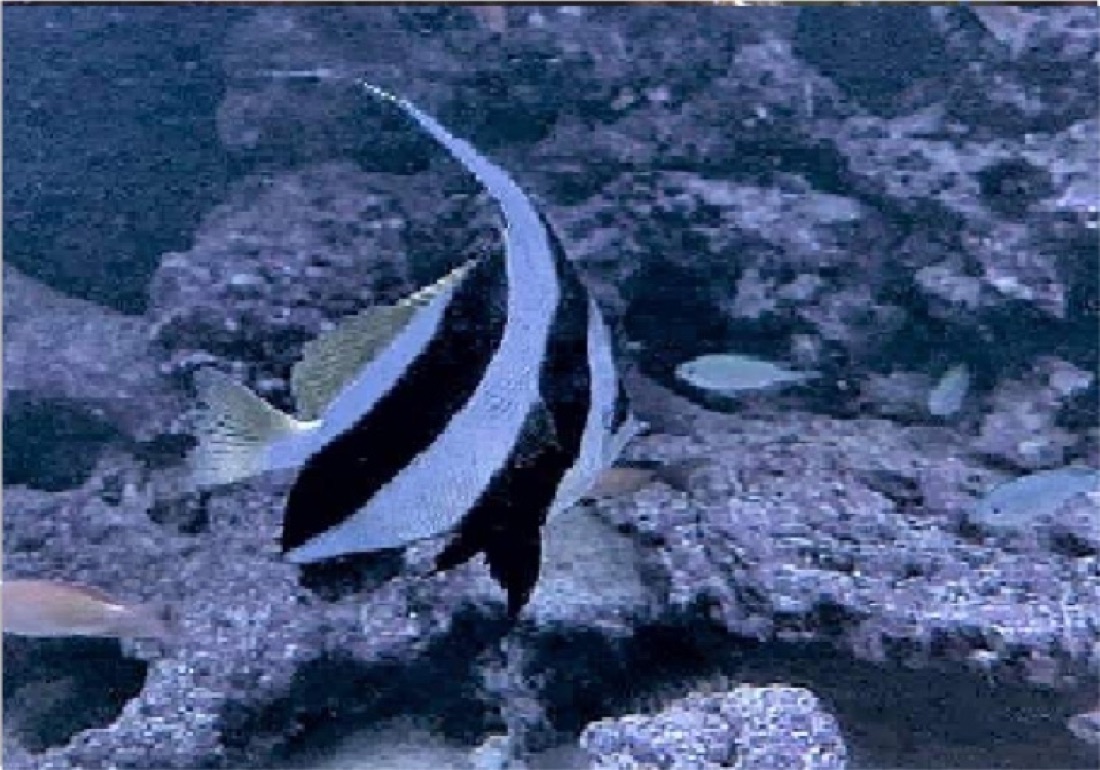
Tap a number on the photo: the key explains what to look for.
- 1Dorsal filament the fourth spine of the dorsal fin, greatly elongated 3
- 2First black band one of the two broad bands on the white body 5
- 3Second black band further back; in the similar H. diphreutes it falls further forward on the anal fin 5
- 4Yellow tail the soft part of the dorsal fin is yellow too 5
Life in the wild
In the aquarium
From the experience of the BallingMania community.
A fish belonging to the family Chaetodontidae; it lives in coastal lagoons and coral reefs from the coasts of East Africa to the coasts of western America: the Red Sea and the Gulf of Aden, Bali, the Philippines, Indonesia and the Hawaiian Islands. A peaceful, fairly hardy fish, suitable for a tank with small or medium-sized fish and live rock. It tolerates the presence of other Heniochus, since in the wild it lives in very large schools; it cannot live with invertebrates and stony corals, as it would end up damaging them irreparably.
It has a strongly laterally compressed body, almost triangular in shape; the head is small and pointed; the mouth is small and protractile, set at the tip of a short snout protected by thick scales, and inside it there are several rows of tiny bristle-like teeth. The eyes, slightly prominent, are set far forward; the gill cover is small and does not extend past the pectoral fins; the caudal peduncle is small and clearly distinct. The livery is fairly colourful; the base colour is milky white with turquoise highlights; it has two black or dark brown vertical stripes; the first runs from the front section of the dorsal fin, through the base of the pectoral fin, down to the belly and includes the pelvic fins; the second, parallel, crosses the rear section of the spiny dorsal fin and reaches the lower belly and the rear section of the anal fin; sometimes the belly is completely dark, and so is the tail. A tireless swimmer, it needs a very large tank with shelters and hiding places, as it loves swimming in the water column; at nightfall or when in danger it retreats into the crevices of the reef.
Not very resistant to disease, it often falls victim to attacks of Oodinium. In the wild it is an almost exclusively carnivorous fish: in fact it feeds mainly on small crustaceans, polychaete worms, annelids, bryozoans, tunicates, fish eggs and larvae, and also on anthozoans (anemones, sea anemones, stony corals, stoloniferans and zoanthids). In the aquarium it is very difficult to settle in, as in the first days it is very shy and fearful; for this reason it would be better to buy specimens already acclimatised by expert hands and introduce them into well-matured tanks. Once well settled in it is strictly carnivorous; it prefers frozen food, especially Chironomus, brine shrimp and Mysis. If accustomed to it, it also likes freeze-dried and dry food and granules.
Species sheet by Massimo Ramognimo and photo by David Biascelli
Did you know?
Sources
- WoRMS Editorial Board (2026). Heniochus acuminatus (Linnaeus, 1758). World Register of Marine Species.
- Froese R., Pauly D. (eds.) (2026). Heniochus acuminatus, Pennant coralfish. FishBase.
- Pyle R., in Carpenter K.E., Niem V.H. (eds.) (2001). Chaetodontidae. The living marine resources of the Western Central Pacific, vol. 5. FAO.
- Pyle R., in Carpenter K.E., Niem V.H. (eds.) (2001). Heniochus acuminatus. The living marine resources of the Western Central Pacific, vol. 5. FAO.
- McGrouther M. (2021). Longfin Bannerfish, Heniochus acuminatus. Australian Museum.
- Rumbold K.; Fink W. (eds.) (2000). Heniochus acuminatus, Wimple fish. Animal Diversity Web, University of Michigan.
- (2026). Chaetodontidae: L III E8, Heniochus acuminatus. Marine fish eggs and larvae. South African Institute for Aquatic Biodiversity.
- (2026). Longfin bannerfish. Nausicaá, Centre National de la Mer.
- GBIF Secretariat (2026). Heniochus acuminatus, common names and IUCN Red List category. GBIF.
- UNEP-WCMC (2026). Search for Heniochus acuminatus in the CITES lists. Species+.
Sources checked on 5 November 2026. Community texts and ratings are kept separate from the scientific data.