
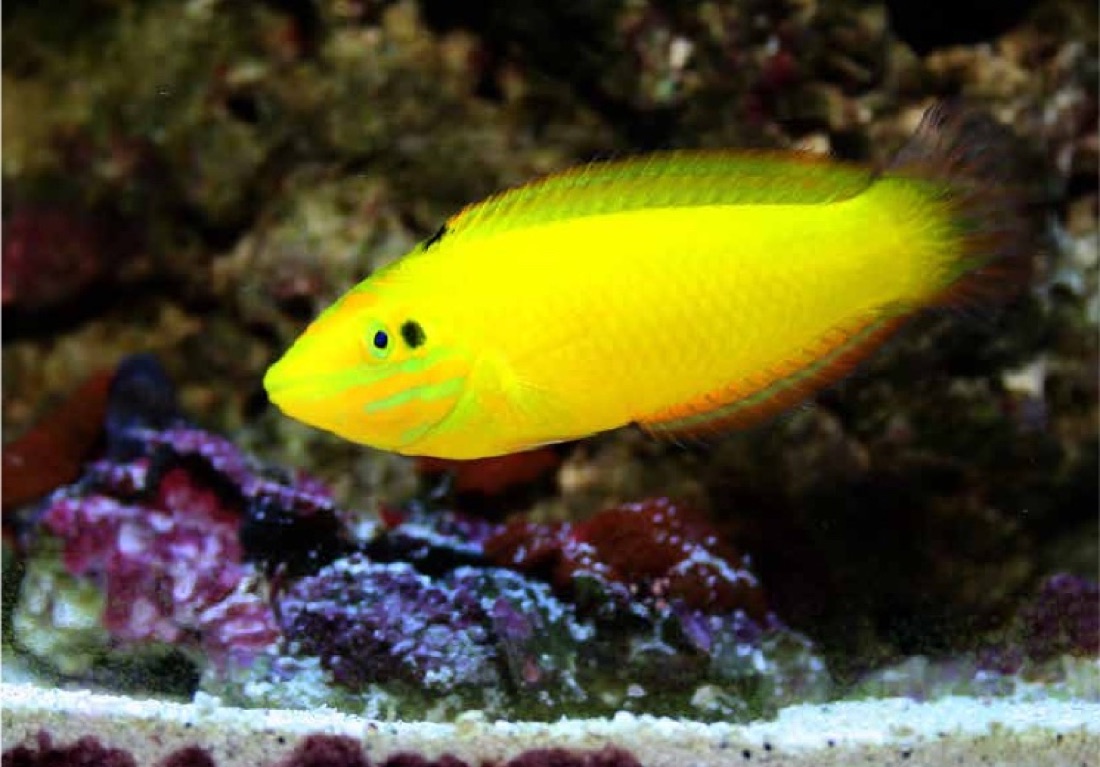
At a glance
Data from the scientific sources listed at the bottom.
Depth in the wild
15–60 m
Size
up to 12 cm
maximum total length
Temperature in the wild
24–27 °C
Where it lives
Eastern Indian Ocean (Christmas Island) and western Pacific: from the Solomon Islands north to southern Japan and south to the Rowley Shoals and New South Wales. 2 It has recently also been recorded in Tonga. 2 In the Indian Ocean it is replaced by the related species Halichoeres leucoxanthus, with which it overlaps in Indonesia. 2
Conservation
IUCN Red List: least concern (2009). Red List data taken from FishBase and GBIF. 2 4 It does not appear in the CITES lists checked on Species+. 5 A study on imports of marine ornamental fish into the European Union from 2014 to 2021 places it 19th on a list of species to be monitored, based on quantities traded, trends over time, IUCN status and vulnerability. 8
How to recognise it
Tap a number on the photo: the key explains what to look for.
Life in the wild
In the aquarium
From the experience of the BallingMania community.
A small fish belonging to the family Labridae, yellow in colour; when young it has four black dots on the dorsal and caudal fins, which in adulthood are reduced to two in the female and one in the male.
It can be kept in tanks from 150 litres upwards, preferably with a sandy bottom, where it will hide at night and when frightened.
A very useful fish for those who keep SPS, a constant predator of pests (flatworms and nudibranchs).
It can be kept in pairs; obviously they must be introduced into the aquarium at the same time.
Did you know?
Sources
- Froese R., Pauly D. (eds.), via WoRMS (2026). Halichoeres chrysus Randall, 1981. World Register of Marine Species.
- Froese R., Pauly D. (eds.) (2026). Halichoeres chrysus, Canary wrasse. FishBase.
- Reef Life Survey (2026). Halichoeres chrysus, Yellow wrasse. Reef Life Survey.
- GBIF Secretariat (2026). Halichoeres chrysus, IUCN Red List category. GBIF.
- UNEP-WCMC (2026). Search for Halichoeres chrysus in the CITES lists. Species+.
- Gerkema M.P., Videler J.J., de Wiljes J., van Lavieren H., Gerritsen H., Karel M. (2000). Photic entrainment of circadian activity patterns in the tropical labrid fish Halichoeres chrysus. Chronobiology International.
- Mattos F.M.G., Mulla A.J., Denis V., Lin C.H., Lin T.H., Nozawa Y. (2025). The Role of Live and Dead Corals in Shaping Fish Assemblages Across Life Stages. Ecology and Evolution.
- Biondo M.V., Burki R.P., Aguayo F., Calado R. (2024). An Updated Review of the Marine Ornamental Fish Trade in the European Union. Animals.
Sources checked on 5 November 2026. Community texts and ratings are kept separate from the scientific data.