
Naso elegans
Elegant unicornfish
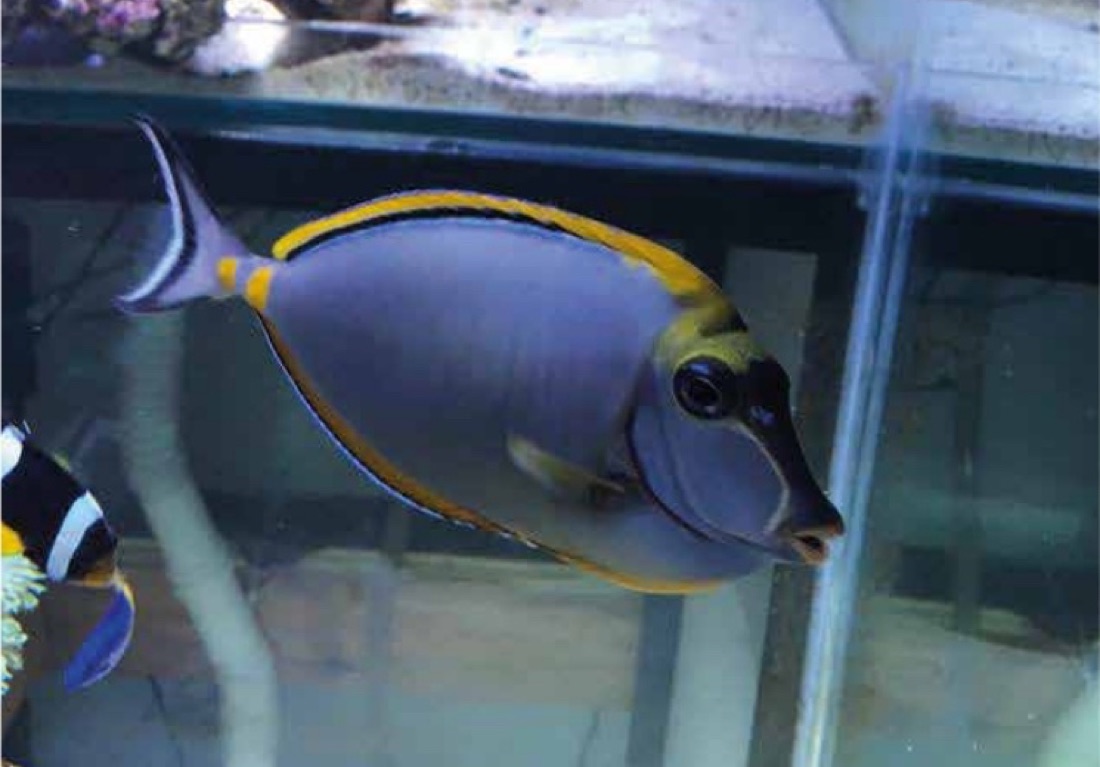
The elegant unicornfish, known in Italian as pesce unicorno arancione occidentale 11, is a surgeonfish (Acanthuridae) 1 from the Indian Ocean that can exceed 40 cm. 2 It looks very much like the Pacific Naso lituratus, of which it was once considered a population; it is told apart by its yellow dorsal fin. 2 9 It grazes on bottom-growing algae, mainly large brown algae. 2 6
At a glance
Data from the scientific sources listed at the bottom.
Depth in the wild
5–30 m
Size
up to 45 cm
maximum standard length; commonly up to 35 cm total length
Conservation
IUCN Red List: least concern (2010). Red List data taken from FishBase and GBIF. 2 10 It does not appear in the CITES lists checked on Species+. 12
Where it lives
Indian Ocean: from the Red Sea to Durban, in South Africa, and east through the islands of the western Indian Ocean to south-western Indonesia, at least as far as Bali. 2 In the Pacific it is replaced by Naso lituratus; hybrids between the two have been found at Christmas and Cocos Islands. 8 9 The 2001 FAO guide still combined them into a single species, while noting different colours in the Indian Ocean. 7
How to recognise it
Tap a number on the photo: the key explains what to look for.
- 1Yellow dorsal fin with a black band near the base: this is the mark that separates it from N. lituratus 2 7
- 2Orange plates at the base of the tail; FAO describes them for the group combined with N. lituratus 7
- 3Yellow patch above and behind the eye 7
- 4Black band on the snout from the upper lip to the space between the eyes 7
- 5Black band on the tail near the margin, without the yellow edge seen in N. lituratus 2 7
Life in the wild
What it eats
It grazes on bottom-growing algae. 2 In samples from the central Red Sea the stomach mainly contained large brown algae. 5 On coastal reefs close to beds of algae, Sargassum made up 41% of the gut content (a figure for this species and Naso unicornis together), while it was almost entirely absent on offshore reefs. 6
Reproduction
Separate sexes and external fertilisation; it scatters its eggs and does not care for its young. 3 I found no studies specific to this species.
In the aquarium
From the experience of the BallingMania community.
A fish from the Indo-Pacific and the Red Sea, where it swims, in pairs or alone, along the deeper waters of coral reefs. In the wild, specimens of about 50 cm in length have been observed, but in the aquarium it does not exceed 25/30. The main differences between Naso lituratus and Naso elegans are that the latter has a yellow/orange dorsal fin, a yellow area above the eyes, and black tail streamers and edges. This Acanthurid adapts easily to tanks of about 120 cm in length and 400 litres in volume fitted with rocks colonised by algae, but it can prove aggressive towards specimens of the same species. Adult specimens show some difficulty during acclimatisation, while young ones adapt quickly. In particular, they may refuse food for as long as about 10/15 days, especially when they are introduced into tanks with greedier fish. During acclimatisation this fish feeds mainly on fresh algae, such as blanched lettuce and spinach, but it does not refuse adult Artemia, mysis, chironomus and finely chopped mussel flesh. Later on it will willingly accept dried algae (Nori seaweed) and flake and/or granular foods.
photo by: Maurizio Bruno
Did you know?
Sources
- Froese R., Pauly D. (eds.), via WoRMS (2026). Naso elegans (Rüppell, 1829). World Register of Marine Species.
- Froese R., Pauly D. (eds.) (2026). Naso elegans, Elegant unicornfish. FishBase.
- Froese R., Pauly D. (eds.) (2026). Reproduction of Naso elegans. FishBase.
- Reef Life Survey (2026). Naso elegans, Elegant unicornfish. Reef Life Survey.
- Miyake S., Ngugi D.K., Stingl U. (2016). Phylogenetic diversity, distribution, and cophylogeny of giant bacteria (Epulopiscium) with their surgeonfish hosts in the Red Sea. Frontiers in Microbiology.
- Dunne A.F., Tietbohl M.D., Nuber C., Berumen M., Jones B.H. (2023). Fish-mediated nutrient flows from macroalgae habitats to coral reefs in the Red Sea. Marine Environmental Research.
- Randall J.E., in Carpenter K.E., Niem V.H. (eds.) (2001). Acanthuridae. The living marine resources of the Western Central Pacific, vol. 6. FAO.
- Hobbs J.P., Frisch A.J., Allen G.R., Van Herwerden L. (2009). Marine hybrid hotspot at Indo-Pacific biogeographic border. Biology Letters.
- Froese R., Pauly D. (eds.) (2026). Naso lituratus, Orangespine unicornfish. FishBase.
- GBIF Secretariat (2026). Naso elegans, IUCN Red List category. GBIF.
- GBIF Secretariat, da Catalogue of Life (2026). Naso elegans, nomi comuni. GBIF.
- UNEP-WCMC, Segretariato CITES (2026). Search for Naso elegans in the CITES lists. Species+.
Sources checked on 5 November 2026. Community texts and ratings are kept separate from the scientific data.