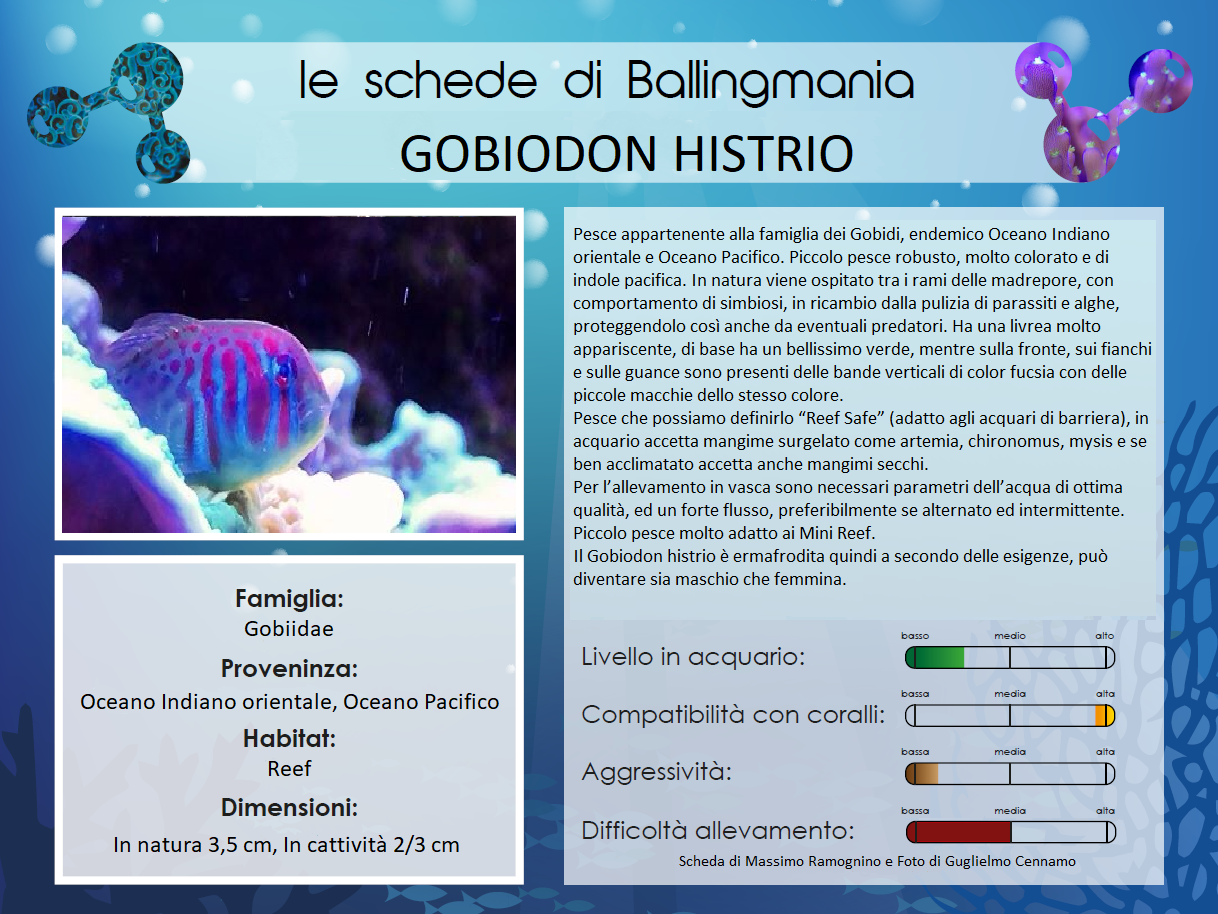
Gobiodon histrio
A tiny scaleless goby (family Gobiidae), about 3.5 cm long, that spends its life among the branches of Acropora corals. 1 2 It has a green body with reddish bars on the head and skin covered in toxic mucus. 2 10 It usually lives in pairs and can change sex in both directions. 4
At a glance
Data from the scientific sources listed at the bottom.
Depth in the wild
2–15 m
Size
up to 3.5 cm
maximum total length according to FishBase
Temperature in the wild
22–28 °C
Where it lives
Western Indo-Pacific: from the Red Sea to Samoa, north to southern Japan and south to the Great Barrier Reef. 2 In Australia it ranges from Shark Bay, in the west, to One Tree Island, in the east. 4
Conservation
IUCN Red List: least concern (2023). Red List data taken from FishBase and GBIF. 2 5 It does not appear in the CITES lists checked on Species+. 6 After back-to-back cyclones and heatwaves at Lizard Island, the species remained present but showed a genetic bottleneck, that is, a loss of diversity. 15 Its dependence on large colonies of a certain shape increases the risk when the reef degrades. 11
How to recognise it
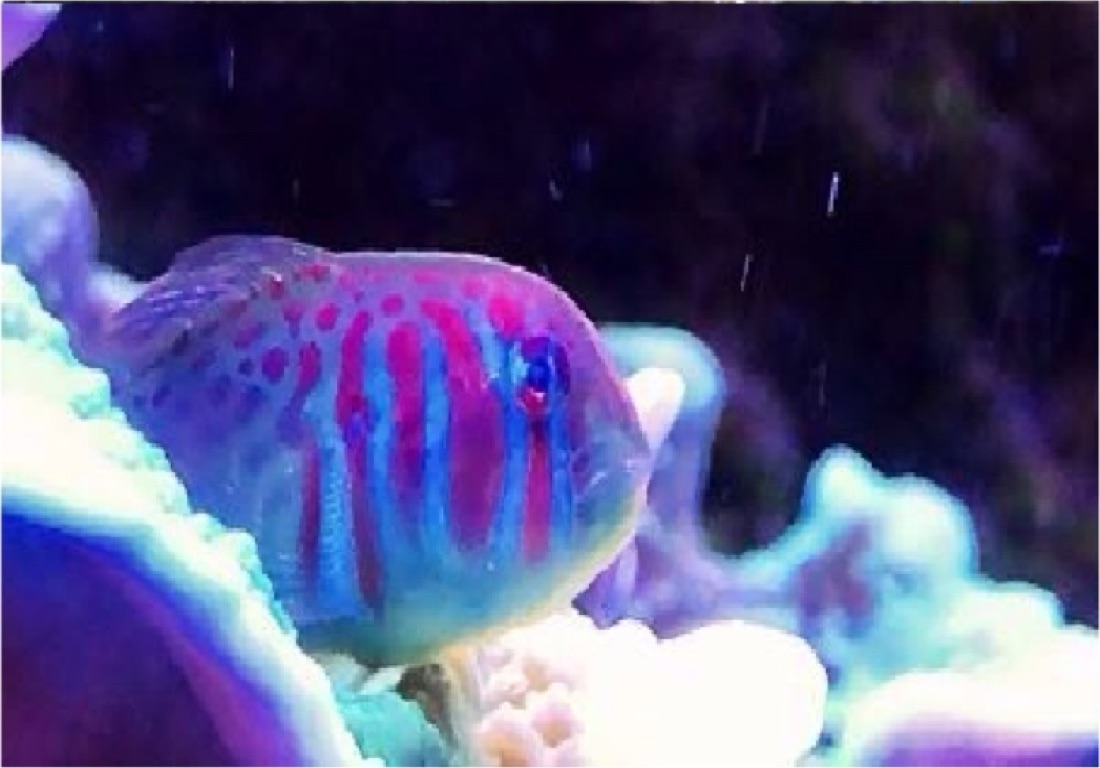
Tap a number on the photo: the key explains what to look for.
Life in the wild
Where it is found
It lives among the branches of Acropora corals, on which it depends for shelter, food and spawning. 4 It usually stays between 2 and 15 m, also on crests and in lagoons; Fishes of Australia gives a wider range, 0-30 m. 2 3 4 On the Great Barrier Reef and in Fiji it prefers Acropora nasuta, in the Red Sea mainly A. digitifera and A. gemmifera. 4 11 14 Coral structure matters: branches longer than 5 cm and spaces between branches that suit the width of the fish are important. 11
Behaviour
It rarely leaves the colony it lives in. 8 It is generally solitary or in pairs. 2 It defends the coral: in aquarium trials it cut bites by the butterflyfish Chaetodon austriacus by 62-98% compared with empty colonies. 9 In the laboratory it drove the similar G. erythrospilus away from A. nasuta in over 70% of trials. 13
Reproduction
A breeding pair often occupies a single colony, and sex change is possible in both directions. 4 The two partners adjust their growth to reduce the difference in size: the smaller one speeds up and the larger one slows down, because the pair's success depends on the smaller individual. 12 Larval life lasts about 21 days. 13
In the aquarium
From the experience of the BallingMania community.
A fish belonging to the goby family (Gobiidae), native to the eastern Indian Ocean and the Pacific Ocean. A small, hardy, very colourful fish with a peaceful temperament. In the wild it is hosted among the branches of stony corals, in a symbiotic relationship, in exchange for cleaning off parasites and algae, thus also protecting the coral from possible predators. It has a very striking livery: the base colour is a beautiful green, while on the forehead, flanks and cheeks there are vertical fuchsia bands with small spots of the same colour.
A fish we can call "Reef Safe" (suitable for reef aquariums); in the aquarium it accepts frozen food such as Artemia, chironomus and mysis, and if well acclimatised it also accepts dry foods.
To keep it in a tank, excellent water quality is needed, and a strong flow, preferably alternating and intermittent. A small fish very well suited to mini reefs.
Gobiodon histrio is a hermaphrodite, so depending on need it can become either male or female.
Species sheet by Massimo Ramognino and photo by Guglielmo Cennamo
Did you know?
Sources
- Froese R., Pauly D. (FishBase) (2026). Gobiodon histrio (Valenciennes, 1837). World Register of Marine Species.
- Froese R., Pauly D. (eds.) (2026). Gobiodon histrio, Broad-barred goby. FishBase.
- Reef Life Survey (2026). Gobiodon histrio - Maori Coralgoby. Reef Life Survey.
- Bray D.J. (2020). Maori Coralgoby, Gobiodon histrio (Valenciennes 1837). Fishes of Australia.
- GBIF Secretariat (2026). Gobiodon histrio, IUCN Red List category. GBIF.
- UNEP-WCMC (2026). Search for Gobiodon histrio in the CITES lists. Species+.
- Dixson D.L., Hay M.E. (2012). Corals chemically cue mutualistic fishes to remove competing seaweeds. Science.
- Nilsson G.E., Hobbs J.P., Munday P.L., Ostlund-Nilsson S. (2004). Coward or braveheart: extreme habitat fidelity through hypoxia tolerance in a coral-dwelling goby. Journal of Experimental Biology.
- Dirnwoeber M., Herler J. (2013). Toxic coral gobies reduce the feeding rate of a corallivorous butterflyfish on Acropora corals. Coral Reefs.
- Gratzer B., Millesi E., Walzl M., Herler J. (2015). Skin toxins in coral-associated Gobiodon species (Teleostei: Gobiidae) affect predator preference and prey survival. Marine Ecology.
- Untersteggaber L., Mitteroecker P., Herler J. (2014). Coral architecture affects the habitat choice and form of associated gobiid fishes. Marine Biology.
- Munday P.L., Cardoni A.M., Syms C. (2006). Cooperative growth regulation in coral-dwelling fishes. Biology Letters.
- Pereira P.H., Munday P.L., Jones G.P. (2015). Competitive mechanisms change with ontogeny in coral-dwelling gobies. Ecology.
- Leingang P.M., Dixson D.L. (2019). Phenotypic variations in the preferred host coral impact the occupancy of an obligate coral-dwelling fish. Coral Reefs.
- Froehlich C.Y.M., Kirby R.L., Greaves S. et al. (2026). Population Genomics Highlight the Vulnerability of Coral-Dwelling Gobies to Ecological Losses due to Climatic Disturbances. Molecular Ecology.
Sources checked on 4 November 2026. Community texts and ratings are kept separate from the scientific data.