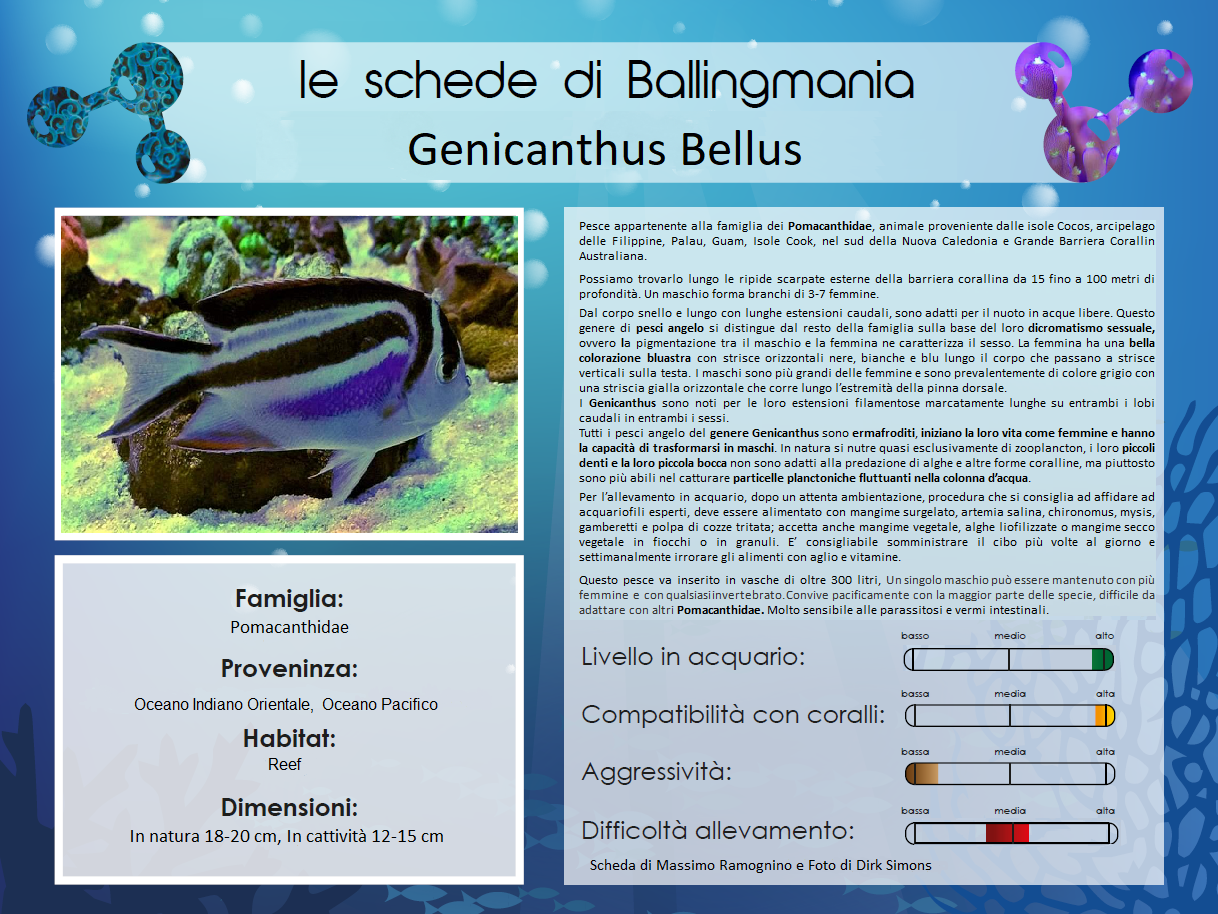
Genicanthus bellus
Ornate angelfish
The ornate angelfish, known in Italian as pesce angelo ornato 6, is a deep-water angelfish (Pomacanthidae) 1 with long tail filaments. 3 Males and females have very different colours. 3 5 It swims in small groups on current-swept outer reef slopes and feeds on plankton. 2 4
At a glance
Data from the scientific sources listed at the bottom.
Depth in the wild
50–100 m
Size
up to 18 cm
maximum total length; FAO gives about 17 cm
Conservation
IUCN Red List: least concern (2009). Red List data taken from FishBase and GBIF. 2 6 It does not appear in the CITES lists checked on Species+. 7 It is rarely exported for the aquarium, because it lives in deep water. 4 5
Where it lives
In the eastern Indian Ocean it lives at Cocos-Keeling and Christmas Island. 2 5 In the Pacific it is recorded from Indonesia, the Philippines, Palau, Guam, the Marshall Islands, the Cook Islands and the Society Islands, with a recent record from Tonga. 2 4 5 In Australia it is known from Holmes Reef, in the Coral Sea. 5 Its known range may widen with new exploration of deep reefs. 4
How to recognise it
Tap a number on the photo: the key explains what to look for.
- 1Diagonal black band edged with white, from the gill cover to the lower lobe of the tail; a female feature, as in this photo 5
- 2Blue streak on the flank elongated, on the lower part of the body 5
- 3Black bar over the eye broad 5
- 4Black dorsal fin in the female 5
- 5Black upper tail lobe it gives a scissor-like look 5
Life in the wild
In the aquarium
From the experience of the BallingMania community.
A fish belonging to the family Pomacanthidae, an animal coming from the Cocos Islands, the Philippine archipelago, Palau, Guam, the Cook Islands, southern New Caledonia and the Australian Great Barrier Reef.
It can be found along the steep outer drop-offs of the coral reef from 15 to 100 metres deep. One male forms groups with 3-7 females.
With their slim, long bodies and long tail extensions, they are well suited to swimming in open water. This genus of angelfish stands out from the rest of the family because of its sexual dichromatism, that is, the colouring of male and female shows their sex. The female has a beautiful bluish colouring with black, white and blue horizontal stripes along the body that turn into vertical stripes on the head. Males are larger than females and are mainly grey, with a horizontal yellow stripe running along the edge of the dorsal fin.
Genicanthus are known for their markedly long filamentous extensions on both tail lobes in both sexes.
All angelfish of the genus Genicanthus are hermaphrodites: they begin life as females and are able to turn into males. In the wild it feeds almost exclusively on zooplankton; their small teeth and small mouth are not suited to feeding on algae and other coralline forms, but are rather better at catching planktonic particles floating in the water column.
For keeping in an aquarium, after careful settling-in, a procedure best left to experienced aquarists, it must be fed frozen food, brine shrimp, chironomus, mysis, shrimp and minced mussel flesh; it also accepts plant food, freeze-dried algae or dry vegetable food in flakes or granules. It is advisable to give food several times a day and, every week, to soak the food in garlic and vitamins.
This fish should be placed in tanks of over 300 litres. A single male can be kept with several females and with any invertebrate. It lives peacefully with most species, but is hard to keep with other Pomacanthidae. Very susceptible to parasites and intestinal worms.
Species sheet by Massimo Ramognino and photo by Dirk Simons
Did you know?
Sources
- WoRMS Editorial Board (2026). Genicanthus bellus Randall, 1975. World Register of Marine Species.
- Froese R., Pauly D. (eds.) (2026). Genicanthus bellus, Ornate angelfish. FishBase.
- Pyle R., in Carpenter K.E., Niem V.H. (eds.) (2001). Pomacanthidae. The living marine resources of the Western Central Pacific, vol. 5. FAO.
- Pyle R., in Carpenter K.E., Niem V.H. (eds.) (2001). Genicanthus bellus. The living marine resources of the Western Central Pacific, vol. 5. FAO.
- Bray D.J. (2020). Genicanthus bellus, in Fishes of Australia. Museums Victoria.
- GBIF Secretariat (2026). Genicanthus bellus, common names and IUCN Red List category. GBIF.
- UNEP-WCMC (2026). Search for Genicanthus bellus in the CITES lists. Species+.
Sources checked on 5 November 2026. Community texts and ratings are kept separate from the scientific data.