
Ecsenius midas
Midas blenny
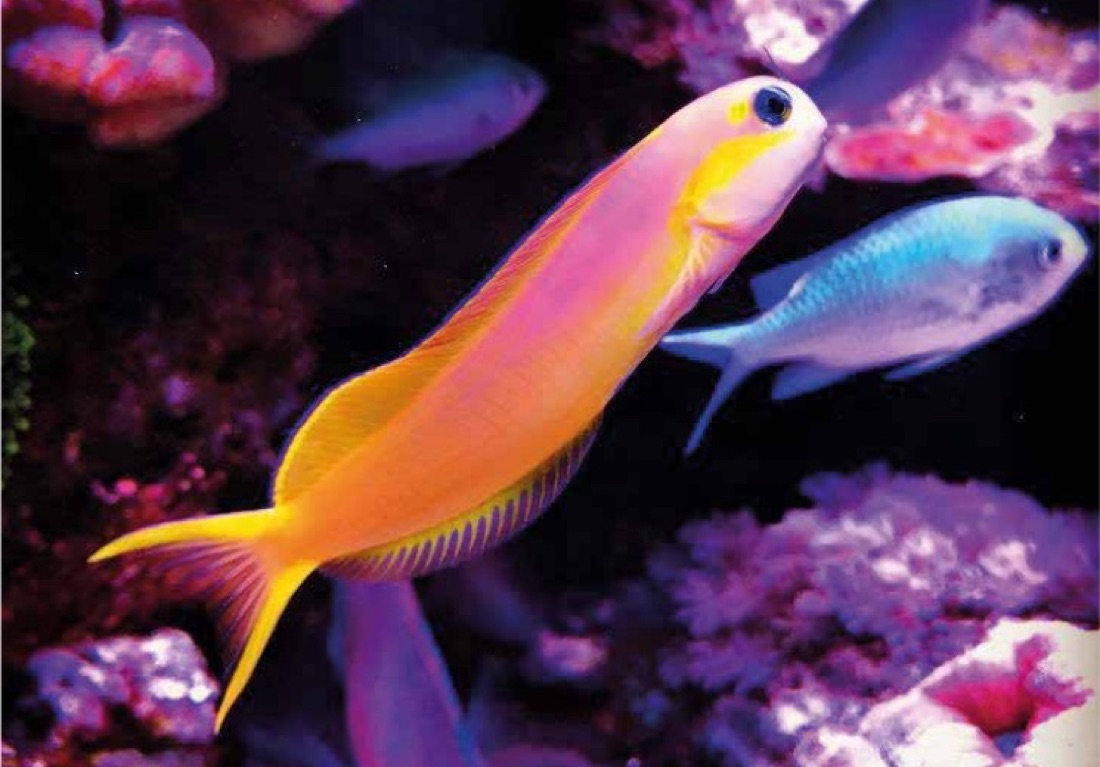
The Midas blenny, known in Italian as bavosa coda a lira 7, is a blenny (Blenniidae) 1 that reaches about 13 cm. 2 It leaves the bottom to eat plankton a few metres up and joins schools of other plankton-eating fish, imitating their colours and way of swimming. 2 3 4 Adults have elongated outer tail rays. 3
At a glance
Data from the scientific sources listed at the bottom.
Depth in the wild
2–40 m
Size
up to 13 cm
maximum total length
Conservation
IUCN Red List: least concern (2009). Red List data taken from FishBase and GBIF. 2 6 It does not appear in the CITES lists checked on Species+. 8
Where it lives
From the Gulf of Aqaba and the south-east coast of Africa to the Marquesas Islands. 2 In Australia it is recorded on the northern Great Barrier Reef and at the Cocos (Keeling) and Christmas Islands, in the eastern Indian Ocean. 3 It also lives in Indonesia and in the Line and Phoenix Islands, in the central Pacific. 3 4
How to recognise it
Tap a number on the photo: the key explains what to look for.
Life in the wild
Behaviour
It is an example of social mimicry: it swims in schools of Pseudanthias squamipinnis, Pseudanthias huchtii and Lepidozygus tapeinosoma, and copies their movements. 2 3 4 It can change colour quickly when moving from the bottom to open water, to look like the fish it mingles with. 2 In the Line and Phoenix Islands it shares a yellow and pink livery with other species. 4
In the aquarium
From the experience of the BallingMania community.
A Reef Safe fish with a very colourful livery and a small size. Peaceful with the other reef inhabitants, it can however become territorial with others of its kind. It is better to introduce it into mature tanks with rocks full of hiding places, where it will settle in search of shelter at night. Easy to feed, it willingly accepts algae flakes and granules, but it prefers to feed on the zooplankton present in the tank, so it is advisable to vary its diet by giving Artemia, mysis or lobster eggs.
Ecsenius midas is a hardy fish, able to adapt well to aquarium life. Their behaviour in the tank often arouses curiosity, as they can spend much of their time watching what happens outside the aquarium, showing themselves off right at the front, close to the glass. It is also able to adapt to small aquariums and nano reefs, as long as it has a good number of hiding places where it can take cover.
Photo by: Sandro Jelmini
Did you know?
Sources
- WoRMS Editorial Board (2026). Ecsenius midas Starck, 1969. World Register of Marine Species.
- Froese R., Pauly D. (eds.) (2026). Ecsenius midas, Persian blenny. FishBase.
- Bray D.J. (2026). Ecsenius midas in Fishes of Australia. Museums Victoria.
- Randall J.E. (2005). A review of mimicry in marine fishes. Zoological Studies 44(3): 299-328.
- Reef Life Survey (2026). Ecsenius midas. Reef Life Survey.
- GBIF Secretariat (2026). Ecsenius midas, IUCN Red List category. GBIF.
- GBIF Secretariat, da Catalogue of Life (2026). Ecsenius midas, nomi comuni. GBIF.
- UNEP-WCMC, Segretariato CITES (2026). Search for Ecsenius midas in the CITES lists. Species+.
Sources checked on 5 November 2026. Community texts and ratings are kept separate from the scientific data.