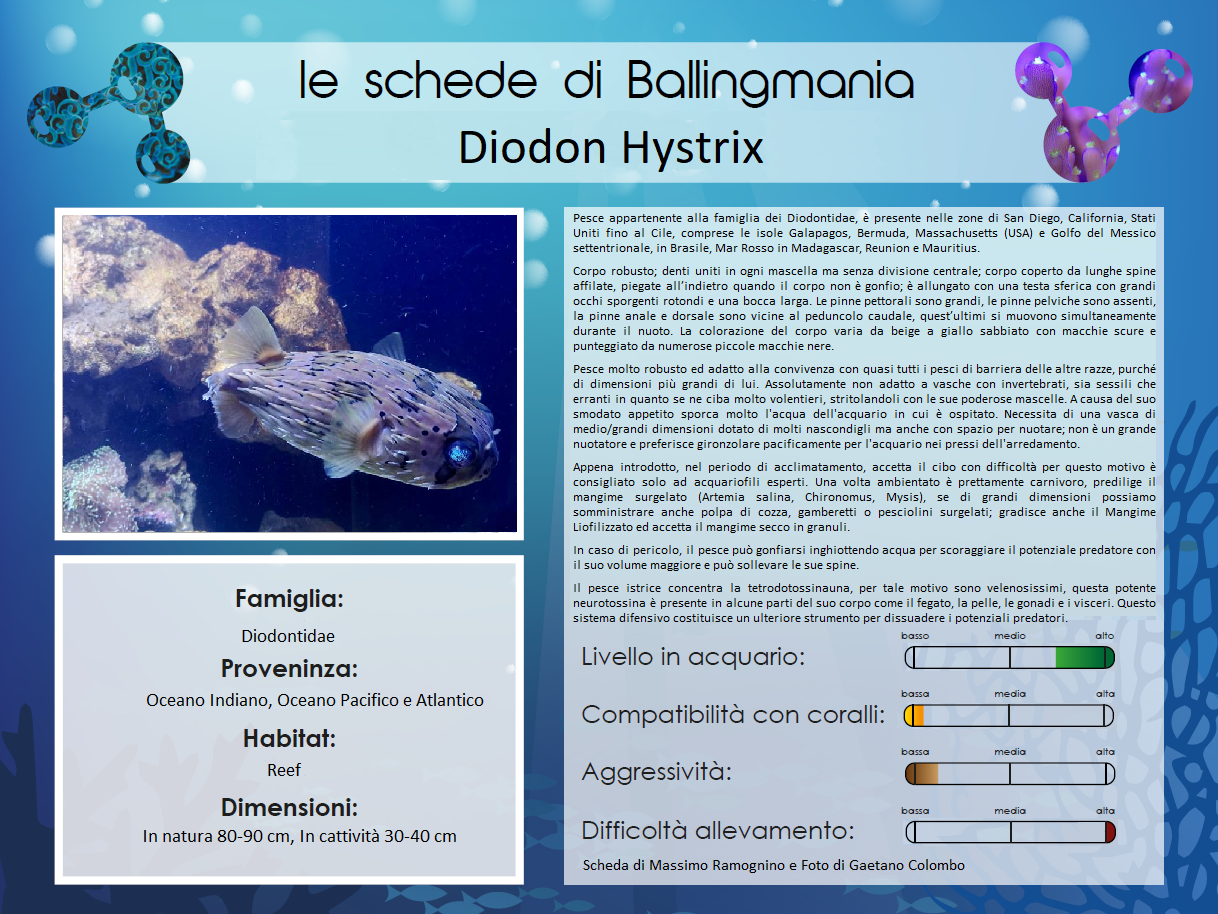
Diodon hystrix
Diodon hystrix is a large porcupinefish (Diodontidae) 1 of tropical seas worldwide, usually about 40 cm long but up to 91 cm. 2 It has long erectile spines, inflates itself by swallowing water and crushes hard-shelled prey with its teeth fused into a beak. 4 5 Warning: eating it has caused deaths, and even small wounds from its spines have caused poisoning. 8 9
At a glance
Data from the scientific sources listed at the bottom.
Depth in the wild
3–20 m
Size
up to 91 cm
maximum total length; the common size is about 40 cm
Temperature in the wild
18.7–31.4 °C
Where it lives
Found throughout the tropics. In the eastern Pacific it ranges from San Diego to Chile, including the Galápagos; in the western Atlantic from Bermuda and Massachusetts to the northern Gulf of Mexico and Brazil; in the eastern Atlantic from 30° N to 23° S; in the western Indian Ocean from the Red Sea to Madagascar, Réunion and Mauritius. Records from the Mediterranean are doubtful. 2 In Australia it is found from the west of the continent to at least Sydney, together with the Coral Sea and the Cocos, Christmas, Lord Howe and Norfolk Islands. 4
Life in the wild
Where it is found
Lagoons and the outer side of reefs, with caves and hollows in shallow water. 2 Usually between 3 and 20 m; FishBase gives 2-50 m 2 and a Smithsonian database goes to 1-137 m. 7 Reef Life Survey observed it between 18.7 and 31.4 °C. 3 Adults stay on the bottom, while juveniles up to about 20 cm live in open water; 2 juveniles are also found in eastern Pacific estuaries and in mangroves. 7 4
In the aquarium
From the experience of the BallingMania community.
A fish belonging to the family Diodontidae; it is found in the areas of San Diego, California, United States, down to Chile, including the Galápagos Islands, Bermuda, Massachusetts (USA) and the northern Gulf of Mexico, in Brazil, the Red Sea, Madagascar, Réunion and Mauritius.
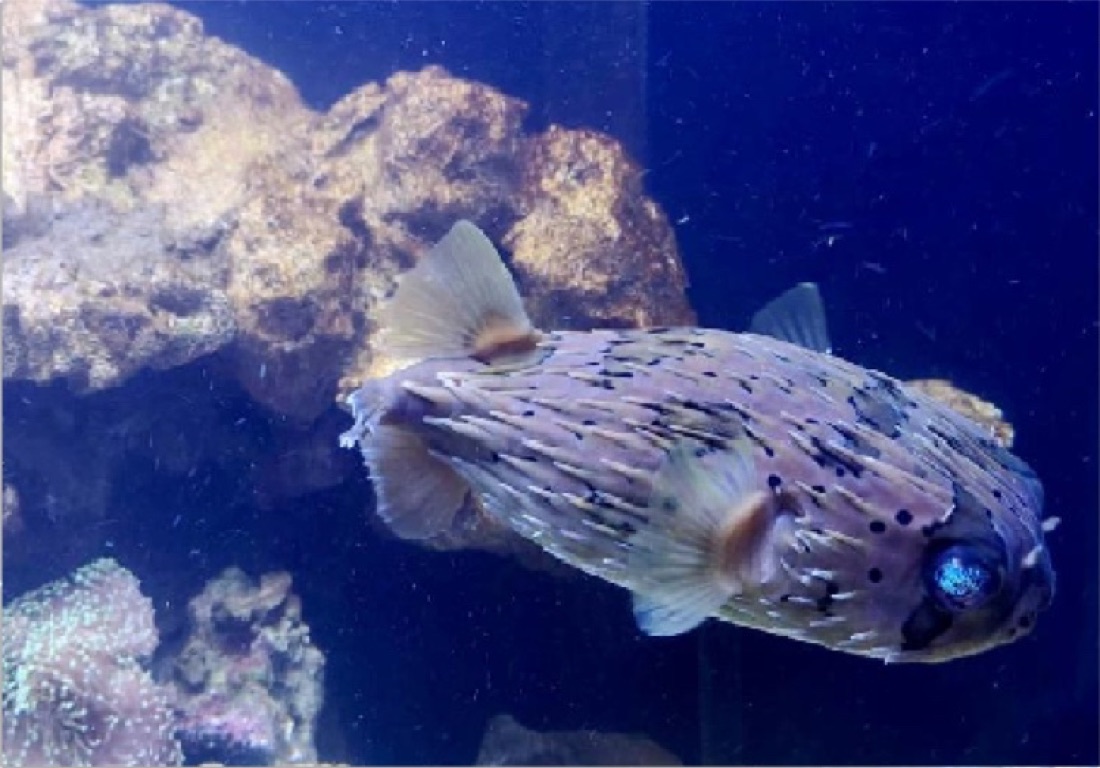
A sturdy body; teeth fused in each jaw but without a central division; the body is covered with long sharp spines, folded backwards when the body is not inflated; it is elongated, with a spherical head with large, round, protruding eyes and a wide mouth. The pectoral fins are large, the pelvic fins are absent, and the anal and dorsal fins are close to the caudal peduncle; the latter move together when swimming. The body colour varies from beige to sandy yellow with dark patches, dotted with numerous small black spots.
A very hardy fish, suitable for living with almost all reef fish of other kinds, as long as they are larger than it. Absolutely not suitable for tanks with invertebrates, whether sessile or mobile, as it very willingly feeds on them, crushing them with its powerful jaws. Because of its immoderate appetite it dirties the water of the aquarium it lives in a great deal. It needs a medium/large tank with plenty of hiding places but also with room to swim; it is not a great swimmer and prefers to wander peacefully around the aquarium near the decor.
Once introduced, during acclimatisation, it accepts food with difficulty, which is why it is recommended only for experienced aquarists. Once settled in it is strictly carnivorous; it prefers frozen food (brine shrimp, Chironomus, Mysis); if it is large we can also give mussel flesh, shrimp or frozen small fish; it also likes freeze-dried food and accepts dry food in granules.
When in danger, the fish can inflate itself by swallowing water to discourage the potential predator with its greater size, and it can raise its spines.
The porcupinefish concentrates tetrodotoxin, and for this reason they are extremely poisonous; this powerful neurotoxin is present in some parts of its body, such as the liver, skin, gonads and viscera. This defence system is a further means of deterring potential predators.
Species sheet by Massimo Ramognino and photo by Gaetano Colombo
Did you know?
Sources
- WoRMS Editorial Board (2026). Diodon hystrix Linnaeus, 1758. World Register of Marine Species.
- Froese R., Pauly D. (eds.) (2026). Diodon hystrix, Spotted porcupinefish. FishBase.
- Reef Life Survey (2026). Diodon hystrix. Reef Life Survey.
- Bray D.J. (2021). Diodon hystrix. Fishes of Australia, Museums Victoria.
- Australian Museum (2022). Diodontidae - Porcupinefishes. Australian Museum.
- Malpezzi E.L., de Freitas J.C., Rantin F.T. (1997). Occurrence of toxins, other than paralysing type, in the skin of Tetraodontiformes fish. Toxicon.
- Smithsonian Tropical Research Institute (2026). Diodon hystrix, Spotfin porcupinefish. Smithsonian Tropical Research Institute, Shorefishes of the Eastern Pacific.
- Trevett A.J., Mavo B., Warrell D.A. (1997). Tetrodotoxic poisoning from ingestion of a porcupine fish (Diodon hystrix) in Papua New Guinea: nerve conduction studies. American Journal of Tropical Medicine and Hygiene.
- van Gorcum T.F., Janse M., Leenders M.E.C., de Vries I., Meulenbelt J. (2006). Intoxication following minor stabs from the spines of a porcupine fish. Clinical Toxicology.
- Tamele I.J., Timba I., Costa P.R., Vasconcelos V. (2022). Tetrodotoxin and analogues in two local pufferfish species from Inhaca Island - South of Mozambique: First report in the Mozambican coast. Toxicon.
- Nagashima Y., Ohta A., Yin X. et al. (2018). Difference in Uptake of Tetrodotoxin and Saxitoxins into Liver Tissue Slices among Pufferfish, Boxfish and Porcupinefish. Marine Drugs.
- UNEP-WCMC, Segretariato CITES (2026). Search for Diodon hystrix in the CITES lists. Species+.
Sources checked on 5 November 2026. Community texts and ratings are kept separate from the scientific data.