
Cromileptes altivelis
Panther grouper
Currently accepted name: Chromileptes altivelis
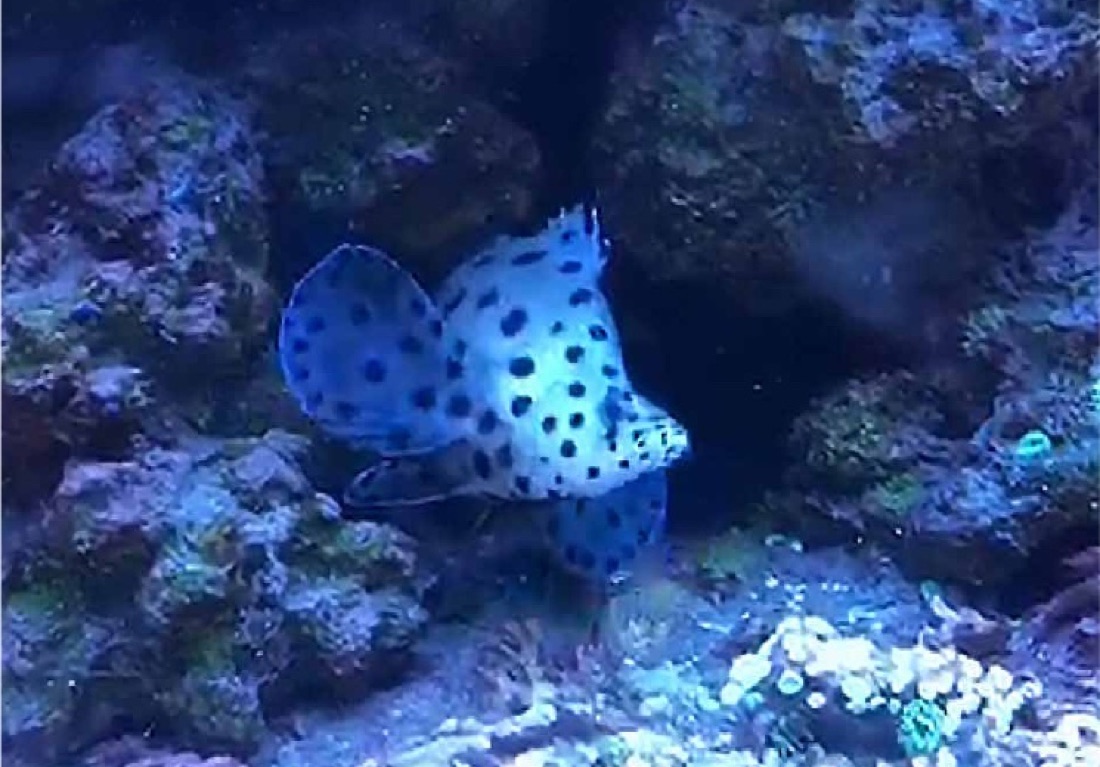
A pale grouper with black polka dots, recognisable by its small head and strongly concave profile that gives it a humpbacked look. 1 2 4 6 It reaches 70 cm, grows very slowly and is sought after both as a food fish and, when young, for aquariums. 2 In Italian it is recorded as cernia pantera, cernia gobba or cernia a pois. 11
At a glance
Data from the scientific sources listed at the bottom.
Depth in the wild
5–25 m
Size
up to 70 cm
maximum total length (males or unsexed specimens)
Conservation
IUCN Red List: data deficient (2016). Red List data taken from FishBase and GBIF. 2 10 Fishes of Australia still reports an earlier assessment, Vulnerable. 4 It does not appear in the CITES lists checked on Species+. 12 It is described as naturally rare and heavily exploited in part of its range for the live fish trade. 4 6 In Queensland it may not be kept: it must be released immediately without harm. 4
Where it lives
Western Pacific, from southern Japan to Palau, Guam, New Caledonia and southern Queensland, and the eastern Indian Ocean, from the Nicobar Islands to Broome in Western Australia. 2 5 Of the records from the western Indian Ocean only one from Kenya appears to be valid; those from Hawaii probably concern released aquarium fish. 2
How to recognise it
Tap a number on the photo: the key explains what to look for.
Life in the wild
In the aquarium
From the experience of the BallingMania community.
A beautiful grouper with a very distinctive and striking livery, ice white with large black polka dots, belonging to the family Serranidae. In its first days in the tank it is very shy and tends to hide among the rocks, coming out only in the evening; once settled in it is greedy, with an insatiable appetite, and accepts frozen food (shrimp, mussels, small fish, etc.), brine shrimp, chironomus, mysis and also large pellet food. It reaches a considerable size and dirties the water a lot because of its appetite; aquariums with a capacity in proportion to the size of the animal (which reaches 70 cm in length in the wild) and technical equipment able to cope with the considerable organic load are therefore advisable.
Once settled in it is a very decorative and unusual fish; it lives peacefully with other fish as long as they are not too small, in which case they would easily be eaten.
Very resistant to disease, it is therefore well suited to being kept even by a beginner, as long as they have an aquarium of the right size and the equipment needed to keep it properly.
photo by: Salvatore Riccardo
What studies say about keeping it
Data from aquaculture studies, not advice for a home aquarium. With improvements in larval rearing, survival rose from less than 10% to 30-50%; in 2002 Indonesian hatcheries produced about 698,000 juveniles of 5-10 cm, destined both for food and for the ornamental market. Viral nervous necrosis, however, continues to strike larvae in hatcheries. 5 A later study also lists it among the main pathogens of the species in farming. 9
Did you know?
Sources
- Froese R., Pauly D. (FishBase) (2026). Chromileptes altivelis (Valenciennes, 1828). World Register of Marine Species.
- Froese R., Pauly D. (eds.) (2026). Chromileptes altivelis, Humpback grouper. FishBase.
- Froese R., Pauly D. (eds.) (2026). Food items reported for Chromileptes altivelis. FishBase.
- Bray D.J. (2018). Barramundi Cod, Chromileptes altivelis (Valenciennes 1828). Fishes of Australia.
- Rimmer M.A., McBride S., Williams K.C. (eds.) (2004). Advances in Grouper Aquaculture (ACIAR Monograph 110). Australian Centre for International Agricultural Research.
- Liu J., Sun H., Tang L. et al. (2024). Chromosome-level genome assembly of humpback grouper using PacBio HiFi reads and Hi-C technologies. Scientific Data.
- Yang Y., Wu L., Weng Z. et al. (2021). Chromosome Genome Assembly of Cromileptes altivelis Reveals Loss of Genome Fragment in Cromileptes Compared with Epinephelus Species. Genes.
- Cao X., Deng S., Liu Q. et al. (2023). Important Role of the Ihh Signaling Pathway in Initiating Early Cranial Remodeling and Morphological Specialization in Cromileptes altivelis. Animals.
- Du H., Cao Z., Liu Z. et al. (2022). Cromileptes altivelis microRNA Transcriptome Analysis upon Nervous Necrosis Virus (NNV) Infection and the Effect of cal-miR-155 on Cells Apoptosis and Virus Replication. Viruses.
- GBIF Secretariat (2026). Chromileptes altivelis, IUCN Red List category. GBIF.
- GBIF Secretariat (2026). Chromileptes altivelis, nomi comuni. GBIF.
- UNEP-WCMC (2026). Search for Chromileptes altivelis in the CITES lists. Species+.
Sources checked on 5 November 2026. Community texts and ratings are kept separate from the scientific data.